Yuma Test Center's Proof Gun System supports Army goal to increase munition production
Courtesy Photo |
In the past, testing a gun tube required an accompanying weapon system. The future is......read moreread more
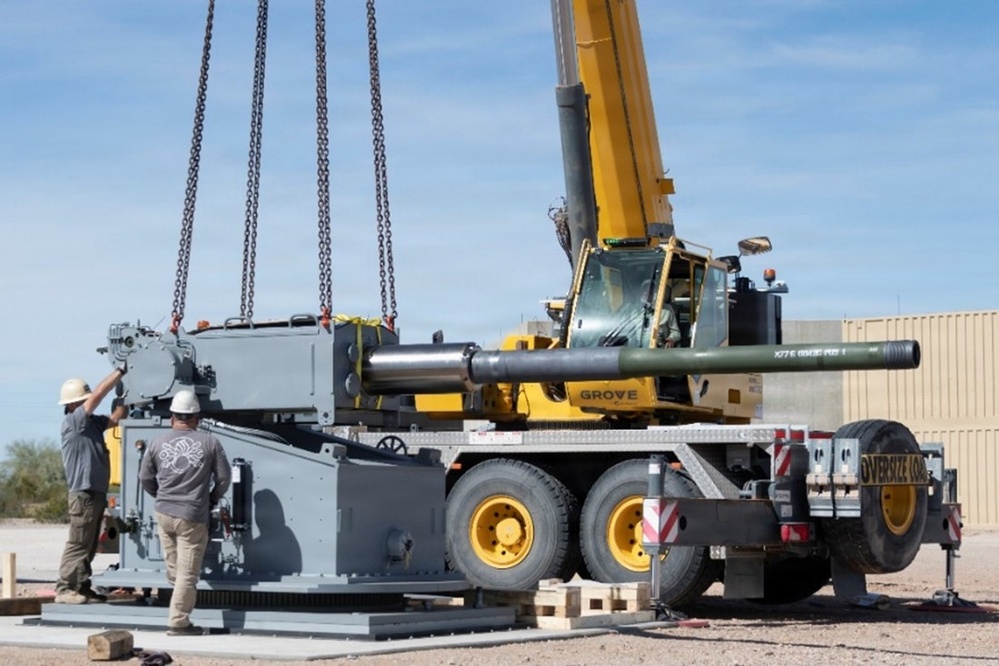
Courtesy Photo | In the past, testing a gun tube required an accompanying weapon system. The future is here where that is no longer necessary. U.S Army Yuma Test Center recently acquired a Proof Gun System (PGS) developed by U.S. Army Combat Capabilities Development Command Armaments Center, which allows a gun tube to be mounted and fired for testing without the weapon system. see less
| View Image Page
Yuma Test Center's Proof Gun System supports Army goal to increase munition production
In the past, testing a gun tube required an accompanying weapon system. The future is here where that is no longer necessary.
Yuma Test Center (YTC) acquired a Proof Gun System (PGS) developed by U.S. Army Combat Capabilities Development Command Armaments Center which allows a gun tube to be mounted and fired for testing without the weapon system.
“The idea was to build a system that would allow them to put a number of different tubes in,” explained Quentin Sorenson, the test officer with the Munitions and Weapons Division who oversaw the installation of the PGS at YTC.
He further explained, “There are no electronics, it’s hydraulic or mechanical. It was specifically designed to sit out in the desert. They are hoping for a 30–50-year lifespan.”
The timing of this advancement is no coincidence. In fact, its funding comes directly from the U.S. Army’s initiative to ramp up overall production capacity for 155mm artillery munitions. The Army’s goal is to produce 100,000 artillery rounds per month. The PGS will aid with production testing.
For the last several months, YTC has worked to acquire, assemble, emplace, and test fire the first of two PGS. YTC crews placed the system on a reaction mass that was built to YTC standards by a U.S. Army Corps of Engineers contractor to sustain the immense power of firing.
“The concrete is about 7 feet deep and contains rebar grids and a fabricated cage that houses the removable mounting rods designed to secure the Ground Engagement System adapter plate,” explained Jered Ford the Chief of the Indirect Fire Modernization and Mines Branch.
Sorenson added, “It took us most of the day to get the PGS on the reaction mass. We had to get the adapter plate cleaned up and prepared to emplace the saddle or lower portion, then we mounted the gun mount, or upper portion on top of that. Then we spent the rest of the week making sure everything was securely locked down.”
Crews used a special large pneumatic wrench to torque the mounting bolts to 3,100 foot-pounds. Then the carpenters constructed a wooden deck around the system to allow closer access to the PGS’s loading side. Once the system was set up Sorenson conducted acceptance firing.
“We fired at four QEs [quadrant elevations] just to make sure everything was good as we elevated up and down. Most were done at zone five to introduce maximum shock and everything went well.”
YTC’s second PGS arrives in May. Currently, both systems work with M776 tube sleeves, yet there are plans to expand their capabilities to include other types.
This new capability provides industry partners testing artillery flexibility, efficiency and cost savings explains Sorenson.
“You just swap the tubes in and out as you need and then you are not trying to constantly maintain a chassis because you have this one system that will handle everything.”
Currently artillery testing requires a significant effort to prepare and emplace an entire weapon system at the test site.
“We have to tow in a towed howitzer, like an M777A2 or an M199 or you have to drive in an M109A6.You have to bring in the whole system and then you have to have ready and running to conduct your test.”
Omitting the weapon system cuts the extra time and effort needed on a test site and the time when switching between programs.
“It minimizes set up costs and it minimizes the mechanical effort of keeping the whole system functioning when all we really need is the tube,” said Sorenson of the new capability.

 Subscribe






