
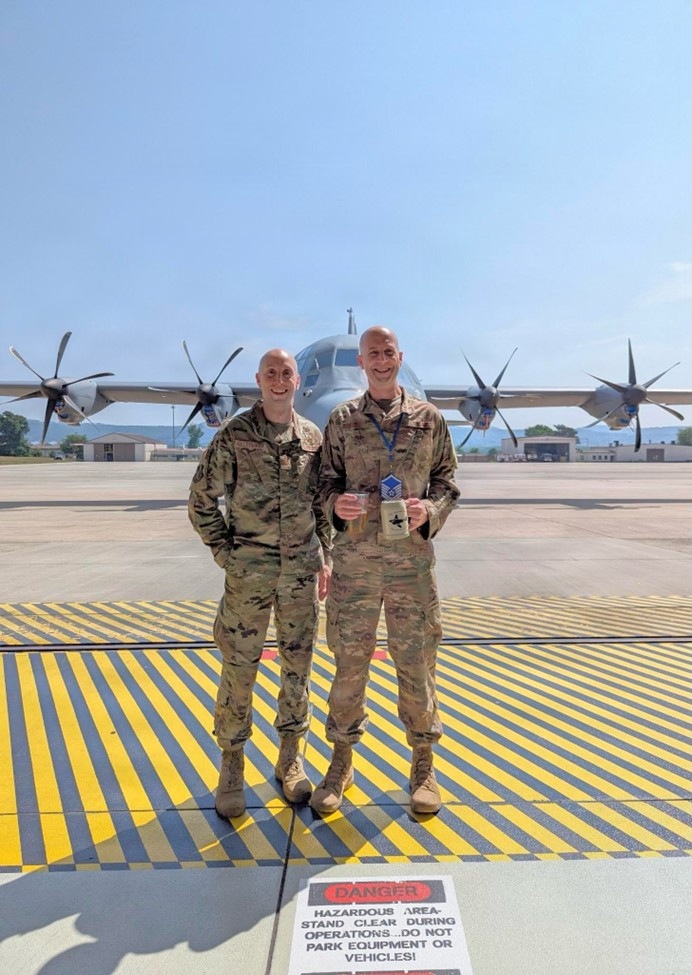
Courtesy Photo | Maj. Thomas Kellerman, chief of contracting for the 406th Air Expeditionary Wing,...... read more read more
PEASE AIR NATIONAL GUARD BASE, N.H. - When April arrived in the Horn of Africa, the temperature routinely spiked well past 100 degrees. This brought a dangerous reality to base entry control points. Critical vehicle scanners had been plagued by frequent outages, forcing military working dogs to step in as the primary defense against explosives and contraband. The extreme heat severely limited how long the K9 teams could safely work, threatening to choke off the installation's supply chain and stall vital infrastructure construction.
It was a tactical crisis disguised as a logistical delay. Recognizing the imminent risk to base defense, Lt. Col. Thomas Kellerman, chief of contracting for the 406th Air Expeditionary Wing at the time, immediately took action to secure emergency repairs and source redundant scanners.
"We needed to ensure our primary capabilities relied on vehicle scanners that don't get tired, don't need to eat, and don't need to sleep," Kellerman said. "This allowed us to employ the military working dogs where they were truly needed, rather than forcing them to pull double duty at the gates."
It is this ability to translate administrative processes into life-saving, real-world solutions that recently earned Kellerman the fiscal year 2025 Department of the Air Force Outstanding Guardsman in Contracting Award. His sweeping achievements across two continents highlight the critical, force-multiplying role the Air National Guard plays in securing global interests and enabling the joint force environment.
In a standard deployment, contingency contracting is often perceived as a predictable back-office support function. However, the reality Kellerman faced shattered those expectations.
Managing a $265 million contract portfolio across four operating locations in U.S. Africa Command and U.S. Air Forces in Europe, Kellerman was met with a cascade of high-stakes complications. Looming largest was the 2024 withdrawal of U.S. forces from Niger, a highly sensitive mandate requiring the rapid reallocation of 2,700 tons of joint force assets worth over $2 billion.
Simultaneously, he faced a severe interagency vetting backlog that left 1,400 third-country nationals stranded outside the gates, paralyzing base construction and essential services.
"There is an AFRICOM instruction that mandates anybody coming onto one of those installations is going to go through that screening and vetting program to ensure that we don't have another incident that could result in a loss of a service member's life," Kellerman explained, referencing the tragic prior attacks at Manda Bay, Kenya. "If they're being held up in the screening program, no one is coming through that gate, and the work is never going to occur."
Facing a paralyzed logistical footprint, Kellerman leaned on his experience as a citizen-Airman. The Guard's unique model, blending civilian corporate ingenuity with military discipline, had trained him to view systemic roadblocks as puzzles requiring a pivot.
"As a civilian business owner, I know that if your company is not successful, the people who rely on you to make a living will suffer," Kellerman noted. "Taking that serious mindset into a deployed leadership role is vital, because on the military side, failure can result in casualties and assets."
Kellerman made a decisive shift in his approach. To clear the vetting backlog, he synchronized five different intelligence and security agencies, including the Army and the Office of Special Investigations, to identify manpower shortfalls and streamline the background checks.
Navigating this intense, 24/7 operational tempo required immense trust and coordination across a widely dispersed team.
"For us, the most important thing was to establish expectations and clear lines of communication across all of our operating sites," Ketterman said. "We had to allow them the autonomy to make tough decisions, to be on call 24/7, and to work with their deployed installation commanders."
Through that struggle, the achievements materialized. His interagency team reduced the security backlog by 300 percent, securing the installation while allowing construction to resume. He successfully pushed $2 billion in assets out of Niger while building a reposture plan for a new base footprint in West Africa. His impact was also felt in the Pacific, where he developed a strategic procurement curriculum for the Philippines to mitigate Chinese influence.
Ultimately, Kellerman’s tenure at the 406th AEW demonstrated that the true strength of the Department of Defense relies on the adaptive, Total Force Airmen who power it.
"It can be tough to see how you affect the broader mission when you are just executing day-to-day, but those micro-movements you make are constantly supporting the bigger picture," Kellerman said, "Our goal was to find a huge win locally on the installation each day, and build on that to meet the intent of our national security strategy."
| Date Taken: | 05.06.2026 |
| Date Posted: | 05.06.2026 16:38 |
| Story ID: | 564572 |
| Location: | NEW HAMPSHIRE, US |
| Web Views: | 561 |
| Downloads: | 0 |

This work, New Hampshire Guardsman Wins 2025 DAF Outstanding Guardsman in Contracting Award, by SSgt Elliot Boutin, identified by DVIDS, must comply with the restrictions shown on https://www.dvidshub.net/about/copyright.

No keywords found.





