
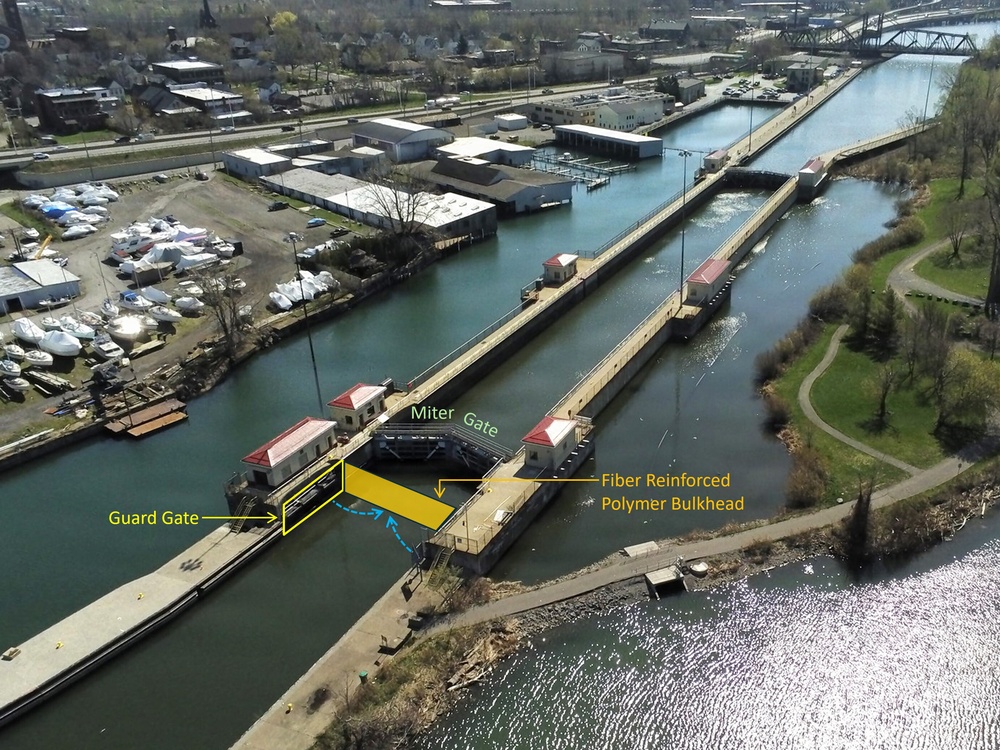
Photo By Maj. Avery Schneider | This graphic was created for the U.S. Army Corps of Engineers, Buffalo District, April...... read more read more
New technology is on its way to the more than 110-year-old Black Rock Lock, with a $6.9 million contract awarded to Maine-based Basalt International, Inc. on April 10 for full design and fabrication of new fiber reinforced polymer bulkheads.
The bulkheads are part of the more than $65 million in upgrades over the last decade and planned through 2030 to ensure it continues serving the regional and national economy for future generations.
“The Corps of Engineers’ move toward fiber reinforced polymer technology represents a significant step forward in modernizing and maintaining vital navigation infrastructure,” said Lt. Col. Robert Burnham, U.S. Army Corps of Engineers, Buffalo District commander. “Ensuring the longevity of the Black Rock Lock is critical to the economy and safe navigation for commercial and recreational vessels. This is a worthwhile investment in the future of the Great Lakes Navigation System.”
Bulkheads are stackable structures used to seal each end of the lock. After cranes lower the bulkheads into place and seals are checked, the lock can be pumped dry for personnel to conduct hands-on maintenance inside the structure.
The new fiber reinforced polymer bulkheads will replace the original steel “guard gates” that sit on each end of the lock outside the main “miter gates.” The bulkheads will be just as strong as steel, but far lighter with a 100-year design life, and cost less than steel bulkheads.
USACE Buffalo District Structural Engineers and USACE’s Inland Design Center drafted preliminary designs and plans and specifications for the bulkhead.
Fabrication is scheduled to be completed in approximately 18 months, with delivery to the Black Rock Lock in November 2027.
Additional planned upgrades to the lock include installation of new rock anchors, modifications to the lock walls and sills to accept the bulkheads, and installation of new upper and lower miter gates.
About the Black Rock Lock
The Black Rock Lock, constructed by USACE from 1908 to 1913, is one of three lock systems operated and maintained by USACE on the U.S. side of the Great Lakes. More than 1,000 vessels and 80.2 tons of cargo passed through its gates in 2025.
The Black Rock Lock and the Black Rock Channel provide safe passage for vessels to travel between Buffalo Harbor and Tonawanda Harbor around the reefs, rapids and fast currents that exist in the upstream portion of the Niagara River. Waterborne transportation facilitated by the Buffalo and Tonawanda harbors support $57.4 million in business revenue, 189 jobs, and $16.3 million in labor income to the transportation sector.
More information is available at: https://www.lrd.usace.army.mil/Missions/Projects/Article/3736492/black-rock-lock/.
B-roll and photos of the lock are available at www.flickr.com/photos/buffalousace/albums/72177720333100920.
The Buffalo District delivers world class engineering solutions to the Great Lakes Region, the Army and the Nation to ensure national security, environmental sustainability, water resource management, and emergency assistance during peace and war.
For 250 years, the U.S. Army Corps of Engineers has been at the forefront of the nation’s engineering excellence, responding when called. From constructing fortifications during the Revolutionary War, to building the infrastructure that saw America’s strength grow militarily and economically, USACE’s mission has always been to deliver engineering solutions for our nation’s toughest challenges. Learn more about the USACE 250th anniversary at http://www.usace.army.mil/Home/250th
| Date Taken: | 04.23.2026 |
| Date Posted: | 04.29.2026 15:25 |
| Story ID: | 563925 |
| Location: | BUFFALO, NEW YORK, US |
| Hometown: | TONAWANDA, NEW YORK, US |
| Web Views: | 39 |
| Downloads: | 0 |

This work, Corps of Engineers Awards $6.9M Contract to Modernize Black Rock Lock with Fiber Reinforced Polymer Bulkheads, by MAJ Avery Schneider, identified by DVIDS, must comply with the restrictions shown on https://www.dvidshub.net/about/copyright.

No keywords found.





