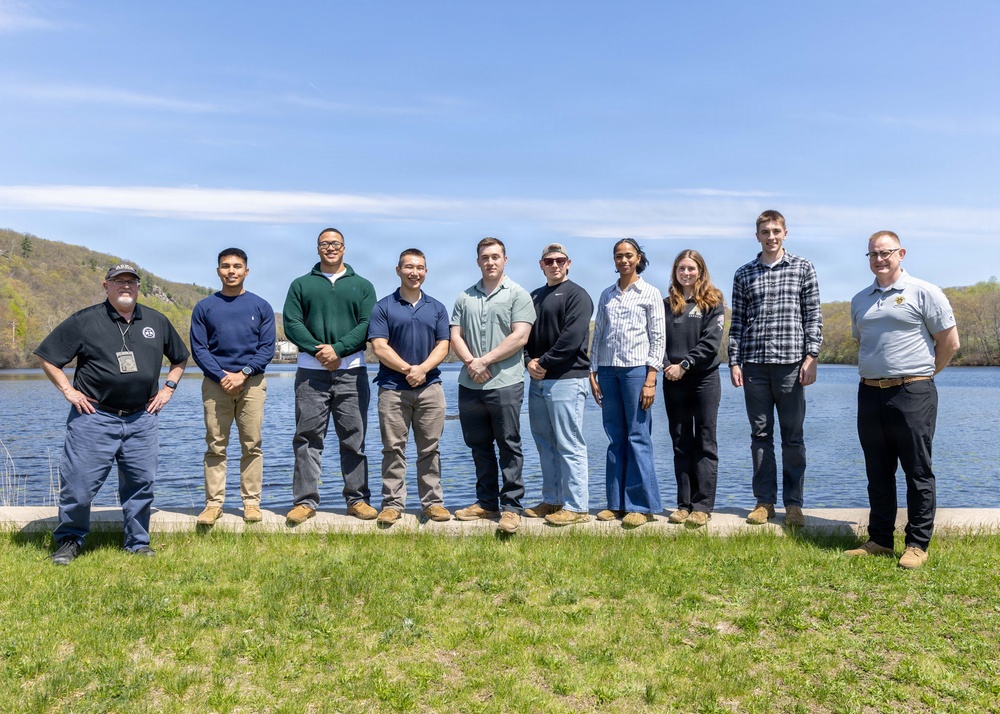
PICATINNY ARSENAL, N.J. - A delegation of cadets, each in their senior year at the U.S. Military Academy in West Point, New York, completed a site visit at the Department of War’s (DoW) Joint Center of Excellence for Guns and Ammunition to study the hazardous waste requirements under the Resource Conservation and Recovery Act (RCRA) and environmental remediation under the Comprehensive Environmental Response, Compensation, and Liability Act (CERCLA) on April 24.
As the nation’s first military academy, West Point prepares young men and women to become officers in the U.S. Army. Cadets attend the academy for four years, graduating with a Bachelor of Science degree and a commission as a second lieutenant.
“The goal of our visit to Picatinny was to give the cadets an opportunity to see in practice the urgency, importance, and complex nature of hazardous waste management now and the implications of past practices for current stakeholders,” said Lt. Col. David Zgonc, who instructs the Solid and Hazardous Waste Management course at West Point.
Picatinny Arsenal has a long history of manufacturing explosives, beginning in the mid-1800s. As a result, the New Jersey Environmental Protection Agency (EPA) placed the site on the Superfund program’s National Priorities List in February 1990.
There are two program categories for categorizing environmental restoration activities at Picatinny Arsenal within the Defense Environmental Restoration Program (DERP). They are the Installation Restoration Program (IRP) and the Military Munitions Response Program (MMRP).
The Arsenal is participating in the IRP, established in 1978 to identify, investigate and control the migration of hazardous contaminants at military and other facilities. The Army and EPA signed an Interagency Agreement in May 1991 to formalize EPA oversight of CERCLA cleanup of the facility. DERP addresses hazardous substances, pollutants, contaminants, and military munition sites, consistent with CERCLA.
The tour provided to the cadets focused heavily on the Arsenal’s adherence to CERCLA, as well as modern solid and hazardous waste management protocols.
“I wanted the cadets to see in person how the CERCLA process works at an actively managed site, interact with the professionals who manage it, and observe some of the clean-up technologies we discuss in class,” Zgonc said.
The Picatinny Arsenal Environmental Affairs Division under the Directorate of Public Works coordinated the visit with Zgonc and the cadets to provide the group with a program that highlighted responsible continual site characterization and remediation efforts with the history of the installation. As future leaders, the cadets were briefed on the critical intersection between military readiness and environmental stewardship.
“I demonstrated to the cadets, the importance of proper waste management practices and the pitfalls of past operating practices such as waste burial pits and lagoons that are very costly today to remediate,” said Michael Bolen, Picatinny Arsenal’s IRP and MMRP Manager. “In addition, I provided evidence of our mitigation successes and our remedial actions to protect human health and the environment.”
Picatinny Arsenal has utilized multiple remedies in place for contaminated groundwater which involve both active treatment (e.g., pump and treat) and performance monitoring, as well as for monitoring natural attenuation. The current primary treatment methods for groundwater are remedies consisting of in-situ bioremediation such as the injection of slow-release substrates such as dilute molasses or emulsified vegetable oil directly into the groundwater to stimulate anaerobic bioremediation of chlorinated solvents (e.g., Trichloroethylene).
In addition, Picatinny Arsenal installed a Passive Reactive Barrier (PRB) trench in 2007 to protect Green Pond Brook from a chlorinated solvent plume in the groundwater. The PRB utilizes zero valent iron which is a strong reducing agent to treat and remove chlorinated solvents from the groundwater as it passes through the PRB.
“The visit to Picatinny showcased for the cadets how seriously the U.S. Army takes hazardous waste management, taking responsibility for contamination that occurred over 100 years ago and today making every effort to not create new problems for future generations to address in their own time,” Zgonc said.
During the visit, time was allotted for the cadets to sit and eat with Lt. Col. Craig A. Bonham II, U.S. Army Garrison Picatinny Arsenal Garrison Commander and his deputy and retired Marine Corps Sergeant Major, Fortunato Rubio, as well as the installation’s most senior noncommissioned officer, Command Sgt. Maj. Claudia Tapia, U.S. Army Garrison Picatinny Arsenal Garrison Command Sergeant Major.
The lunch session between the military cadets and the Garrison command team served as a pivotal mentorship opportunity, allowing future officers to engage directly with senior leadership within an informal professional setting.
During the engagement, the cadets utilized the opportunity to query the commander and his trusted advisors on career trajectory, and decision-making requirements. This interaction allowed the cadets to gain valuable advice as they prepare to transition into commissioned service.
| Date Taken: |
04.28.2026 |
| Date Posted: |
04.28.2026 13:27 |
| Story ID: |
563786 |
| Location: |
PICATINNY ARSENAL, NEW JERSEY, US |
| Web Views: |
42 |
| Downloads: |
0 |
PUBLIC DOMAIN

This work, Future Army officers receive practical lessons in Superfund cleanup at Picatinny, by Eric Kowal, identified by DVIDS, must comply with the restrictions shown on https://www.dvidshub.net/about/copyright.