By Tyler Barth
PICATINNY ARSENAL, N.J. - Experts on blast overpressure (BOP) came together for a hybrid conference hosted by Picatinny Arsenal on Wednesday, March 18 and Thursday, March 19 to discuss field advancements and potential safety measures.
Representatives of the U.S. Army Combat Capabilities Development Command (DEVCOM) Armament Center joined attendees from not just engineering circles at other DEVCOM locations and military institutes, but also many from the medical field, including the U.S. Army Medical Command. Topics ranged from how to best mitigate health effects caused by BOP and emerging technologies to securing funding and future testing possibilities.
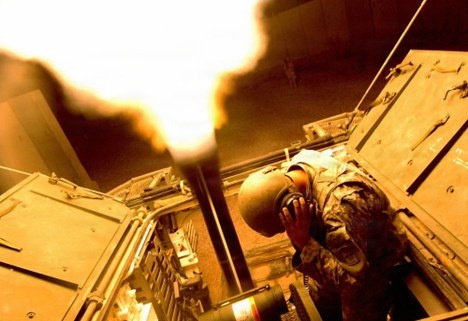
BOP is defined as the pressure effects caused by a shockwave created from setting off explosive charges or firing high-caliber weaponry; this can cause a blast injury, a complex physical trauma that can compromise brain health and motor skills.
“Blast overpressure has become a significant topic of concern, particularly within the military, due to a growing understanding of its potential for causing both immediate and long-term health problems,” explained Watervliet Arsenal Research Mechanical Engineer Robert Carson.
Program analyst and event organizer Andrew Pskowski stated that the summit provided development communities with a forum to foster a unified approach and share ongoing and planned efforts. Attendees could also seek opportunities to collaborate, and already several follow-on conversations have been scheduled, Pskowski said, to further explore sharing resources and knowledge between medical and weapons development teams.
On day one, the Tri-Service Toxicology Consortium, chartered to coordinate and optimize toxicology services within the Department of War (DoW), updated attendees on its efforts to establish an occupational limit on low level BOP. Low level BOP, referring to weaker but more gradual effects over the long term, does not yet have a defined limit unlike its more immediate counterpart, and is still being studied. According to its representatives, toxicology professionals Dr. Amy DeLong and Consortium Chairwoman Dr. Valerie Adams, a provisional occupational exposure limit should be released in January 2027.
Also on day one, research psychologist Maj. Sarah Sanjakdar delved into the Army Research for Mitigating Overpressure Risks program, a collaboration between the United States Army Research Institute of Environmental Medicine, the U.S. Army Aeromedical Research Laboratory, and the Walter Reed Army Institute of Research to accelerate development of blast mitigation technologies. This effort, she said, will support utilization of the Blast Overpressure Sensor System by providing a scientific foundation to interpret data.
Among the presenters on day two were mechanical engineer Mario Tarabocchia, who spoke of low overpressure breaching charges and efforts to mitigate their effects, computer engineer Julia Gustafson, who detailed potential updates to the Mortars App and blast mitigation efforts in relation to fire control, and data scientist Denay Sicsko, who discussed DEVCOM’s perspective on incorporating BOP into its lethality models.
The DEVCOM Army Research Laboratory spoke several times with different representatives, giving an update on a medical device BOP sensor on day one, and detailing how to minimize exposure on day two, along with giving a detonation sciences update.
“What stood out to me was the extensive knowledge and expertise each participant brought to the summit,” said Environmental Safety and Occupational Health Manager, Joint Program Executive Office Armaments & Ammunition Brian Hubbard. “It was encouraging to learn from subject matter experts across DoW and Army medical, research, engineering and acquisition communities sharing lessons learned as well as proposing courses of action to mitigate Soldier BOP exposures.”
| Date Taken: |
04.23.2026 |
| Date Posted: |
04.23.2026 15:23 |
| Story ID: |
563448 |
| Location: |
PICATINNY ARSENAL, NEW JERSEY, US |
| Web Views: |
40 |
| Downloads: |
0 |
PUBLIC DOMAIN

This work, Blast Overpressure Summit provides field’s best with research updates, medical insights, must comply with the restrictions shown on https://www.dvidshub.net/about/copyright.