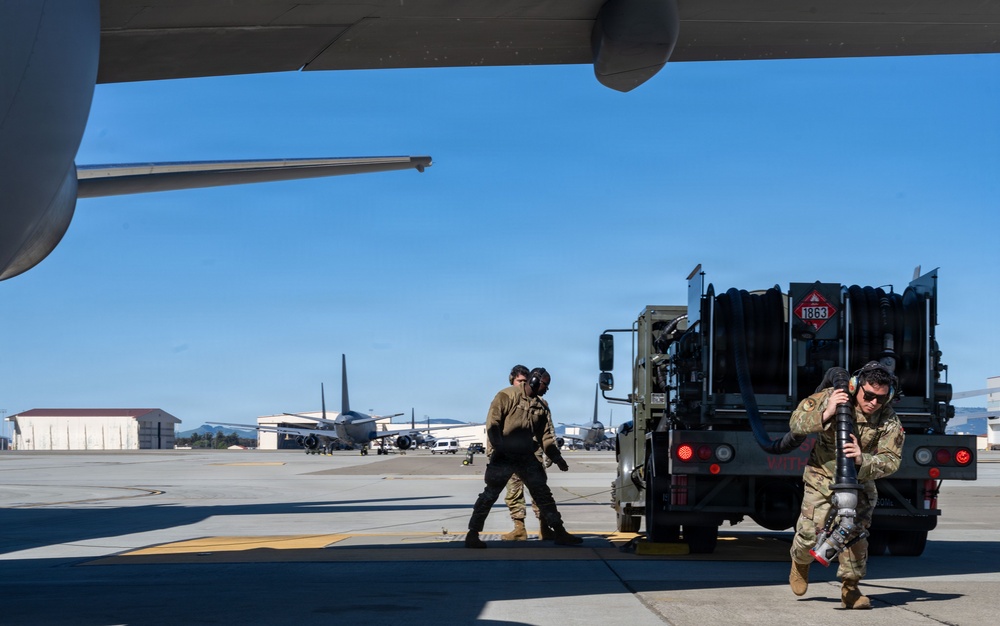
TRAVIS AIR FORCE BASE, Calif. – U.S. Airmen assigned to the 660th Aircraft Maintenance Squadron established a KC-46A Pegasus hot pit refueling capability at Travis Air Force Base, California, April 4, 2026, marking a significant step forward in operational readiness and rapid global mobility.
Following direction from Air Mobility Command, a team of maintainers executed an accelerated training plan, certifying 23 personnel in less than 96 hours. The effort validated a proof of concept for KC-46 hot pit refueling and established a foundation for future implementation across AMC, enhancing the Air Force’s ability to launch missions faster in contested environments.
Hot pit refueling allows aircraft to be refueled while engines remain running, reducing time on the ground and enabling aircraft to return to the mission faster.
“This capability allows us to prepare for an ever-adapting environment while meeting the mission in uncertain times,” said Chief Master Sgt. Jerome L. Lundy, 660th AMXS senior enlisted leader. “By reducing refuel time, we are able to get tankers back in the air faster and close the gap between supply and demand.”
“In a contested environment, the ability to rapidly refuel aircraft is a critical combat capability that directly impacts survivability and operational tempo,” said Lundy. “This allows the KC-46 to operate more effectively under threat.”
The certification effort required close coordination across operations, maintenance, logistics readiness and quality assurance teams and was completed within a compressed timeline.
“This was a Total Force effort,” said Lundy. “Every member of the team brought a specific skill, and it was only through that teamwork that we were able to meet the deadline.”
Senior Airman Avery Breakfield, 660th AMXS crew chief, served as a refuel supervisor and panel operator during the certification, responsible for initiating the refueling process.
“It was definitely a sprint, but I was fully confident in our team’s ability to understand the process and put it into action,” said Breakfield. “Once we realized it was just a refuel with one engine running, everything became a lot smoother.”
Airmen progressed from walkthroughs to multiple dry runs before executing live operations, building confidence through repetition and teamwork.
“I’m proud to be part of the first team to accomplish hot pit refueling [for the KC-46] at Travis,” said Breakfield. “This capability is important because it significantly reduces aircraft downtime.”
Staff Sgt. Tyler Navarro, KC-46 flying crew chief, served as the lead maintainer for the expedited training, overseeing the hot pit refueling sequence from aircraft arrival through engine-on refueling and departure.
“The accelerated timeline demanded a high level of discipline and focus from the entire team,” said Navarro. “It required us to compress the learning curve without compromising safety or technical accuracy.”
Navarro emphasized the unique challenges associated with hot pit operations, including working in close proximity to running engines and maintaining communication in a high-noise environment.
“We had to rely heavily on hand signals and pre-briefed coordination to overcome those challenges,” Navarro said. “It pushed us to adapt quickly and operate efficiently under pressure.”
Airmen conducted tabletop reviews and rehearsals prior to live operations to ensure each step was performed safely and effectively.
“They partnered with quality assurance to ensure each step was conducted as safely as possible,” said Lundy. “It was a methodical process that allowed us to build confidence before executing the live refuel.”
As the Gateway to the Pacific, Travis plays a critical role in supporting operations across the Indo-Pacific region. The addition of hot pit refueling strengthens the installation’s ability to project power and respond rapidly.
“This shows Travis is at the forefront of agile combat employment,” said Lundy. “If air assets are needed in the Pacific theater, Travis KC-46s will help ensure they get there.”
Rapid refueling capabilities increase operational flexibility and reduce aircraft vulnerability on the ground.
“Speed is a fundamental component of survivability,” said Lundy. “Being able to land, refuel, and get back airborne quickly reduces the time aircraft are vulnerable.”
Navarro said being part of the effort was both professionally and personally significant.
“Being part of this milestone means we are setting the standard for the rest of the fleet,” said Navarro. “Knowing this process will contribute to mission success for years to come is a highlight of my career.”
The certification effort highlights the professionalism and adaptability of Travis Airmen and reinforces their role in advancing Air Force capabilities.
“We are extremely proud of the Airmen who made this happen,” said Lundy. “They rose to the challenge and delivered under pressure, showing that maintainers are the engine that drives the mission.”
The effort sets the stage for expanded KC-46 capabilities and reinforces Travis’s role in delivering rapid, reliable airpower anywhere in the world.
| Date Taken: |
04.13.2026 |
| Date Posted: |
04.21.2026 12:37 |
| Story ID: |
563239 |
| Location: |
TRAVIS AIR FORCE BASE, US |
| Web Views: |
12 |
| Downloads: |
0 |
PUBLIC DOMAIN

This work, Travis Airmen establish KC-46 hot pit refueling capability, by SrA Jahnae Holmes, identified by DVIDS, must comply with the restrictions shown on https://www.dvidshub.net/about/copyright.

 Subscribe






