
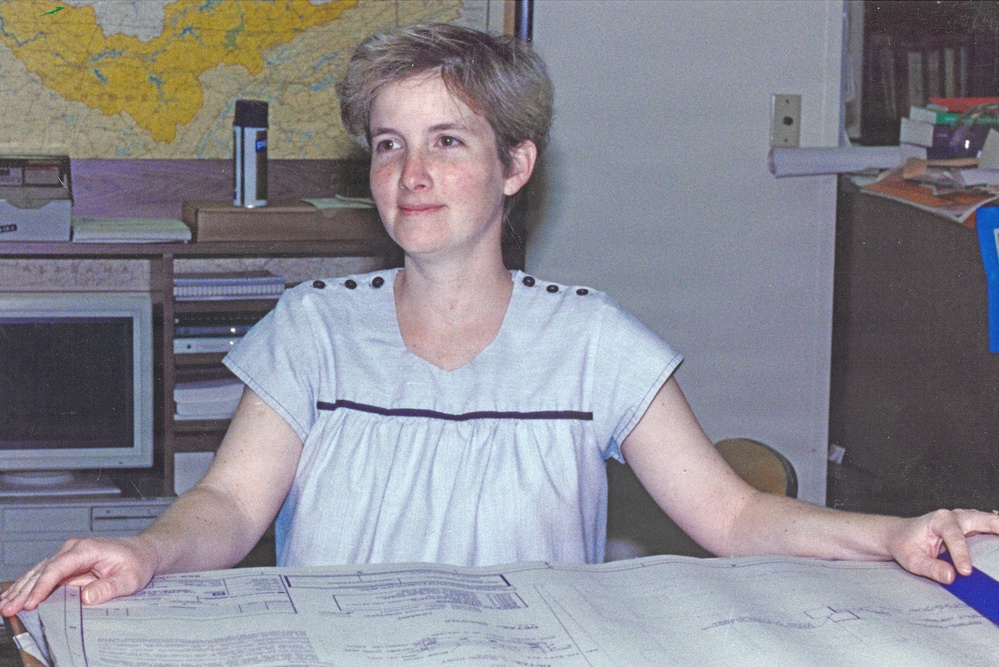
Photo By Leon Roberts | Connie Flatt reviews a project blueprint July 7, 1986, at the U.S. Army Corps of...... read more read more
NASHVILLE, Tenn. (April 20, 2026) – When Connie Flatt began her federal service, the "cloud" was merely a weather pattern over the Cumberland River, and "data" lived in ink-stained ledgers. Over a 46-year career that culminated in managing the Nashville District’s Operations and Maintenance (O&M) Program, Flatt didn't just witness a technological revolution — she engineered her way through it.
Encouraged by her brother Barry Mitchell to pursue a field where women were then a rarity, Flatt graduated from Tennessee Tech and joined the Nashville District in 1980, stepping into a world of blueprints and slide rules that she would eventually help digitize.
Flatt became a program and project manager in 1985. She then transitioned to become the district’s Engineering and Construction Division coordinator for architect engineer acquisition, a position she held from 1997 to 2003. She has served in her current position as Operations and Maintenance Program manager since 2003 and administered more than $150 million of O&M projects annually.
As Flatt enters retirement, she recalls how she worked hard to become an engineer during an era where women were much less common, a move she said put a dent in the “glass ceiling” and perhaps helped pave the way for women to flourish in the career field.
“I will always be grateful to my older brother Barry Mitchell, who encouraged me to become a civil engineer,” Flatt said. “In 1975, women rarely pursued engineering as their major. Barry and I attended Tennessee Tech University together for one year before he died in a tragic accident. I often think of Barry and how he encouraged me.”
Craig Carrington, Nashville District deputy for Project Management, presented the Department of the Army Civilian Service Commendation Medal and Certificate of Retirement to Flatt on behalf of Lt. Col. Guillermo Guandique, Nashville District commander. The award recognized her many contributions in the Programs and Project Delivery Branch and Carrington highlighted the legacy of her decades of service.
“Connie’s intimate understanding of the district and its projects helped her communicate needs and ‘fight’ for the funding Nashville needed,” Carrington said. “As an engineer, she understood the technical aspects of components used to operate flood gates, miter gates and many other aspects of our projects. During her career, Connie secured hundreds of millions of dollars in desperately needed funds. Her impact will be felt for generations.”
Early in her career she supported operations and maintenance at Fort Campbell as part of a program called “Work for Others.” Although people used ledgers, carbon paper for copies, and hard-copy forms, she soon began using a personal computer as the Corps of Engineers tracked and scheduled work for projects like the Tennessee-Tombigbee Waterway Project.
“Nashville District has always been a strong advocate of scheduling systems and our senior leaders advocated for Primavera (software) being included as a part of the relatively new Program and Project Management Information System (known as P2),” Flatt said.
While the tools have evolved from the rhythmic clack of typewriters to the integrated "single data entry" logic of the P2 system, Flatt notes that the goal remained the same: precision.
"We’ve always sought to transform our processes," Flatt said. "From having one of the first personal computers in the office to using AI today, it’s about making sure the data serves the project."
In 1980, information literally moved via the Postal Service or inter-office mail in physical envelopes and files were stored in large filing cabinets. Flatt accessed technical info in a library filled with books, encyclopedias, and rolodexes. To reach her you had to catch her on a desk phone or, later in the 80s, contact her via a pager.
Fast forward to today, Flatt used paperless cloud storage, specialized software, and TEAMS to communicate and participate in meetings. She obtained information using search engines and AI assistants and could be reached virtually anywhere on her cell phone and e-mail.
“I had one of the first personal computers in the early 1980s and used a scheduling software for project management duties,” Flatt said. “We seem to be always seeking to transform our project management processes. Artificial intelligence today has really surprised me in how useful it can be in certain situations, so that’s a big change for me regarding automation over time.”
Spanning a distinguished career, her work supported complex navigation, hydropower, flood risk management, recreation, environmental stewardship, water supply and emergency management projects across seven states in the Cumberland River and Tennessee River basins, a massive geographical footprint.
She supported the Engineering Division, Operations Division, and the Planning, Programs and Project Management Division and managed her program using financial, scheduling and budgeting systems. “The Nashville District is the only place I ever worked,” Flatt said.
In departing, she leaves more than her legacy on the job with the Nashville District. Her son Cody, born in the 1990s, is a biologist, former park ranger, experienced program manager, and now takes over as the O&M Program manager.
“I am most proud of his being such a kind and hard-working person and always striving to do the right thing,” Flatt said in passing the torch to her son.
As Flatt officially retired March 31, 2026, the transition of the O&M Program to her son Cody represented more than a vacancy filled — it marked the continuation of a family legacy dedicated to the Nashville District.
The public can obtain news, updates and information from the U.S. Army Corps of Engineers Nashville District on the district’s website athttps://www.lrd.usace.army.mil/About/Districts/Nashville-District/, on Facebook athttp://www.facebook.com/nashvillecorpsand on X (formerly Twitter) athttp://www.x.com/nashvillecorps. Follow us on LinkedIn for the latest Nashville District employment and contracting opportunities athttps://www.linkedin.com/company/u-s-army-corps-of-engineers-nashville-district.
| Date Taken: | 04.20.2026 |
| Date Posted: | 04.20.2026 14:43 |
| Story ID: | 563138 |
| Location: | NASHVILLE, TENNESSEE, US |
| Web Views: | 48 |
| Downloads: | 0 |

This work, From typewriters to AI, Connie Flatt marks 46 years of service and innovation, by Leon Roberts, identified by DVIDS, must comply with the restrictions shown on https://www.dvidshub.net/about/copyright.


No keywords found.





