
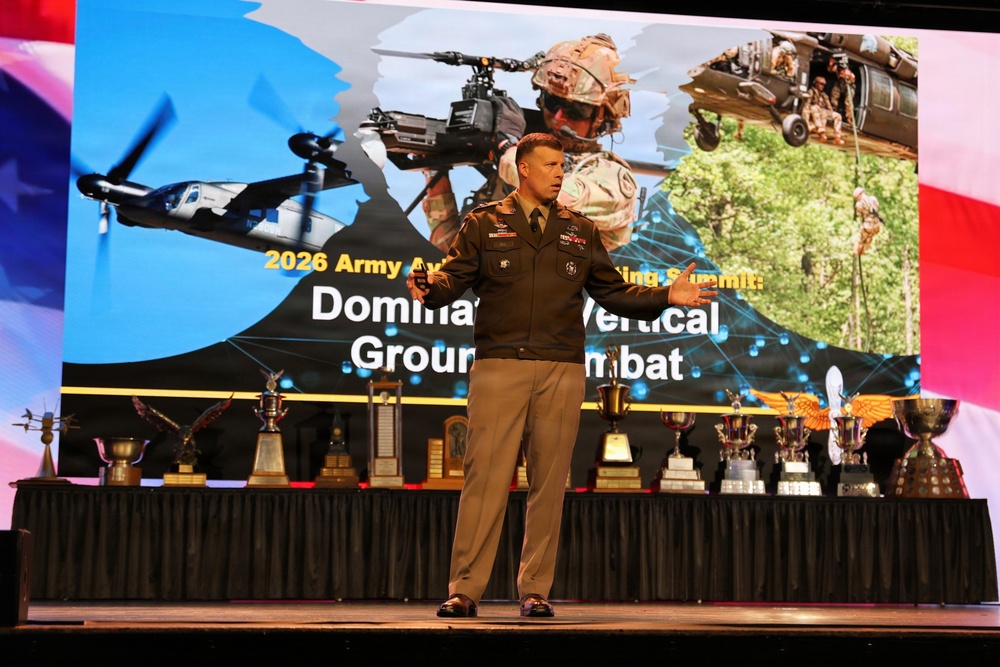
Photo By Leslie Herlick | Maj. Gen. Clair Gill, the Commanding General of the U.S. Army Aviation Center of...... read more read more
 Subscribe
NASHVILLE, Tenn. — Maj. Gen. Clair Gill told Army aviation leaders and supporters Wednesday that the branch is transforming at pace to meet a rapidly evolving battlefield, emphasizing culture, modernization, and soldier‑driven innovation as the service reshapes training, formations, and acquisition priorities.
Gill, the Commanding General of the U.S. Army Aviation Center of Excellence, the Army’s Program Acquisition Executive for Maneuver Air, and the Aviation Branch Chief, delivered the remarks during the opening session of the Army Aviation Association of America Summit on April 15.
Gill said the foundation of Army Aviation’s future remains its warfighter culture, calling it the most important responsibility of commanders. “This is the warfighting capability of our branch… the people that you represent,” he said, noting that culture must endure across generations of aviators.
He outlined a vision shaped with Army senior leaders that focuses on deployed mission success, combined arms integration, and manned‑unmanned capability built on a “purposeful warfighter culture.”
Gill said the Army can “generate a better aviator,” announcing plans for more solo flight time, improved decision‑making training, and a simpler single‑engine trainer to build stronger fundamentals. “I want young men and women… to have the confidence that we trust them,” he said, describing efforts to reduce the burden on operational units by producing more capable graduates.
The Army is preparing to redesign flight school this fall following the conclusion of a major training pilot program.
He also highlighted updates to enlisted aviation training and UAS instruction, including the Advanced Tactics Instructor Course, which has already undergone multiple revisions based on field feedback.
Responding to the Chief of Staff of the Army’s directive, Gill described sweeping changes to unmanned aircraft operator and maintainer training. The Army merged the 15W and 15E specialties into the new 15X unmanned operator, producing soldiers who can “fabricate, maintain, train, operate, plan, [and] advise.”
By October, every former 15W and 15E soldier will be certified as a 15X, he said.
Gill also praised the new five‑week Unmanned Advanced Leader Course at Fort Rucker, designed to standardize training across the Army and accelerate capability to the field.
Gill acknowledged the personnel strain created by the Army’s recent structure changes but said the branch is taking a deliberate, soldier‑focused approach. The Army is engaging affected officers and warrant officers “down to name‑tape level” to ensure they understand their options, including branch transfers and service transfers. He noted that temporary authorities allowing formations to man up to 125 percent this year will help stabilize units.
Gill said today’s battlefield demands rapid adaptation and tight industry‑government partnership. “We have to be moving at the speed of technology,” he said.
He highlighted the Army’s work on one‑way attack drones, counter‑UAS capabilities, and the new UAS Marketplace, an Amazon‑like platform that allows soldiers to compare systems, costs, and performance.
Gill described his role as the Program Acquisition Executive for Maneuver Air as an extension of long‑standing aviation collaboration. The new portfolio structure formalizes processes the branch already used, he said, enabling faster prioritization of systems such as the T901 engine, Group 3 UAS, and one‑way attack munitions.
Gill praised the counter‑UAS effort led by soldiers in the South Carolina National Guard, who integrated multiple Apache munitions to defeat drones. Their work accelerated procurement of a new 30mm proximity round, with production increasing fivefold.
“This is the model for how we solve problems,” he said.
Gill said the Army must modernize airspace management tools, replacing legacy systems and addressing increasingly congested airspace. New software is expected to reach formations this year for experimentation. He also highlighted ongoing soldier‑driven testing of launch‑effects capabilities across multiple divisions. Gill called the MV‑75 the Army’s “signature system,” emphasizing its unmatched range, speed, and modularity.
The aircraft will support medevac, assault, and other mission sets through plug‑and‑play configurations. “This cannot happen fast enough,” he said, adding that the Army is balancing speed with cost discipline.
Addressing questions about the future of manned aviation, Gill pointed to recent combat rescues and valorous actions as proof of enduring relevance. He recounted the story of Chief Warrant Officer 5 Aaron Slover, recently awarded the Medal of Honor, and the rescue of “Dude 44 Bravo” from a mountaintop in Iran just two weeks ago.
“The fundamentals made the mission happen,” he said. “I am not worried about relevance or irrelevance. I’m extremely proud of what everybody in this room does for our Army and for our nation.”
| Date Taken: | 04.16.2026 |
| Date Posted: | 04.16.2026 21:28 |
| Story ID: | 562937 |
| Location: | US |
| Web Views: | 112 |
| Downloads: | 0 |

This work, New training, new tech, new aircraft will define Army Aviation’s future, by Leslie Herlick, identified by DVIDS, must comply with the restrictions shown on https://www.dvidshub.net/about/copyright.

No keywords found.




