
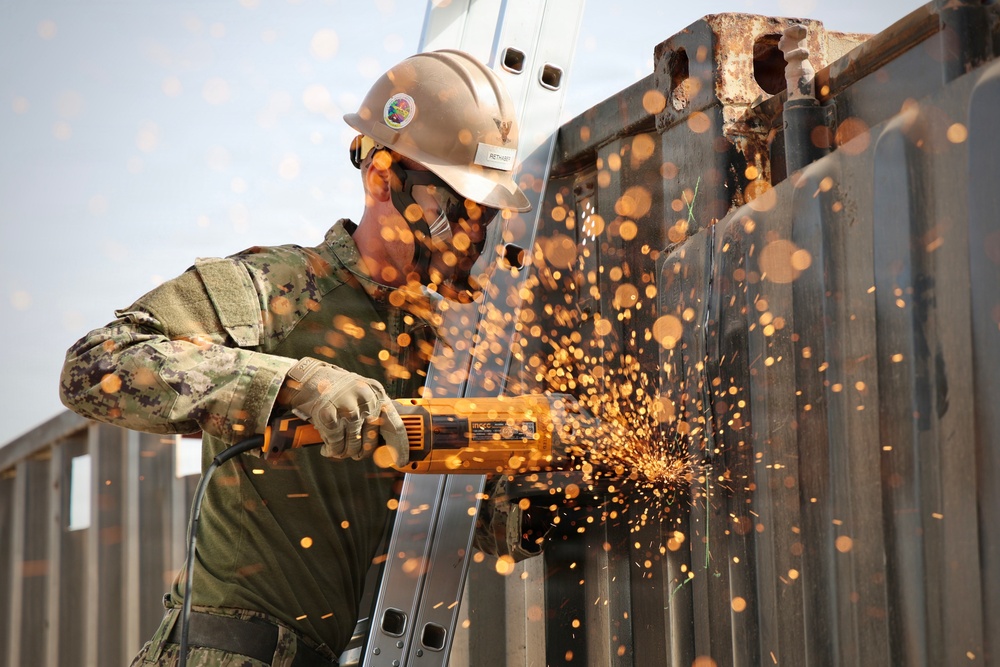
Photo By Chief Petty Officer Justin Stumberg | Builder 3rd Class James Rethaber, assigned to Naval Mobile Construction Battalion 1,...... read more read more
The sharp crackle of a stick welder cuts through the Senegal Navy Bel Air Base morning air, followed by a burst of sparks from an angle grinder just a few feet away.
Steel meets steel as Seabees assigned to Naval Mobile Construction Battalion 1,move deliberately through the worksite, shaping raw materials into something far more purposeful.
Steel Worker 2nd Class Thomas Weidauer leans into the weld, steady and focused, pausing only briefly to inspect the seam before moving to the next section. Around him, the framework of a visit, board, search, and seizure (VBSS) shoot house begins to take shape.
In just a few days, this structure will be used by partner forces to rehearse maritime interdiction operations, moving through tight corridors, clearing rooms, and making split-second decisions.
For now, it’s still under construction.
A few steps away, the work continues in a different form.
Where the shoot house rises from steel and framing, another team focuses on the ground beneath their boots by measuring, marking, and reshaping a worn training space into a new small arms pistol range.
What remains of the old backstop is pulled apart piece by piece, weathered boards stripped away and stacked aside as the surface is prepared for what comes next.
The timber that once lined the range had been worn down through repeated use. Each round fired gradually broke it apart, exposing a hardened steel plate beneath. Lined with bolts and metal fixtures, that exposed surface created an increasing risk of ricochet.
In its place, Seabees are preparing to field test a shock-absorbing, fiber-reinforced concrete designed to reduce that risk while extending the lifespan of the range. Developed by U.S. Army engineers, the material offers a more durable and safer alternative to traditional backstop systems.
The rhythm is constant, tear down, clear out, build back stronger.
What once served a different purpose is being reshaped into something aligned with today’s mission. It’s a process that mirrors the exercise itself, adapting, improving, and building capability from the ground up. The work may look routine, measuring, cutting, rebuilding, but its impact extends far beyond the site itself.
“What’s being built here directly supports how our partners train and operate,” said Chief Builder Caleb Walters, Obangame Express 2026 Senegal construction detachment officer in charge. “It’s about giving them the tools and environments they need to train safely, realistically, and effectively.”
As part of Exercise Obangame Express 2026, forces from across West and Central Africa will come together to strengthen maritime security, improve coordination, and enhance their ability to detect and disrupt illicit activity in the Gulf of Guinea.
The training that unfolds at sea begins in places like this where the fundamentals are built, refined, and reinforced long before the first scenario ever begins.
When Obangame Express begins, the focus will shift offshore to ships, coordination, and operations at sea. What won’t be seen are the early stages, the tearing down, the rebuilding, and the work that made it possible.
For the Seabees in Senegal, the mission didn’t start with the exercise.
It started here.
| Date Taken: | 03.29.2026 |
| Date Posted: | 04.15.2026 15:39 |
| Story ID: | 562800 |
| Location: | DAKAR, SN |
| Web Views: | 75 |
| Downloads: | 0 |

This work, Where Capability Begins, by CPO Justin Stumberg, identified by DVIDS, must comply with the restrictions shown on https://www.dvidshub.net/about/copyright.


No keywords found.





