
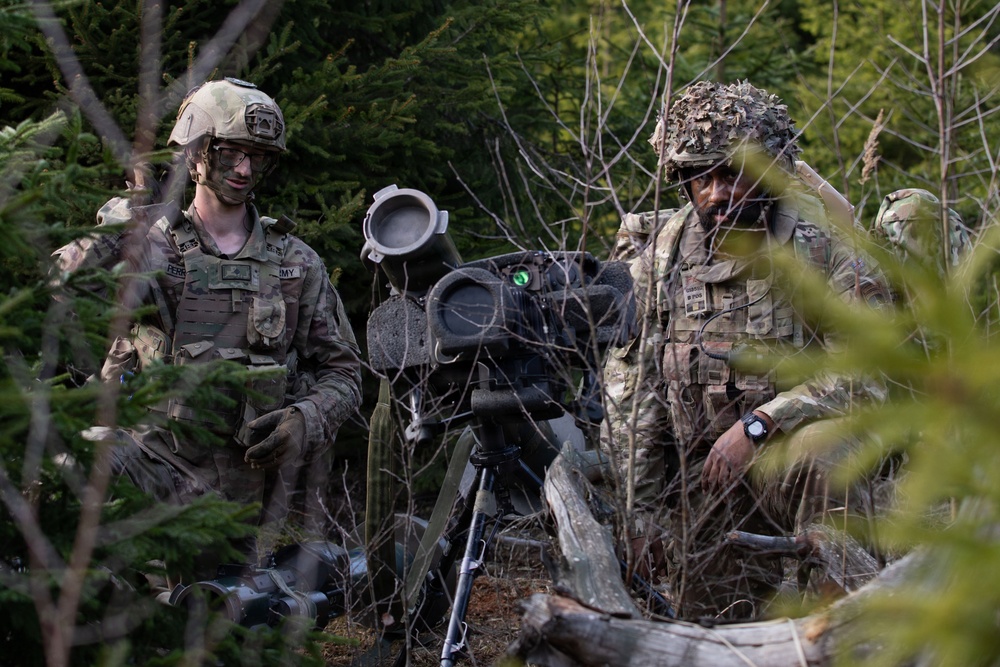
Photo By Staff Sgt. Emilie Lenglain | U.S. Army Pfc. David Perry, 3rd Battalion 8th Cavalry Regiment and British Army Pte....... read more read more
 Subscribe
BEMOWO PISKIE, Poland – “There are fundamental differences between how we conduct reconnaissance and sniper operations and how they do,” said a U.S. Army sniper in training with 3rd Battalion, 8th Cavalry (3-8th CAV). “If we’re deployed and attached with them, it’s imperative we understand how they work so we can plan accordingly.”
Weeks of joint training between 3-8th CAV and 2nd Battalion Royal Anglian Regiment, British Army took place at Bemowo Piskie Training Area. The program included sniper, reconnaissance and anti-tank training for U.S. soldiers, which was a qualifying course for British troops.
U.S. Army Sgt. 1st Class William Nybroten, a scout platoon sergeant in 3-8th CAV coordinated the joint training with Colour Sgt. Max Mander, a recce platoon sergeant in -2nd Royal Anglian Regiment.
Mander said he spoke to Nybroten on what training they had coming up and was keen on adding a few of his soldiers to the fold.
“I’m happy to take on some of your guys. Let’s make it happen,” said Mander.
U.S. and British troops built camaraderie over many months before the 3-8th CAV joined the British qualifying courses.
Day after day during the British qualifying courses they moved into the training area, faces camouflaged, uniforms blending into the tree-line, different weapons in hand but the same mission: prepare to become qualified in one of the following reconnaissance, sniper or anti-tank.
Regardless of specialty, each group worked as a unit and received feedback from their trainers on strengths and areas of improvement.
Directing staff provided the experience and mentorship to guide soldiers, whether one of their soldiers or one from the 3-8th CAV.
U.S. Army Spc. Yousef Perez, who trained with the British anti-tank qualification course, said the trainers who taught him about the Flight Ground Missile-148 (FGM-148) Javelin were very knowledgeable and proficient in their jobs.
He added that the British have a section for anti-tank speciality, which is different from his unit, which has “a fire team that has at least one javelin.”
Besides all three specialties conducting day and night land navigation, there were differences between sniper, reconnaissance and anti-tank training. Snipers practiced shooting 1,000 meter targets, static navigation, and stalks. Reconnaissance trained on reacting to contact, casualty recovery, and establishing observation posts. Anti-tank training consisted of all of the reconnaissance training, as well as use of the FGM-148 Javelin and bayonet.
British soldiers remained focused on meeting qualification standards and U.S. Soldiers who met course requirements would receive a NATO-relevant certification.
“In any NATO mission we’re going to work alongside European and U.S. counterparts,” said Mander. “If we don’t know how each other operates, we won’t be able to work well. We will be handing off targets to one another better. If we know how each other works, we can communicate better and have a greater effect on the ground.”
That effect matters for the armored battalion of 3-8th CAV where snipers and reconnaissance teams operate together on the battlefield.
Leaders saw the training as an investment in future relationships and readiness.
“It’s good to have sniper coverage as tanks push forward,” said 1st Lt. Garrett Petruski, scout platoon leader, 3-8th CAV. “Snipers can take out anti-tank teams.”
This training also provided U.S. Soldiers who will attend a similar qualification course this summer statesides more time prior to practicing their craft.
Petruski hopes that his soldiers attending the training with the British will help them be successful in sniper school.
The training “gave our snipers a lot of range time because they were able to train with the British and learn their methods and kind of how they do things,” said Petruski. “It gave them lots of trigger time. That's one of the biggest things and very important for a sniper. You have to think about all the factors that affect the way a bullet travels.”
A few soldiers who trained with the Recce or reconnaissance (recon) team will also attend a course this summer to qualify in recon.
“It's been really good that they've been able to work with a foreign force and build that camaraderie and learn their methods,” said Petruski.
One battlegroup on the eastern flank, two forces training together, and three specialties focused on defense. U.S. and NATO forces are more capable because of the training at Bemowo Piskie Training Area, Poland.
| Date Taken: | 04.09.2026 |
| Date Posted: | 04.14.2026 11:12 |
| Story ID: | 562631 |
| Location: | PL |
| Web Views: | 144 |
| Downloads: | 0 |

This work, Joint allied training emphasizes intelligence, surveillance, reconnaissance, by SSG Emilie Lenglain, identified by DVIDS, must comply with the restrictions shown on https://www.dvidshub.net/about/copyright.


No keywords found.




