One Team, One Fight: PAE SSP and DTRA Execute Knowledge Transfer Initiative
Courtesy Photo |
The senior advisor for strategic deterrence and Department of War engagement at......read moreread more
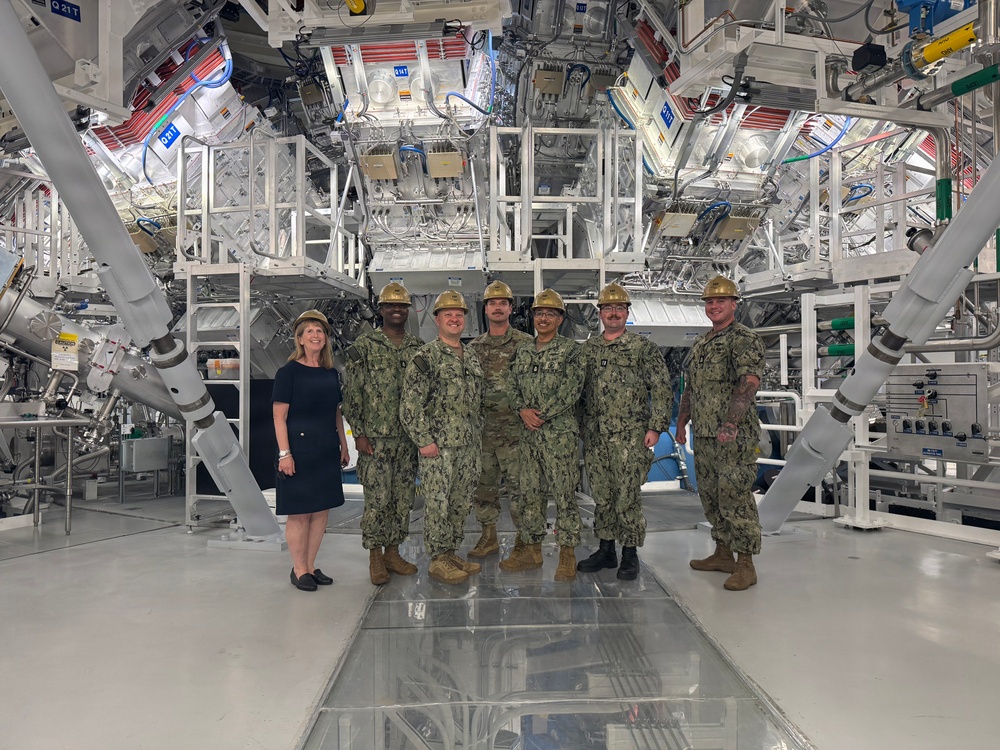
Courtesy Photo | The senior advisor for strategic deterrence and Department of War engagement at Lawrence Livermore National Laboratory (LLNL), Servicemembers assigned to the Defense Threat Reduction Agency (DTRA) Global Threat Reduction Directorate (GT), and Sailors from U.S. Navy Portfolio Acquisition Executive (PAE) Strategic Systems Programs (SSP) participate in a tour of LLNL as part of a week-long cross-program knowledge transfer March 23-27.
The week included tours to SSP’s Program Management Office (PMO) Flight Systems’ (SPF) detachment site in California (SPF(S)), Northrop Grumman’s Marine Systems Site, Lawrence Livermore National Laboratories (LLNL), Travis Air Force Base, and the USS Pampanito Museum.
The initiative was coordinated by SSP's SPF(S) site, and brought together representatives from across the strategic deterrence enterprise to provide a behind-the-scenes look at the Trident II D5 strategic weapons system (SWS) and the elements that support the nation’s most reliable deterrence capabilities. (Photo Courtesy of Lawrence Livermore National Laboratory) see less
| View Image Page
One Team, One Fight: PAE SSP and DTRA Execute Knowledge Transfer Initiative
SUNNYVALE, Calif. - Servicemembers assigned to the Defense Threat Reduction Agency (DTRA) Global Threat Reduction Directorate (GT) and Sailors from U.S. Navy Portfolio Acquisition Executive (PAE) Strategic Systems Programs (SSP) spent a week engaging in cross-program knowledge transfer March 23-27.
The week-long initiative was coordinated by SSP Program Management Office (PMO) Flight Systems’ (SPF) detachment site in California (SPF(S)), and brought together representatives from across the strategic deterrence enterprise to provide a behind-the-scenes look at the Trident II D5 strategic weapons system (SWS) and the elements that support the nation’s most reliable deterrence capabilities.
This knowledge-transfer initiative between DTRA and SSP underscores a fundamental truth: the strength of the nation's nuclear deterrence lies not just in its advanced technology, but in the community and shared understanding of the people who manage it. By providing servicemembers a direct, hands-on look at the entire "cradle-to-grave" lifecycle of sea-based strategic systems, as well as the critical support missions located at Travis Air Force Base that run across the services—the participants broke out of their operational silos.
For the Navy and Air Force specialists accustomed to one facet of the mission, whether maintaining ICBMs or operating the Trident II D5 SWS, the experience provided invaluable context, revealing the complex web of design, production, and inter-service support that underpins their daily duties.
As a PMO detachment site, SPF(S) serves as SSP’s “eyes in the field” with the government representatives overseeing design, development, production, installation, and testing for homeland defense and regional strike weapons systems at industry partner sites. SPF(S) is co-located with Northrop Grumman Marine Systems, the industry partner responsible for producing the launch tubes for the nuclear Trident II D5 SWS and the non-nuclear hypersonic Conventional Prompt Strike (CPS).
The Trident II D5 SWS makes up one leg of the nation’s strategic nuclear Triad that also includes the U.S. Air Force’s intercontinental ballistic missiles (ICBM) and nuclear-capable bombers. PAE SSP is responsible for sustaining Trident on the Ohio-class ballistic missile submarines (SSBN) and supporting the integration of the D5LE weapon system on the new Columbia-class SSBNs. Looking to the future, SSP is actively modernizing the sea-based leg of the nuclear triad through development of the D5LE2 SWS and pioneering regional strike capabilities of the future through development of the nuclear-armed sea launched cruise missile (SLCM-N) and CPS programs.
Lt. Cmdr. Wyatt Middleton, officer-in-charge (OIC) for SPF(S), emphasized that SSP’s cradle-to-grave responsibility for the weapons systems is a leading factor in the continued success of SSP’s deterrence missions.
“As a PAE, SSP controls the contracts, controls the budgets, and has full cradle-to-grave responsibility for the system,” said Middleton. “We design, produce, operate, and dispose of the weapons system - it’s what makes SSP special, and based on our track record, we’ve done a dang good job.”
That proven track record is made possible by SSP’s strong history of industry partnership. Middleton views his role as OIC as one in which he works toward a standard of success wherein both the industry partner and the Navy achieve their goals.
“We’re one team, one fight,” said Middleton.
This unifying framework drove the messaging over the course of the week, which included tours to SPF(S)’s site, Northrop Grumman’s Marine Systems Site, Lawrence Livermore National Laboratories (LLNL), Travis Air Force Base, and the USS Pampanito Museum.
From seeing and touching the launch tubes for the Trident II D5 SWS on the factory floor at Northrop Grumman; to walking through new technology being developed at LLNL; to interacting with different members of the nuclear deterrence community at Travis Air Force Base, each servicemember came away feeling more connected to the nation’s mission of homeland defense.
“Getting to see another side of the nuclear triad and all the additional people involved was an eye opener,” said Tech. Sgt. Charles Hafer, the non-commissioned officer-in-charge of Nuclear Arms Training at DTRA, and a weapon specialist for the Minuteman III intercontinental ballistic missile weapon (ICBM) weapon system. “A very small community gets to work with the most powerful weapon systems in the world, and I am grateful to be a part of that.”
DTRA’s mission is to deter strategic attacks against the United States and its allies, prevent,
reduce, and counter weapons of mass destruction (WMD) and emerging threats, and prevail against WMD-armed adversaries in crisis and conflict.
Chief Petty Officer Darren Hallhuz, is a missile technician currently serving with DTRA as a weapons specialist for the submarine launched ballistic missile weapons system reflected on how the cross collaboration and training provide mission critical knowledge.
"Seeing the research and development that goes into the equipment that we operate is valuable and will continue to be valuable in the future," said Hallhuz. "It is eye-opening seeing everything that goes into supporting us - as Sailors - as we are the ones operating the systems and equipment on the boats. Understanding the thought process that went into the products gives us an advantage and complete transparency."
SSP’s own team was equally impressed with the information shared by their colleagues at Travis Air Force Base, particularly the Fleet Air Reconnaissance Squadron 3 (VQ-3) Detachment Travis. VQ-3 Detachment Travis provides rapid, high-altitude communications to support nuclear deterrent forces, primarily by maintaining an alert pad for the Boeing E-6B Mercury. That mission is a crucial element of the Nation’s sea-based deterrent capability and one that Chief Petty Officer Mark Montgomery, a missile technician and fleet liaison at SSP PMO Flight Systems’ (SPF) detachment site in Cape Canaveral, Florida (SPF(C)) was excited to learn more about.
“It can be difficult to fully understand how all components of the nuclear triad integrate during joint warfighting operations,” said Montgomery. “Opportunities such as this help bridge that gap by providing critical context and connecting the larger strategic picture to day-to-day requirements.”
That critical context ranged from technical specifications to shared experiences between the different members of the deterrence community. Building an understanding of how each leg of the nuclear triad operates, and how their supporting systems function, created a sense of community between participants.
“While underway, it can sometimes feel as though the unique demands placed on SSBN crews are unmatched,” said Montgomery. “However, observing other units, such as VQ-3, revealed that many communities operate under similarly rigorous procedures and expectations. This reinforced the understanding that the deterrence mission is a shared effort across multiple communities, all of whom make significant sacrifices.”
Maintaining the nation's decisive strategic edge requires buy-in at every level of the strategic deterrent enterprise. By making connections across services, job functions, and areas of expertise, PAE SSP continues to lead the way in ensuring peace through strength.

 Subscribe






