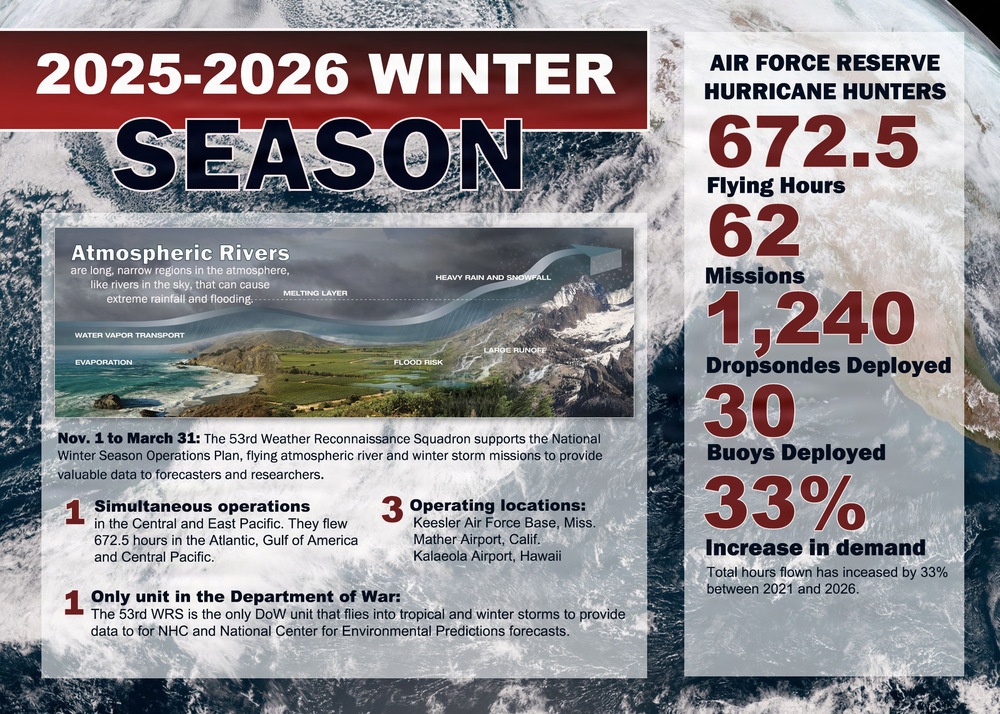
Photo By Lt. Col. Marnee Losurdo | The 2025-2026 winter season wrap up showing the statistics of the 53rd Weather Reconnaissance Squadron. (U.S. Air Force graphic by Lt. Col. Marnee Losurdo) see less
| View Image Page
KEESLER AIR FORCE BASE, MISSISSIPPI, UNITED STATES
Hurricane Hunters close winter season after flying atmospheric rivers, winter storms from Pacific to Northeast
The Air Force Reserve’s 53rd Weather Reconnaissance Squadron concluded its 2026 winter storm season in early March, capping a record-setting year that highlights the increasing demand for airborne weather data outside of hurricane season.
During the winter, the 53rd WRS, famously known as the “Hurricane Hunters,” pivots its focus to atmospheric rivers, which are narrow corridors of concentrated moisture that can cause intense rainfall and significant flooding in the western United States.
The squadron’s involvement with atmospheric river missions began with a research-based project, flying out of various West Coast and Pacific bases in 2016, 2018, and 2019. These flights became integrated into the National Winter Season Operations Plan in 2020.
This year, operating from Mather Airport in California, Kalaeola Airport in Hawaii, and their home base at Keesler, the unit set new records for total hours flown and the number of intensive observation periods completed. IOPs are critical windows when significant atmospheric rivers are expected to make landfall, and during these times, the
squadron flies into the systems to collect data on water vapor, wind speed, pressure, and temperature.
According to Warren Madden, Chief of the Aerial Reconnaissance Coordination, All Hurricanes unit at the National Hurricane Center, the five seasons with the highest number of winter flight hours have all occurred in the last six years. He noted a 33% increase in total hours flown from the fifth-ranked season in 2021 to this year. In the 2026 season alone, the unit flew 62 missions totaling 672.5 hours, releasing 30 buoys and 1,240 dropsondes.
"The data we collect is important for forecasters at the National Weather Service and researchers to track atmospheric rivers," said Lt. Col. Ryan Rickert, 53rd WRS chief aerial reconnaissance weather officer. He stressed that the data is "invaluable in improving the accuracy of weather models, especially in predicting the location of
landfall, timing, intensity, and impact of these events."
Rickert further explained that this information enables officials in California and other western states to make critical decisions about managing water resources in watersheds and reservoirs.
To gather this data, the squadron operates the WC-130J Super Hercules at altitudes between 24,000 and 32,000 feet, collecting profiles of windspeed and wind direction, temperature, humidity, and pressure. Rickert added that crews use advanced sensors, including dropsondes, which are small, parachute-equipped sensors released from the aircraft to obtain data that cannot be accessed by traditional ground-based weather stations or satellites.
At the conclusion of hurricane season in November, the 53rd WRS switches its focus to high-impact weather systems associated with atmospheric rivers and major winter storms. These missions support forecasters and researchers by gathering real-time data over vast, data-sparse ocean areas, which improves forecast models before storms hit the United States.
Lt. Col. Mark Withee, a 53rd WRS navigator, highlighted a mission sequence in February that demonstrated the extensive value of the squadron’s winter operations.
Over several days, crews tracked a powerful jet stream and atmospheric river as it moved from the central Pacific near Hawaii, to the West Coast, across the Gulf of America, and finally contributed to a major snowstorm in the northeastern United States.
“We were flying through the jet stream, through the atmospheric river, as it was going through the central Pacific from Hawaii, and then it was coming to the West Coast,” Withee said. “Then that jet stream atmospheric river event was curving down over the Gulf of America, and we were flying out of home station in Keesler. Ultimately, the final impact of that, beyond the rainfall on the West Coast, was the winter storm that impacted the Northeast.”
The storm developed into a historic blizzard that struck the Northeast on February 23, delivering 27.5 inches of snow to parts of Long Island and 19.7 inches in Central Park.
The storm led to widespread power outages and the cancellation of over 10,000 flights. Withee noted that this sequence showed how airborne weather reconnaissance can document a storm’s entire lifecycle, much like how the squadron tracks a hurricane from its inception to landfall.
The missions flown for winter storms are known as synoptic tracks, designed to give forecasters a comprehensive view of atmospheric conditions over a large area.
“A synoptic track is more like flying over a broad area and dropping a large number of sondes to get a big picture of the integrated vapor transport of the atmosphere throughout that area,” Withee explained. “In many cases, that track may be targeted around specific areas where additional data would be particularly impactful for the forecast.”
These targeted areas are chosen because they are zones of high forecast sensitivity, where a single set of observations can dramatically improve model performance and downstream forecasts.
The winter mission season begins well before the first atmospheric river flight. Withee said that preparations can start as early as November and December with buoy deployment missions over the eastern Pacific. These missions address observation gaps where existing buoys have drifted, leaving data coverage sparse.
“They find the gaps, and then they send us out to drop buoys throughout those areas where they don’t have good coverage,” Withee said. “Then, as we get into January, we start flying those atmospheric river missions as they approach the West Coast.”
The squadron’s record-breaking season underscores its expanding role in national weather support. While best known for flying into hurricanes, the 53rd WRS’s winter reconnaissance work plays a key role in improving forecasts for extreme rainfall, flood-producing atmospheric rivers, and major snowstorms across the country.
From the Pacific to the Gulf Coast and the Northeast, the 53rd WRS spent the winter doing what it has done for decades: flying into hazardous weather so that others can be prepared before the storm arrives.

 Subscribe






