
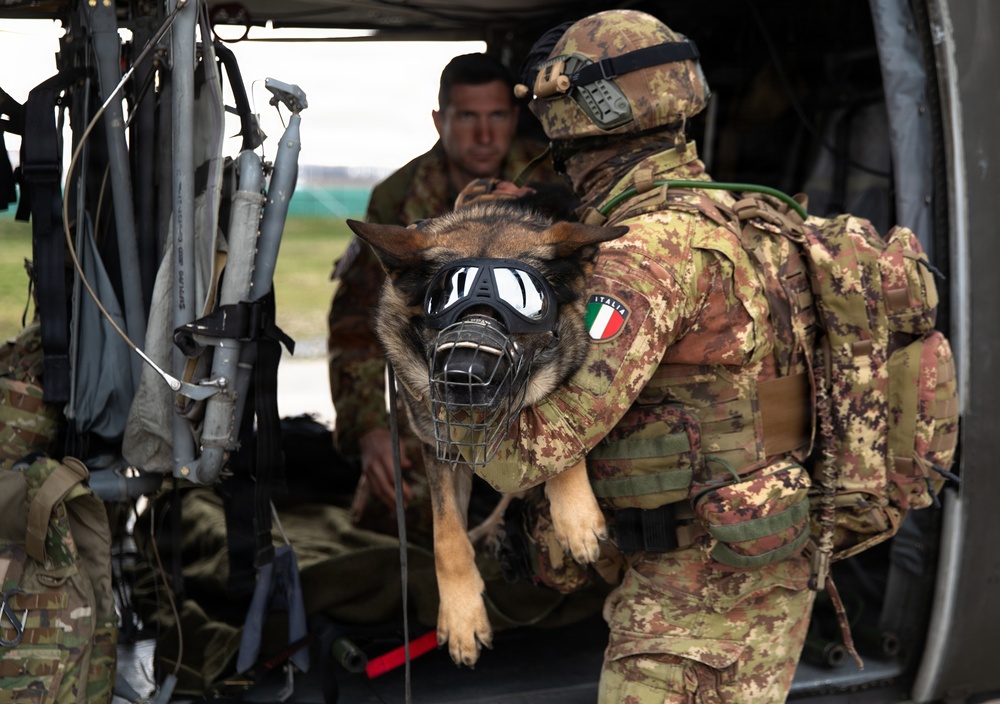
Photo By Staff Sgt. Spencer Rhodes | Italian Army OR-4 Simone Trimarchi, a K9 handler with Kosovo Force (KFOR) Regional...... read more read more
 Subscribe
CAMP BONDSTEEL, Kosovo – Multinational forces assigned to Kosovo Force (KFOR) Regional Command-East, in coordination with Regional Command-West, conducted K-9 medical evacuation training across Kosovo, March 17, 2026, to establish procedures for transporting military working dogs to surgical care.
The training brought together U.S. Army Reserve veterinary personnel, Italian Army K-9 handlers at Camp Novo Selo in RC-E and a veterinarian from RC-W, along with U.S. aviation elements from the Tennessee Army National Guard’s Detachment 1, Company C, 1st General Support Aviation Battalion, 135th Aviation Regiment, to address gaps in how military working dogs are treated and evacuated.
“Working dogs and veterinarians for KFOR are spread out throughout the country with some dogs not being housed on the same base as the veterinarian,” said U.S. Army Reserve Maj. Christine Bui, a veterinarian assigned to the 7360th Veterinary Detachment under Task Force Medical.
Bui explained that the distance between veterinarians and working dogs can delay care, with response times ranging from one to two hours. She said the training was designed to improve coordination between veterinary teams, handlers, and aviation units during a K-9 medical evacuation.
Camp Bondsteel is the only location in Kosovo with surgical veterinary capability, making coordination across locations critical when working dogs require advanced care.
Italian Army veterinarian Maj. Filippo Pinagli and K-9 handlers OR-4 Simone Trimarchi and OR-4 Giuseppe Dipietro trained alongside their working dogs, Neo and Erek.
“K9 Medevac training is essential for maintaining high standards of readiness and addressing potential operational scenarios that require the emergency evacuation of a canine patient following a veterinary incident,” said Pinagli. “Due to the vastness of the territory, terrain characteristics, and mobility requirements, the current operational scenario in Kosovo demands rapid intervention and decisive action to mitigate health risks.”
Pinagli explained that working dog teams support KFOR operations by conducting perimeter security, monitoring sensitive and culturally significant sites, and assisting with mobility support to ensure freedom of movement across Kosovo.
“It’s important for us to not only train the K-9 handlers and medics on how to provide point of injury and basic care to the dogs, but also prepare ourselves in case we ever need to MEDEVAC a K-9 for a more serious injury,” Bui said.
During the training, participants conducted a route familiarization exercise that brought together a veterinarian from Camp Villaggio Italia, RC-W, with K-9 handlers at Camp Novo Selo, RC-E, simulating the movement required to transport an injured working dog to Camp Bondsteel.
U.S. Army Reserve Sgt. Clara Maia, an animal care specialist with the 442nd Veterinary Detachment, Maryland, and Maj. Christine Bui, a veterinarian with the 7354th Veterinary Detachment, Colorado, are both assigned to the 7360th Veterinary Detachment under Task Force Medical for the deployment.
The training builds upon an existing agreement between U.S. and Italian forces that enables veterinary support across national lines and supports the development of a formal standard operating procedure currently under review.
Participants emphasized the need for flexible, adaptable procedures, as variations in aircraft configuration, dog temperament and mission requirements can impact how a K-9 evacuation is conducted. While working dogs are accustomed to aircraft environments, the training reinforced loading procedures and coordination between handlers and aircrew.
With a limited number of military working dogs in Kosovo and no veterinary facilities at some locations, the ability to rapidly coordinate and transport animals remains critical to sustaining operational capability.
This effort enhances interoperability among KFOR partners and supports the mission to maintain a safe and secure environment and freedom of movement for all people living in Kosovo.
| Date Taken: | 03.29.2026 |
| Date Posted: | 04.08.2026 08:39 |
| Story ID: | 562218 |
| Location: | CAMP BONDSTEEL, ZZ |
| Hometown: | SAN ANTONIO, TEXAS, US |
| Web Views: | 101 |
| Downloads: | 0 |

This work, Multinational partners develop K-9 MEDEVAC procedures for working dogs across KFOR, by CPT Balinda ONeal, identified by DVIDS, must comply with the restrictions shown on https://www.dvidshub.net/about/copyright.


No keywords found.




