
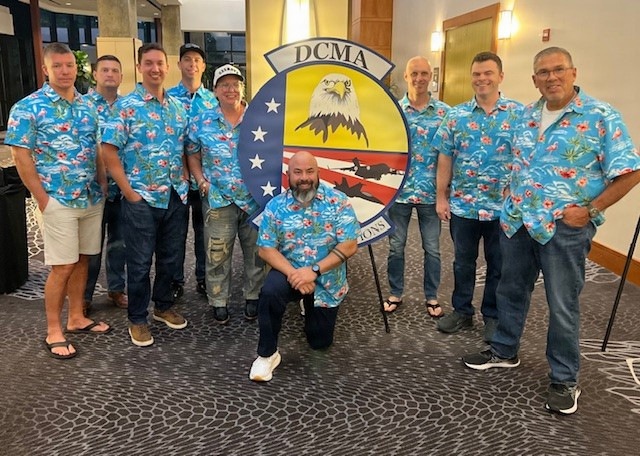
Photo By Debra Watts | Members of Defense Contract Management Agency’s Aircraft Integrated Maintenance...... read more read more
 Subscribe
SAN ANTONIO–Deep in the heart of Texas, a small team of aviation professionalsbrightena sprawling industrial site just outside the city centerhere, wearing Hawaiian shirts to signal unity, strengthen morale and reinforce their commitment to delivering mission-ready capability.
The Defense Contract Management Agency’s Aviation Program Team, or APT, stationed here at the agency’s largest Maintenance, Repair, and Overhaul facility ensures aircraft readiness by embedding government oversight within contractor operations.
“Our oversight directly enables the timely and safe return of aircraft through meticulous focus on quality and risk-mitigation, ensuring the final product meets all contractual and airworthiness standards,” saidSonny Gomez, a government flight representative for the agency’s Aircraft Integrated Maintenance Operations, or AIMO,San Antonio team. “The APT’s primary function is to serve as the government’s eyes and ears on the factory floor, ensuring adherence to the approved technical baseline. Specifically, we conduct surveillance to confirm that the contractor’s maintenance,repairand overhaul processescomply withrigorous standards for all ground and flight operations.”
The team’s mission aligns with theDepartment ofWar’s strategic priorities: maximize warfighting readiness, strengthen deterrence, modernize theforceand institutionalize accountability.
“By catching non-conformances early – before they become costly rework or safety hazards – we prevent delays that would otherwise hold the aircraft off the flight line and back into the unit’s ability to force-extend the power of the Department of War,”Gomezsaid.“Our work ensures every aircraft leaving this site is not just airworthy butcombatready.”
The APT’s collaborative, risk-focused approach is where these priorities are translated into day-to-day execution,operatingunder the guidance ofDCMA Instruction 8210.1and conductingdaily surveillance on maintenance, groundoperationsand flight procedures. These oversight functions enable the team to verify that each step is completedin accordance withapproved data and safety protocols.
“Our certification of airworthiness documentation is the final technical gate that allows an aircraft to be accepted by the services, making our surveillance a direct and non-negotiable prerequisite for warfighting readiness,” said Alviz Lacanilao, AIMO San Antonio quality assurance director.
By embedding with contractor teams, theteamprovidesimmediateevaluations and contributesto an integrated safety culture. These efforts reflect the principles taught in the Air Operations Safety Seminar, which promotes shared risk management between the contractor, thegovernmentand the program office.
“Our relationships are key,” saidGomez.“When a problem arises, we’re already at the table–ready to act, not react.”
The APT also supports readiness across allied and foreign military platforms. When an aircraft used by a foreign military sales partner sustained structural damage, the AIMO San Antonio team coordinated immediately with the contractor and the customer, minimizing disruption to the fleet and preserving trust in U.S. sustainment capabilities.
“Our team worked immediatelyandmoved to ensure the recovery of the pilot and the aircraft,”saidGomez.“We used that local failure as a catalyst to implement cross-program corrective actions–forexample, mandating enhanced daily inspection metrics across all programs utilizing similar configurations.”
Such coordinationproves especiallycritical duringF/A-18Hornet’sService Life Modification efforts and other modernization programs, which often span years. The team’s oversight prevents latent defects and avoidscostly rework that can delay operations and erode strategic advantages.
“Our job is to protect the warfighter’s time and the taxpayer’s investment,” saidNavySenior Chief Petty Officer Jarad Johnston,an AIMO San Antonio government ground representative.“That means getting it right the first time.”
Beyond technical inspections, the team evaluates contractor procedures to ensure consistency, safety and accountability. APT members also monitor training, clearances and procedural discipline – all while maintaining cohesive internal operations.
“Our mission as the final line of defense for the warfighter requires technical rigor andvigilant discernmentwhen reviewing contractor processes,” said Lacanilao. “Ensuring the delivery of safe and reliable aircraft is a high-consequence responsibility; maintaining that level of professional intensity requires deep internal trust and a foundation of strong team morale.”
The cohesion and moraleisreinforced by leadership traditions, including theteam’sHawaiian shirt,started by long-timegovernmentflightrepresentative Sonny Gomez.Thepractice, while informal, fosters camaraderie in a high-stakes environment.They alsoparticipatein the contractor’s Red Shirt Friday tradition, an effort to “remember everyone deployed.”
“It’s about fostering internal cohesion and demonstratingesprit de corps,” saidGomez.“The Hawaiian shirt is a deliberate, lighthearted effort to build that internal connection, showing that while we are diverse in background, we are unified in our mission.”
The APT’sholistic approach–regulatoryenforcement paired with teamwork and technical depth–ensuresa strategic force multiplier. Everyaircraftthey certify contributes to global deterrence, forceprojectionand the modernization of the fleet.
“Teaming isn’t just about collaboration,” saidAir ForceCol.JoannKenneally, AIMOSan Antonio commander.“It’s about shared ownership of the mission.”
| Date Taken: | 03.25.2026 |
| Date Posted: | 04.06.2026 19:06 |
| Story ID: | 562051 |
| Location: | SAN ANTONIO, TEXAS, US |
| Hometown: | SAN ANTONIO, TEXAS, US |
| Web Views: | 53 |
| Downloads: | 0 |

This work, AIMO San Antonio team builds unit cohesion for critical mission, by Elizabeth Szoke, identified by DVIDS, must comply with the restrictions shown on https://www.dvidshub.net/about/copyright.

No keywords found.




