
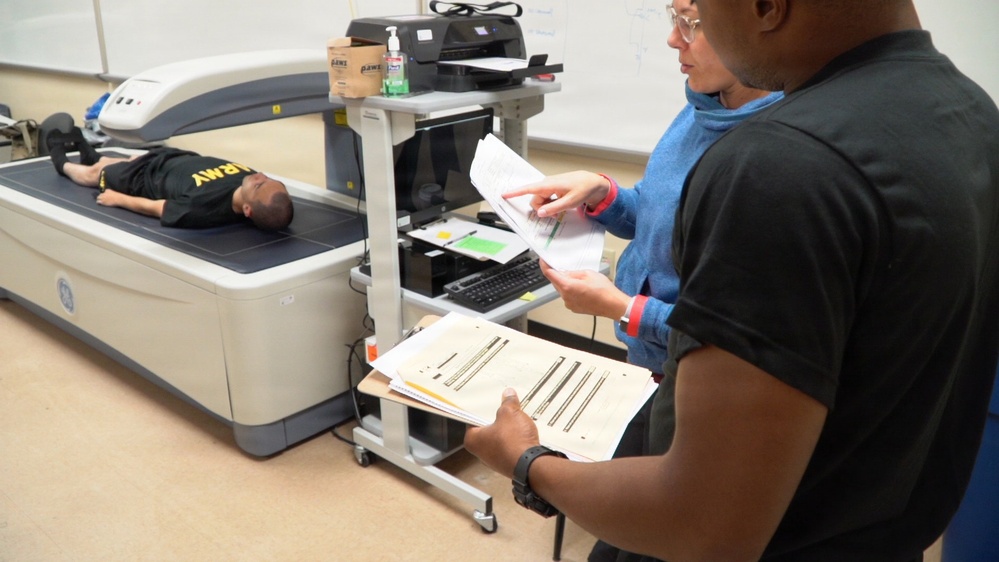
Photo By Carey Phillips | Artificial intelligence and machine learning are tools the Army uses to synthesize...... read more read more
In an era where actionable data and analytics can make it into the hands of tactical and operational decision makers, the U.S. Army Research Institute of Environmental Medicine has embraced this need through its Data and Decision Sciences Program. D2SP is a cutting-edge initiative which uses state-of-the-art computational resources to advance and strengthen the data analytics capabilities of the U.S. Army to provide fast actionable data to key stakeholders and enhance Soldier-based research.
D2SP leverages expertise in Health Economics, Data Science, Epidemiology, and Applied Statistics to answer questions on the return on investment of Army programs, policies, and interventions; injury risk factor identification; prediction and forecasting using Artificial Intelligence/Machine Learning and time-series modeling; cost-of-illness and cost-benefit analyses; and other questions related to Warfighter health, performance, and readiness.
D2SP’s primary tool is the Soldier, Performance, Health, and Readiness Database. The SPHERE is a large data repository that collects and maintains current and historical performance, health, and personnel population-level data aggregated from over 25 Department of War systems of record, including:
D2SP is able to link data across all systems of record to provide novel insights and analytics of Warfighters to senior leaders, operational commanders, Combatant Commands, and command surgeons, in a quick turnaround so the data can be actioned upon.
“The SPHERE is a powerful tool because not all systems of record maintain a full historical record. USARIEM has the capability not only to provide quasi-real-time analytics, but to conduct historical longitudinal analytics and trend analyses as well, which allow us to evaluate how changes to Army policy, doctrine, training, and organization impact readiness and lethality,” says Tim Murray, Ph.D., a Health Economist, Research Statistician, and D2SP Director at USARIEM.
D2SP is currently utilizing the power of the SPHERE to evaluate the return on investment of the Army’s Holistic Health and Fitness system. The SPHERE was used to merge data from FY18-FY25 to create a longitudinal data set with over 40 million Soldier-month records to compare outcomes on the Army Combat Fitness Test/Army Fitness Test, the Army Body Composition Program, return-to-duty following musculoskeletal injuries, medical readiness/deployability, and weapons qualification.
“We implemented powerful quasi-experimental statistical methods to show that H2F resourced Soldiers had improved performance on all ACFT/AFT events, spent fewer days on temporary profiles from MSKI, decreased non-deployability rates, and were more likely to qualify as expert marksman with pistols and rifles,” said Murray. “The ability to leverage population-level data across multiple DoW systems of record allowed us to evaluate H2F at both an enterprise and granular level that is valuable to Army Senior Leaders and brigade and division Commanders.”
The work on the H2F return on investment continues with evaluating utilization rates of H2F Performance Teams, its impact on MTF capacity and utilization, attrition due to injury, adverse administrative actions, and more. But the work of D2SP does not stop with H2F. “We frequently get RFIs from units, commands, and organizations across that Army. Depending on the complexity of the RFI, we are often able to provide actionable data between within 10 days,” Murray added.
Examples of RFIs D2SP has utilized the SPHERE for include the impact of Disease and Non-Battle Injuries in combat operations, the impact of GLP-1 use on the ACBP, trends in MSKI injuries and profiles, ACFT/AFT and OPAT performance among new recruits, separations due to weight control, compliance with pre-deployment walking blood bank screening, graduating and recycle rates from OSUT and BCT, trends in medical readiness, trends in suicides and attempts, and more.
“Senior leaders and unit Commanders have questions and USARIEM has the data and expertise to give them answers to their questions so they can make tactical and operational decisions. As the need for data grows, this capability at USARIEM helps the force be more lethal and agile,” said Murray.
D2SP also helps USARIEM fulfill its mission by partnering with experts in human physiology, performance, and nutrition who often conduct research on Soldiers in their operational environment. D2SP provides advanced analytic capabilities on these data and also helps link data from the SPHERE to operational data to answer detailed and granular questions about Warfighter health.
To propel this research at USARIEM, advanced methods in causal inference and AI/ML can be used to understand relationships in exciting and novel ways. “Often we have a good understanding of the relationship between variables due to models, but when we don’t, we can use AI/ML to find new and important relationships in the data,” Murray said.
“For example, if we have data on injuries and health conditions, such as a heat stroke, blast overpressure injuries, or MSKI, we can use AI/ML techniques to identify the different factors that may predict the likelihood of suffering an injury, which could be used to develop interventions focused on injury prevention,” Murray continued. Artificial intelligence and machine learning are transforming the world in many ways for the military. They can synthesize vast amounts of data within minutes, conduct research and analysis, make predictions and forecasts, and perform risk assessments. AI/ML are powerful tools that can provide important information that benefits the Warfighter when applied to the right question.
For example, USARIEM has begun to investigate how AI/ML techniques with previously collected data from the ARIEM Reduction in Musculoskeletal Injury study, a multi-year effort that collected data on over 4,000 Army trainees, to explore the potential to identify recruits who have an elevated risk of sustaining a MSKI. This innovative work at USARIEM will allow Army leaders to make data-informed decisions about injury prevention. “Knowledge is power. At USARIEM, we have all this knowledge from years of data collection, and now this information we have from our research is able to lead us into exploring future ideas, especially here with machine learning models,” said Col. Sharon Rosser, USARIEM Commander. “You can’t do the product development if you don’t have the knowledge base.”
The addition of D2SP to USARIEM’s well establish research portfolio will continue to position USARIEM at the forefront of Warfighter health, performance and nutrition With streamlined access to powerful data and computers and individuals with subject matter expertise in statistics, causal inference, and machine learning, USARIEM scientists have new tools at their disposal to uncover relationships and patterns in data to foster a stronger Solider for the future.
USARIEM is a subordinate command of the U.S. Army Medical Research and Development Command under the U.S. Army Transformation and Training Command's Futures and Concepts Command. USARIEM is internationally recognized as the DoW's premier laboratory for Warfighter health and performance research and focuses on environmental medicine, physiology, physical and cognitive performance, and nutrition research. Located at the Natick Soldier Systems Center in Natick, Massachusetts, USARIEM's mission is to research and deliver solutions to enhance Warfighter health, performance and lethality in all environments.
| Date Taken: | 04.01.2026 |
| Date Posted: | 04.01.2026 10:31 |
| Story ID: | 561720 |
| Location: | NATICK, MASSACHUSETTS, US |
| Web Views: | 20 |
| Downloads: | 0 |

This work, Harnessing Data for Decisions: How USARIEM’s Data and Decision Sciences Program is Enhancing Soldier Readiness Through Advanced Analytics, by Maddi Langweil, identified by DVIDS, must comply with the restrictions shown on https://www.dvidshub.net/about/copyright.

No keywords found.





