
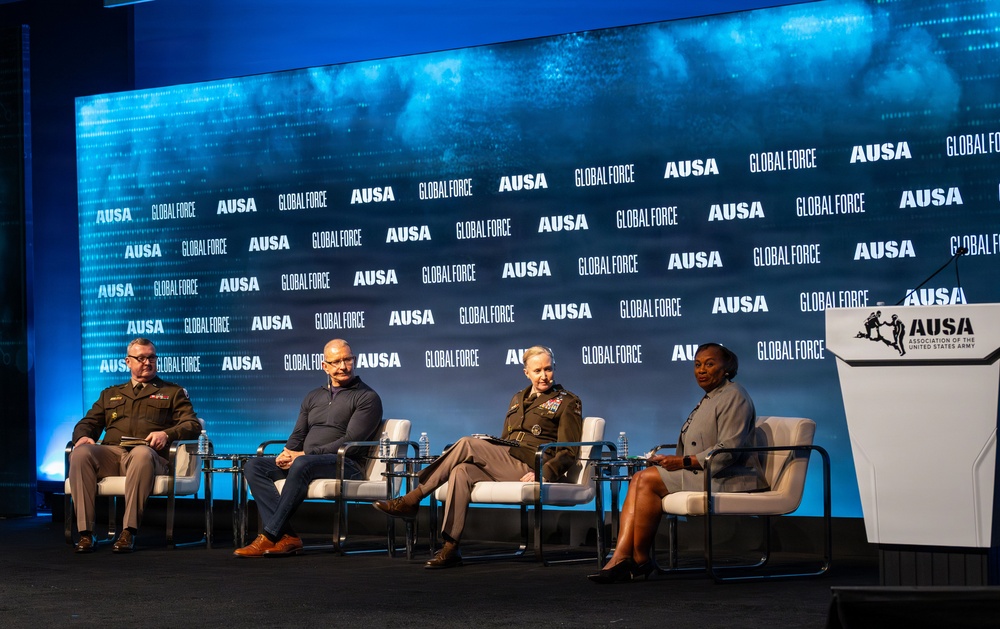
Photo By Joseph M. Lee | (From left) Maj. Gen. Eric Shirley, commanding general of Army Sustainment Command;...... read more read more
 Subscribe
HUNTSVILLE, Ala. — Army leaders and industry partners say the service is in the midst of a sweeping transformation of how Soldiers are fed on installations, calling the effort long overdue and essential to readiness.
Army leaders highlighted the irreversible momentum at the Association of the U.S. Army’s Global Force Symposium and Exposition, during a contemporary military forum on “Partnering with Industry to Revolutionize Garrison Feeding.” Senior leaders described the Army’s food modernization push as a radical break from decades of outdated systems, bureaucratic delays and limited dining options that often failed to meet Soldiers’ needs.
Retired Lt. Gen. Gwen Bingham, former Department of Army assistant chief of staff for installation management, opened the discussion by noting the significance of the shift.
“When you think about the word ‘revolutionize,’ you think about radical change,” Bingham said. “I recently visited 42 Bistro at Fort Hood. It is not my father’s mess hall — and it’s not like anything I saw in 38 years of service.”
Lt. Gen. Michelle Donahue, the Army G‑4, said the transformation began roughly two years ago but required leaders across the sustainment enterprise to confront long‑standing barriers.
“It took all of us to come together to look back in time to understand what we were doing wrong and right,” Donahue said. “We really didn’t understand how commercial industry worked.”
Donahue said the Army’s legacy systems — from menu approval processes to sourcing rules — slowed innovation to a crawl. She recalled that it once took five years to code and distribute a new 21‑day menu across the force.
Through pilots such as Campus-Style Dining Venues and Victory Fresh, Donahue said the Army has already demonstrated that commercial food service can reduce subsistence costs by 35% while improving quality.
The Army’s partnership with professional chef and author Robert Irvine, who serves as a Special Consultant to the Army, helped accelerate that shift. Irvine spent months traveling with Army leaders to study supply chains, campus dining models and commercial best practices. Known for his Food Network show “Restaurant: Impossible,” Irvine said the modernization effort has been the most meaningful project of his career.
“The guy on the TV show is the guy that shows up every day for the last three years to modernize Army feeding,” Irvine said. “It was a struggle to get to this point. Now we have to change the whole Army at a very fast pace.”
Irvine emphasized that the goal is not just better food, but better Soldiers.
“We’re proving that we get a more resilient Soldier — sleeps better, eats better, works out better, better mood,” he said. “You can buy tanks and planes, but if you don’t have people to use them, it’s useless.”
With the Army’s CSDV pilot program, the Army is now experiencing what leaders call “catastrophic success” — rapid adoption and high demand that outpaces existing capacity.
“It’s about better fueling our Soldiers. We owe it to them,” said Maj. Gen. Eric Shirley, commanding general of Army Sustainment Command. “Going to the mess hall used to be seen as an obligation. We have come light years from those days.”
ASC oversees food operations across 81 installations, including 176 dining facilities. Shirley said the Army invests more than half a billion dollars annually in its food program and is now working to expand campus‑style dining venues, Victory Fresh sites, kiosks, food trucks and meal‑prep services across the force.
With Victory Fresh at Fort Lee, Soldiers can move from the point of sale to their seats in two minutes, which Shirley calls a stark contrast to long lines and limited options of the past.
Donahue said the modernization effort also reshapes the mission of the Army’s 92G culinary specialists, allowing them to focus on field feeding rather than running garrison dining facilities.
“We can’t keep asking our 92Gs to do two jobs at once,” she said. “Their mission is greater in the field — feeding warfighters on a modern battlefield.”
By shifting garrison feeding to industry partners, she said, culinary Soldiers can train, maintain equipment and support operations in environments where large, fixed kitchens are no longer feasible.
Panelists all agreed that the Army’s food modernization effort is still in its early stages, but the momentum is undeniable.
“That’s what right looks like,” Shirley said. “It’s not Salisbury steak anymore. It’s barbecue, wood-fired pizza, Asian fusion, wraps — all prepared professionally in a world‑class setting.”
| Date Taken: | 03.30.2026 |
| Date Posted: | 03.30.2026 10:58 |
| Story ID: | 561533 |
| Location: | HUNTSVILLE, ALABAMA, US |
| Web Views: | 171 |
| Downloads: | 0 |

This work, Army highlights Army Food Program overhaul, by Samantha Tyler, identified by DVIDS, must comply with the restrictions shown on https://www.dvidshub.net/about/copyright.


No keywords found.




