
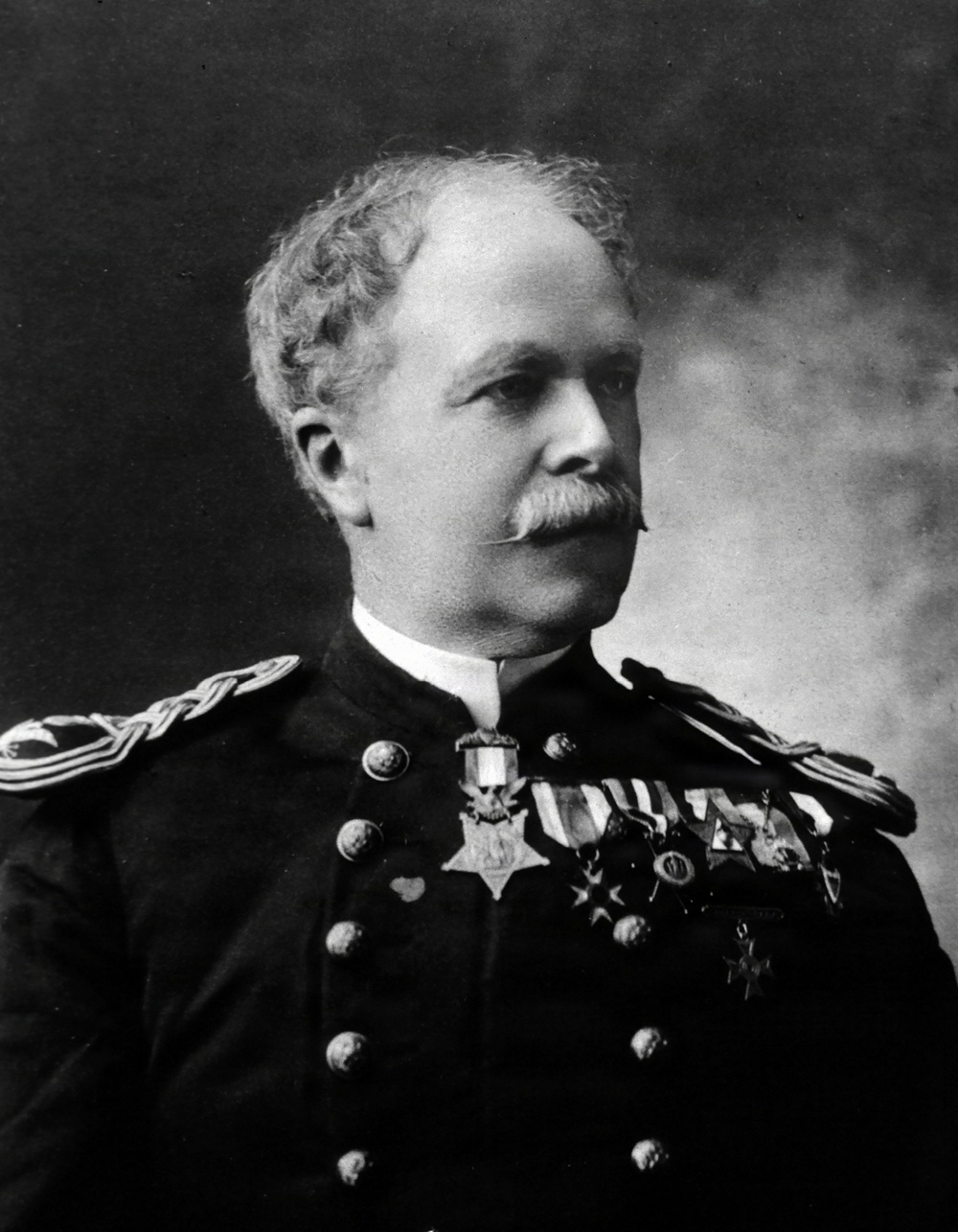
Courtesy Photo | Brig. Gen. Bernard Irwin, the namesake of Irwin Army Community Hospital, Fort Riley,...... read more read more
Irwin Army Community Hospital, Fort Riley, Kansas, is named for Brig. Gen. Bernard Irwin, who served almost four decades in frontier and wartime posts, between 1849 – 1881. Known as the “fighting doctor,” Irwin did not treat Soldiers from a safe distance — he rode on horseback into battle to reach injured service members and later brought surgical care close to the front lines during the Civil War. The hospital honors Irwin’s namesake through high-quality care for warfighters and their families.
It is fitting that Irwin, for his dedication to warfighter readiness, was chosen as the namesake of a military hospital that honors and supports the 1st Infantry Division at Fort Riley — the U.S. Army’s oldest continuously serving active duty division, and its mission of deploying “in an expeditionary manner to conduct decisive action to fight and win in complex environments as members of a joint, inter-organizational, and multinational team.”
Early years shaped approach to military medicine
Irwin was born in Ireland June 24, 1830, and his family later moved to New York City. He earned a medical degree in 1852 and joined the U.S. Army as an acting assistant surgeon in the mid-1850s, according to his biography from the U.S. Army Medical Department Center of History and Heritage. Irwin was appointed assistant surgeon in 1856 and began a career that would take him across the expanding U.S. frontier.
He served at duty posts in New Mexico and Arizona, including Fort Union, Fort Defiance, and Fort Buchanan conducting field operations, according to his biography. These remote locations forced doctors to solve problems quickly, often with limited supplies and personnel.
While stationed in the Arizona Territory early 1861, he volunteered to take command of a small relief force to aid 2nd Lt. George Bascom and his Soldiers who faced attack near Apache Pass. A story about the event from the AMEDD Center of History and Heritage cites “Irwin and his men rode mules because they had no horses, pushed through severe conditions, reached the trapped unit, and helped drive off the enemy.” The U.S. Army later awarded Irwin the Medal of Honor in 1894 for “distinguished gallantry” in that fight. He also earned his “fighting doctor” moniker from the event.
Wartime hospital care
When the Civil War began, Irwin was assigned to the U.S. Army of the Ohio as the medical director (a term that pre-dates today’s “command surgeon” title) and took part in the campaign that ended in April 1862 at the Battle of Shiloh in Tennessee. There, he organized a tent field hospital the U.S. Army called a first of its kind and “the model upon which our later field hospitals were based.” The location was a surgical station in a farmhouse that was converted into a 300-bed surgical hospital, with an operating room, dispensary, kitchen, and other support spaces, according to the National Park Service.
With the success of the field hospital at Shiloh, Irwin proved concentrating care near the battlefield improved outcomes and reduced mortality, without the need to send wounded troops far distances.
Irwin continued to serve after Shiloh in senior medical roles. His biography indicates or shows promotions during the war, later positions across the western frontier, an assignment in October 1873 to the United States Military Academy at West Point, and retirement in 1894. Congress later promoted him to brigadier general on the retired list in 1904.
Hospital honors legacy through nationally accredited care
The original Irwin Army Community Hospital was dedicated in 1958. In 2016, the legacy hospital was replaced by a new, state-of-the-art $343 million facility, built to carry Irwin’s name into the future, With 47% more space, IACH staff was better positioned to serve about 50,000 beneficiaries, which includes active duty service members, family members, and retirees.
In 2016 and 2024, IACH received the Joint Commission’s “Gold Seal of Approval” for its commitment to providing safe, high-quality patient care. The accreditation involved a four-day onsite review, assessing the performance standards such as emergency management, infection prevention, leadership, medication management, national patient safety goals, and patient rights.
The recognition was “a testament to the unwavering commitment of our staff to upholding the highest standards of safe, quality care for our warfighters and their families,” said Col. Laudino Castillo, hospital commander.
The hospital continues to honor the “fighting doctor” through nationally accredited, exemplary warfighter care, bearing the namesake of Irwin, who “gave no thought to distance, danger, or hardship in answering the many calls for his help,” according to his biography.
| Date Taken: | 03.25.2026 |
| Date Posted: | 03.25.2026 15:08 |
| Story ID: | 561309 |
| Location: | US |
| Web Views: | 26 |
| Downloads: | 0 |

This work, Hospital honors ‘Fighting doctor’ and upholds highest standards of care, by Robert Hammer, identified by DVIDS, must comply with the restrictions shown on https://www.dvidshub.net/about/copyright.

No keywords found.





