
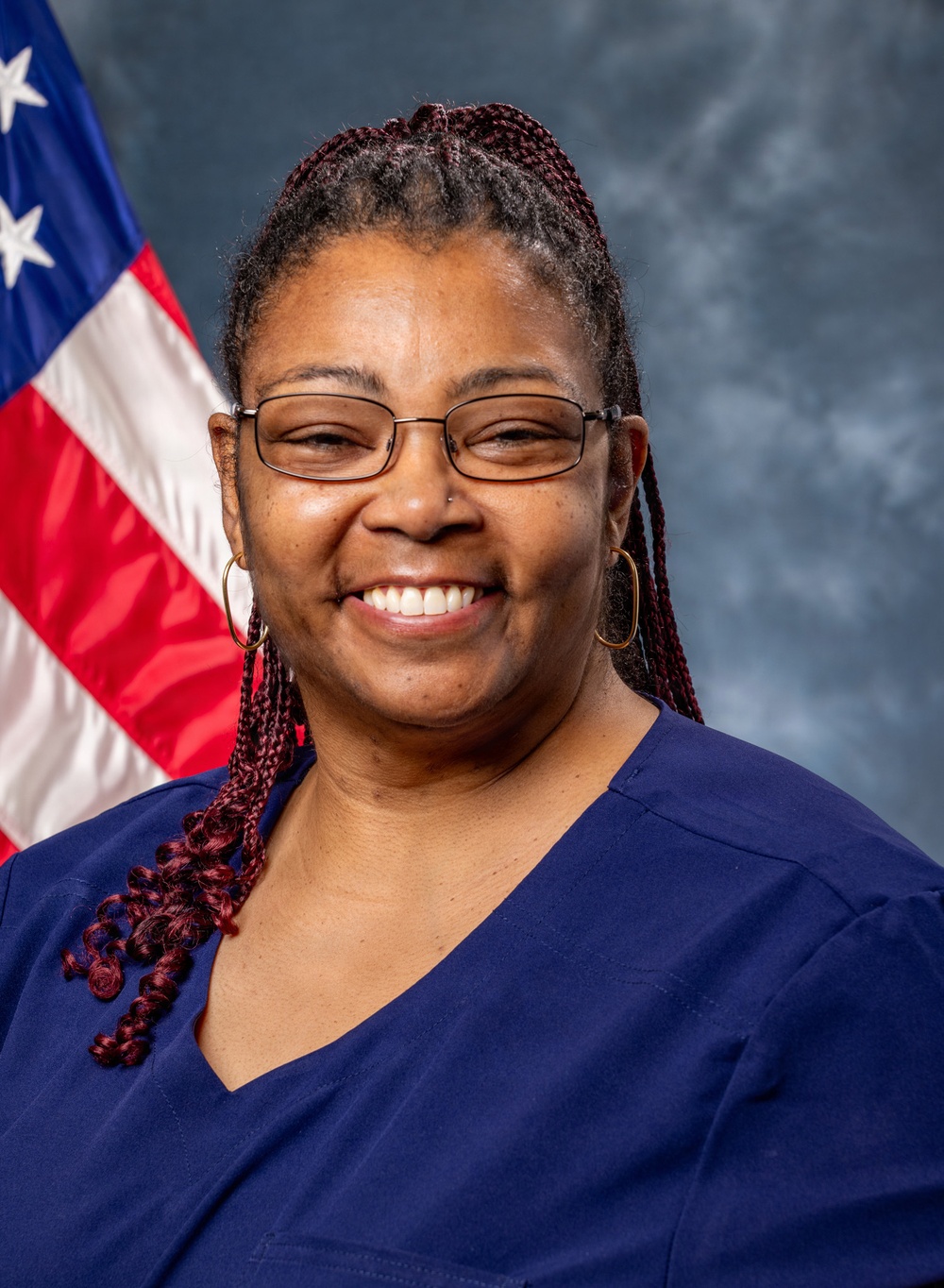
Photo By 1st Lt. Bailey Breving | Lana Hammonds joined the U.S. Army as a food service specialist in May of 1990. Eleven...... read more read more
“I can remember when I was probably about 13,” she said, recalling a discussion with an aunt who shared one regret: never enlisting in the military. “That just stuck with me. So now if I have an inkling that there’s something that I want to do, I will at least give it a try.” She was almost 19 years old when she shipped to basic training at Fort Dix, New Jersey. What followed was an 11-year career that took her across the world — Germany, Korea, Hawaii, Fort Stewart and Fort Campbell.
Hammonds joined the U.S. Army as a food service specialist in May of 1990. Almost immediately after she enlisted, Operations Desert Shield and Desert Storm began. “I thought ‘oh, my God, what did I do?’” She recalled. “I didn't come in to fight. I just wanted to go to Korea.” Like many young women entering service at the time, Hammonds was navigating not only military life, but her place within it. Her drill sergeant once asked her directly why she was there.
“My drill sergeant, she said, ‘You're not the military type. Why are you here?’”
Hammonds’ answer was simple.
“I said that I just want to go to Korea.”
In Korea, a female Non-Commissioned Officer (NCO) changed everything. Her name was Sergeant First Class Wanda Hill. In the Army, NCOs are often called the backbone of the force. They are the frontline leaders who train, mentor, and develop soldiers day-in and day-out. While officers may set the broader vision, it is the NCOs who translate that vision into action and who quietly shape whether a young soldier believes they belong. “That NCO, she was one of the main reasons that I stayed in,” Hammonds reflected. Representation mattered. Seeing women lead, mentor, and model resilience reinforced that she belonged. “All the females that I served with, all the NCOs that I had, they gave me the leadership and the drive to believe I could do it as a woman.” Because she carried both her aunt’s early lesson to at least “give it a try,” and the steady influence of SFC Hill who believed in her, she learned to trust her instincts to confidently step forward when opportunity presented itself. One day in Hawaii, while Hammonds was working to prepare food for several units conducting a range day, an unexpected opportunity walked in the dining facility. The general of the visiting units came to collect food items, and while he waited, in typical officer fashion,he struckup conversation with Hammonds and her team. Impressed with the way she was managing the busy dining facility, he half-jokingly offered her a job opportunity working for him. Remembering the mantra that had served her so well through life, she thought, let’s give it a try.
She got the job.
“I started working as a stewardess on the general's aircraft. Wherever he went, we went,” she said.
The unique assignment took her to Guam, Japan, Nepal, Australia, and Alaska. Places she never imagined visiting when she first enlisted, let alone flying in style.
“I didn't realize the benefits of how one decision like enlisting in the Army would make on my life now,” Hammonds recalled.
Today, Hammonds serves as an advanced medical support assistant with home-based primary care at VA Tennessee Valley Healthcare System (TVHS).
When asked what military service gave her, her answer was immediate.
“The biggest thing is it gave me was my work ethic.”
That ethic shows in the way she serves Veterans today, many of whom are older and homebound. Some Veterans calling her just to talk.
“If they're at home by themselves, they don’t have anybody there,” she said. “So, whether I can help solve their appointment needs or just be a source of connection, I'm always here if they need me.”
Her approach is simple.
“Call me,” she said. “If I can’t help you, I will find someone who can help get us what we need.”
Hammonds is also a VA patient herself. Her belief in the system is deeply personal.
“If it hadn't been for my time in the service and the quality of care that I can get with the VA, I wouldn't have made it through a lot of life.”
She acknowledges that some women still feel hesitant about seeking VA care, but she has also witnessed meaningful change. Hammonds says VA has taken significant steps to better support women Veterans through expanded tools, resources, and health care services.
“I see the progress every day. Now when I walk through the hospital, there are lactation rooms for women to enter and breastfeed their children. That wasn’t a thing when I first started coming to the VA.”
Her observation reflects a broader shift across VA. Women are one of the fastest-growing Veteran populations in the country, with more than 2 million women Veterans nationwide. As that population grows, VA has continued expanding comprehensive women’s health services, including primary care and mental health.
At VA TVHS, that commitment is reflected in specialized support such as dedicated breast care coordinators,pelvic health services, and otherresources designed to ensure women Veterans can receive personalized care close to home.
Her advice to women considering enrolling in VA health care, or even military service, echoes the lesson she learned from her aunt years ago:“I would say give it a shot, because you never know what doors are going to be open to you.” For Hammonds, one women's regret became her opportunity. Eleven years in uniform opened doors she never expected, and today, she holds doors open for others.
| Date Taken: | 03.06.2026 |
| Date Posted: | 03.25.2026 12:14 |
| Story ID: | 561288 |
| Location: | NASHVILLE, TENNESSEE, US |
| Web Views: | 44 |
| Downloads: | 0 |

This work, My Mantra: “Give it a try”, by 1LT Bailey Breving, identified by DVIDS, must comply with the restrictions shown on https://www.dvidshub.net/about/copyright.

No keywords found.





