
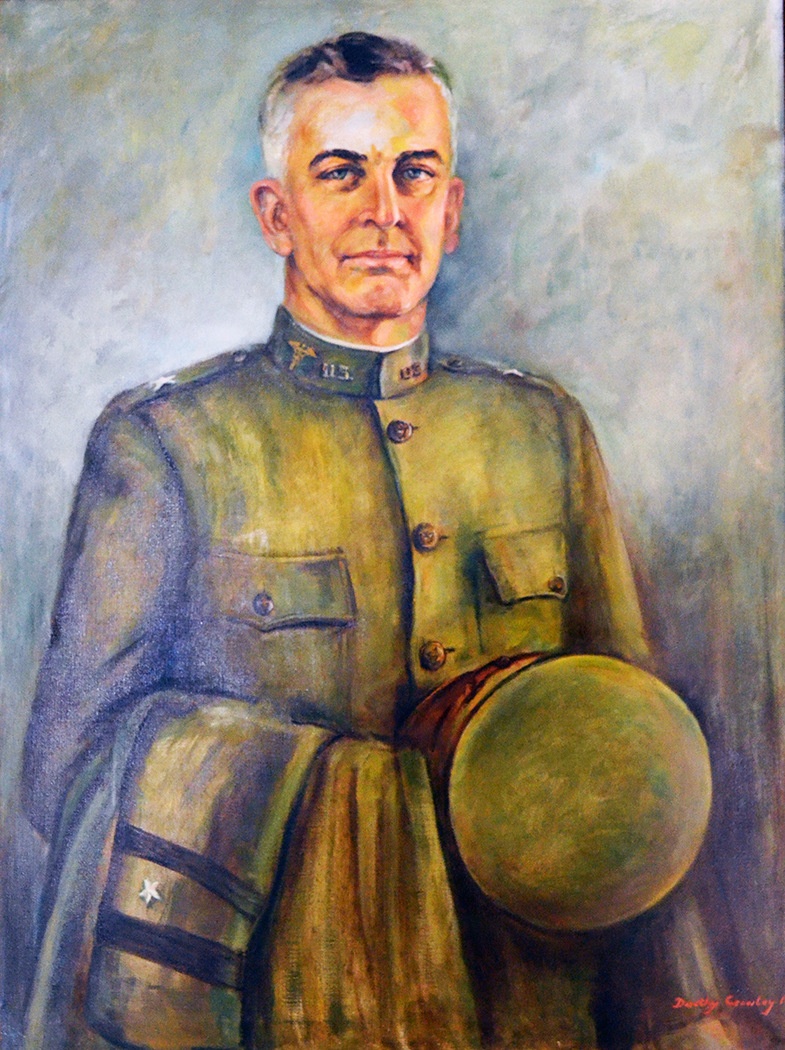
Photo By Janet A. Aker | Brig Gen (Dr.) Theodore Charles Lyster, Father of Aviation Medicine... read more read more
Before the U.S. Air Force was established in 1947, the U.S. Army owned the skies.
The ground and air personnel had various designations going back to 1918.
From 1926-1947, it was the U.S. Army Air Forces, which was preceded by the U.S. Army Air Corps during World War I. It was the Air Corps that had command and control of aerial combat. Brig. Gen. Theodore Lyster, a U.S. Army physician, pioneered aviation medicine and physical standards for pilots and crews in the run-up to and participation of America in World War I. He was selected to be the U.S. Army’s first flight surgeon and became known as the “Father of Aviation Medicine” for his work with pilots.
Lyster, the namesake of Lyster Army Health Clinic on Fort Rucker, Alabama, had a simple reason for keeping pilots and their air and flight line crews in top health and always medically ready for action.
“It is one thing to build machines and train men to fly them, but another to maintain these men and machines in the air by the constant supervision necessary,” Lyster said, according to the clinic’s history. “This is a far-reaching problem, which is imminently involved in the evolution of the Air Service and largely falls upon the medical service to keep these fliers at their greatest efficiency."
Role in first aviator physical standards
After the start of WW I on July 28, 2014 — amid a growing sense the U.S. would be drawn into the conflict — the Army Surgeon General’s office decided to create appropriate physical standards for aviators, according to a 1935 article titled, “On the early history of aviation medicine” written by a Medical Reserve Corps officer, 1st Lt. William Wilmer, an ophthalmologist and colleague of Lyster’s. Flight was such a recent capability that little was known about the physical and psychological reactions pilots would face in wartime.
The U.S. entered the Great War on April 6, 1917. In May 1917, then-Col. Lyster was put in charge of all U.S. aviator physicals. Medical examiners used a short form (Form 609) of 34 standardized questions and sub-categories to look at every possible recruit for a whole-body analysis of their health. The exams included:
“Efficiency and ultimate economy were the controlling influences, from a physical standpoint, in determining the selection of personnel for training for fliers,” according to a chapter written by Lyster in a 1923 government book on WW I medical care.
Four months later, Lyster was designated as the first chief surgeon, Aviation Section, Signal Corps, U.S. Army. On Oct. 18, 1917, Lyster established the Medical Research Board at Hazelhurst Field, Mineola, New York, to:
According to the Wilmer article, Lyster realized the “importance of visual and vestibular function,” and “the appropriate psychological profile in the novice aviator.”
In late October 1917, Lyster and his team sailed to France on a medical fact-finding mission.
The doctors had long conversations with U.S. aviators at the front lines and immediately noticed they were losing weight and in poor physical and, often poor mental, condition. Their morale was low.
Accident rates were high, with three times as many pilots dying from accidents as from enemy action, according to retired Air Force Maj. Gen. (Dr.) Harry Armstrong, another pioneer of aviation medicine, in his 1952 book, “The Principles and Practices of Aerospace Medicine.” Armstrong was the U.S. Air Force Surgeon General in the early 1950’s. He also served as the 8th Air Force surgeon during World War II and the commandant of the School of Aviation Medicine at Randolph Field, Texas.
Medical officers underdiagnosed pilot health problems because they didn’t have the training to recognize them. And pilots had to clear all medical visits with their commanders.
Role of the flight surgeon
To address these issues, Lyster created the flight surgeon, a doctor who had the sole duty of caring for pilots, according to his September 1918 article titled “The Aviation Service of the Medical Department of the Army.” This new type of medical officer had a team of college-recruited athletic physical trainers who coached pilots in everything from down time to diet.
Flight surgeons had to have extensive knowledge of the Lyster-team developed aviation physical examination, have post-graduate training in aviation medicine, be able to communicate authoritatively to the commanding officer, and “command the confidence of the pilots, so they would instinctively come to him with their difficulties,” Lyster wrote in the 1923 War Department history.
With the implementation of flight surgeons, the death rate went down even when the number of pilot flying hours increased, according to a 1920 U.S. government book titled “Aviation Medicine in the A.E.F.”
Fort Rucker’s aviation activities, Lyster services today
Fort Rucker is the primary flight training installation for the U.S. Army Aviation branch, established in 1983, and is the home of the U.S. Army Aviation Center of Excellence.
In 2023, Lyster ACH established the Aviation Medicine Clinic to provide medical care to aviators and their crews. By 2024, the clinic completed on average 3,500 student physicals and over 5,500 flight physicals per year. And in 2024, the clinic earned the Army Surgeon General’s Wolf Pack Award “for exceptional teamwork in improving clinical operations in primary care and establishing an Aviation Medicine Clinic.”
The hospital is accredited by The Joint Commission with its Gold Seal of Approval for its quality health care management and safety. Lyster provides primary care, mental health care, pharmacy services, OB-GYN, pediatrics, and specialty services, including optometry, and physical therapy to around 17,500 direct, enrolled patients.
During a visit by Lyster’s great grandson in December 2025, Lt. Col. Leah Steder, Lyster commander said, “Maintaining the medical fitness of our aviators is complex, and we’re committed to upholding the standards of excellence that Brig. Gen. Lyster embodied, and ensuring our aviators are medically ready to fly. Our care keeps them in the air.”
| Date Taken: | 01.01.2026 |
| Date Posted: | 03.23.2026 14:02 |
| Story ID: | 561120 |
| Location: | US |
| Web Views: | 85 |
| Downloads: | 1 |

This work, ‘Father of Aviation Medicine’ Lyster Army Health Clinic keeps warfighters ready to fly, by Janet A. Aker, identified by DVIDS, must comply with the restrictions shown on https://www.dvidshub.net/about/copyright.


No keywords found.





