
Courtesy Photo | As a fight tonight force, the Marine Corps must maintain constant readiness. Nothing...... read more read more
 Subscribe
COAST GUARD TRAINING CENTER YORKTOWN, Va. -- As a fight tonight force, the Marine Corps must maintain constant readiness. Nothing embodies Marine Corps readiness more than a three-ship Amphibious Ready Group / Marine Expeditionary Unit (ARG/MEU) with an embarked Marine Air Ground Task Force (MAGTF). Capable of a wide array of missions, a forward-deployed ARG/MEU relies on its access and placement to provide a combatant commander with a multitude of options that span the spectrum of conflict. In order to sustain these forward-deployed capabilities, self-sufficiency is vital to the readiness of an ARG/MEU. Marines at Marine Forces Command are seeking creative training solutions to sustain self-sufficiency at sea, reinforcing an ARG/MEU’s persistent presence.
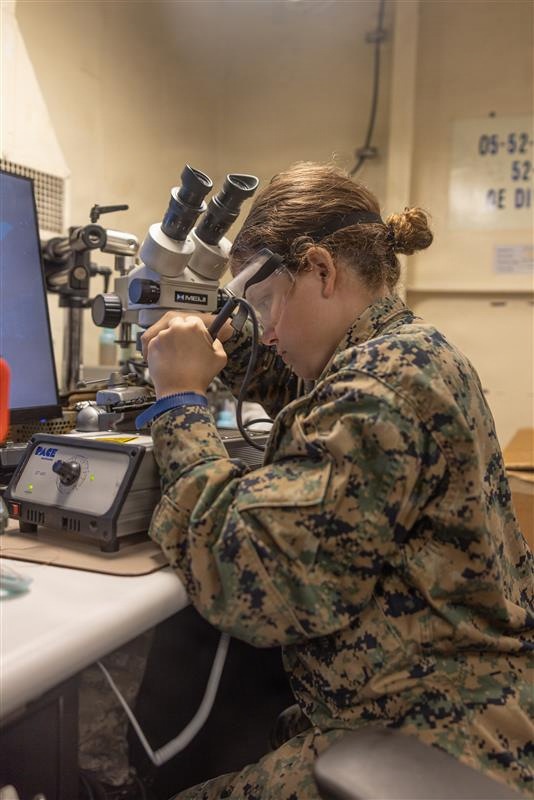
Recently, the United States Marine Corps and Coast Guard celebrated a historical achievement as two Marines graduated the U.S. Coast Guard’s (USCG) Miniature and Micro-Miniature (2M) Electronic Repair Course held at Coast Guard Training Center, Yorktown, Virginia.
U.S. Marine Corps Corporals Timothy Cowden, ground electronics transmission systems maintainer, Marine Corps Security Force Regiment, and Quenlyn Shaver, ground electronics systems repairer, 2d Amphibious Assault Battalion, attended the U.S. Coast Guard’s advanced electronics repair course where they gained advanced expertise of electronic maintenance to extend equipment longevity at sea and reduce reliance on external repair facilities.
“Imagine a future where a deployed MEU has access to a shared inventory of common repair components aboard ship,” said Chief Warrant Officer 2 Steven Bernstein, ground equipment and readiness manager, Marine Forces Command. “That’s the goal: a seamless, at-sea sustainment ecosystem.”
For decades, advanced electronics repair for an embarked MEU was confined to the Combat Logistics Battalion's (CLB) maintenance shop, typically located on a single amphibious ship. If a critical system failed on one of the other two ships in the ARG, getting it repaired was a significant logistical challenge. Marines would have to transport unserviceable equipment to an intermediate or depot-level facility for repair when small electronic components fail.
Through completion of this rigorous training by the U.S. Coast Guard, Marines received a Naval Undersea Warfare Center (NUWC) certification. The NUWC certification is the joint-service standard for electronics repair. This 2M certification enables these Marines to be placed anywhere across the three-ship ARG, independent of the CLB’s maintenance shop, conducting repairs on Marine Corps and Navy equipment within Navy maintenance shops.
“It's a night-and-day difference for a MEU,” said Bernstein. “Right now, if a key radio system or vehicle component fails, they might have to wait weeks for a replacement. A MEU with a certified 2M technician can potentially resolve that issue in hours.”
The two Marines are the first to attend the course, but leadership in the electronic maintenance community looks forward to sending more Marines. Having this joint-certified training, Marines can board any amphibious ship and sustain the readiness of mission critical equipment. According to Bernstein, when we all speak a common language of maintenance, we can create a truly integrated maintenance capability, thereby making the entire naval force more resilient. “Because of the certification, I was the first Marine authorized to integrate into the 2M lab aboard a naval ship and even assist them with their repairs,” said Cpl. Shaver. "It wasn't just about using their space; it was about being part of their team. Back at my unit, this skill saves us weeks or months of waiting for depot-level support, but out here, it means we can keep the mission going."
In addition to strengthening the Marine Corps’ ability to adapt, innovate, and remain effective in an increasingly technology-driven battlespace, having this training will likely reduce expenses for repairs. “When you look at the Navy’s 2M program, which uses the same joint standard we're advocating for, they've documented over $840 million in cost avoidance over a 24-year period,” explained Bernstein. “That number represents thousands of pieces of gear that were fixed at the source instead of being shipped away.”
The independence brought through the completion of this course supports Marine Corps Force Design by enhancing the ability to accomplish missions with limited external dependence. “This training creates technicians who can sustain the force ‘from within’, right at the tactical edge,” stated Bernstein. “It reduces our logistical signature and empowers a small, distributed unit to maintain its own equipment in a contested environment. This is Force Design in action.”
The graduation of two Marines from the Coast Guard’s 2M Electronic Repair Course represents more than a historic first—it underscores the Marine Corps’ commitment to Force Design modernization. By developing structured, at-sea electronic repair capabilities through interservice training, the Marine Corps increases expeditionary sustainment, reduces reliance on external support, and enhances readiness in contested maritime environments. This milestone demonstrates how integrated partnerships and technical self-sufficiency directly support Force Design objectives, bringing the Marine Corps closer to a future of distributed, resilient, and lethal naval operations.
| Date Taken: | 03.20.2026 |
| Date Posted: | 03.24.2026 10:17 |
| Story ID: | 561023 |
| Location: | YORKTOWN, VIRGINIA, US |
| Web Views: | 164 |
| Downloads: | 0 |

This work, Marines Strengthen Joint Force Through Coast Guard Electronics Training, by Cpl Yolanda Lightfoot, identified by DVIDS, must comply with the restrictions shown on https://www.dvidshub.net/about/copyright.


No keywords found.




