
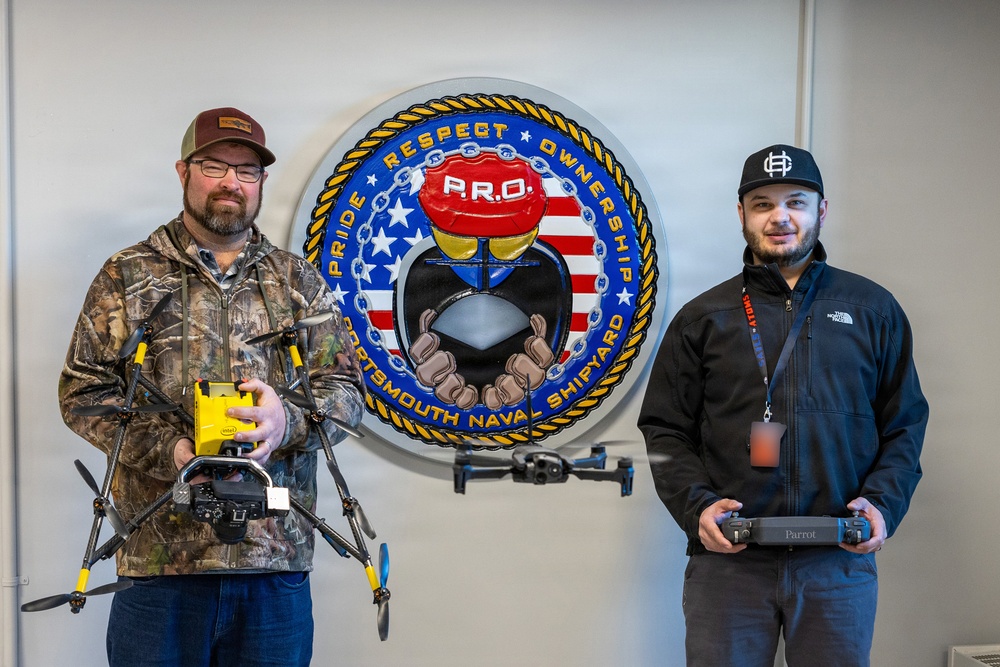
Photo By Neil Boorjian | KITTERY, Maine (Mar. 3, 2026) — Nate Redden, left, and Jeremy Edwards, both...... read more read more
As shipyard maintenance increasingly relies on advanced technology to improve execution, the innovation team at Portsmouth Naval Shipyard is leading efforts to integrate these capabilities into shipyard operations.
Over the past few years, the innovation team — which operates under the Production Resources Department’s Process Improvement Office — has collaborated with other public shipyards to pursue safer, more efficient work processes. In the past six months, the team has acquired advanced technologies and conducted tests to put those efforts into action.
To date, the team has explored the use of Unmanned Underwater Vehicles (UUV), Unmanned Aerial Systems (UAS), and advanced livestream capabilities to optimize processes from dry dock inspections to cross-shipyard collaboration.
In late summer 2025, the innovation team collaborated with the PNSY Dry Dock Engineering Department — responsible for dry dock management, maintenance and certifications — to test the use of UUVs in underwater inspections.
“The engineers were looking for a solution that would provide more detailed, real-time insights into the condition of submerged infrastructure, while minimizing the risks associated with traditional diving,” said James Weyand, mechanical engineer.
The tests, which used a UUV borrowed from the team’s innovation partners at Norfolk Naval Shipyard (NNSY), demonstrated the technology’s ability to reach difficult areas, provide real-time data, reduce operational disruption, and improve personnel safety.
As UUVS were demonstrating their functionality in underwater environments, the innovation team was simultaneously advancing the implementation of UAS for crane inspections on the shipyard.
The first approved UAS test and evaluation flights were conducted over the PNSY softball field in October 2025 with a UAS given to the innovation team by their NNSY partners. Representatives from the Lifting and Handling Department joined the innovation team to observe firsthand how the technology could improve execution during lifting and handling evolutions and help to mitigate risks to personnel.
“UAS [could] revolutionize crane maintenance, and other key areas by offering quicker, safer, and more data‑rich capabilities,” said Jeremy Edwards, innovation specialist. “[Implementing UAS] allows for real‑time visual data, improving the identification of issues such as corrosion or structural stress long before they become costly repairs.”
Following the successful tests flights, the team gained practical insight into the utility of UAS in crane inspections. “We successfully conducted a flight to inspect Portal Crane 31 in December 2025,” said Edwards. “We were able to collect data that was helpful to the Lifting and Handling Department in assessing the crane.”
In parallel with deploying advanced technologies in shipyard operations, the innovation team worked to enhance enterprise-wide communication by exploring advanced livestream capabilities to facilitate clear, real-time communication across shipyards.
In October, a production shop identified a mechanical component as out of specification and required input from off-yard subject matter experts at Naval Sea Systems Command’s Naval Systems Engineering Directorate (NAVSEA 05) and General Dynamics Electric Boat. The innovation team contributed network-connected camera-enabled tablets to connect all parties in a virtual meeting — the first of its kind for the shipyard.
“Communicating technical issues, even simple ones, can be challenging. Sketches and text often fall short,” said David Hawk, innovation specialist. “Most issues require in-person dialogue with context. Network-connected cameras provide the visual context and interaction we’d otherwise only get face-to-face.”
The combined work of the innovation team directly supports Shipyard Commander’s Line of Effort to drive innovation and ensure the delivery of practical, effective solutions that strengthen mission execution in support of the fleet. Testing and integrating new technologies into shipyard operations helps maintain the intellectual edge that underpins maritime advantage and supports the fleet’s ability to deter, fight and win.
| Date Taken: | 03.04.2026 |
| Date Posted: | 03.19.2026 14:22 |
| Story ID: | 560944 |
| Location: | KITTERY, MAINE, US |
| Web Views: | 341 |
| Downloads: | 0 |

This work, Testing Tomorrow: Innovation Through Advanced Technologies, by Hanna Lanoie, identified by DVIDS, must comply with the restrictions shown on https://www.dvidshub.net/about/copyright.

No keywords found.





