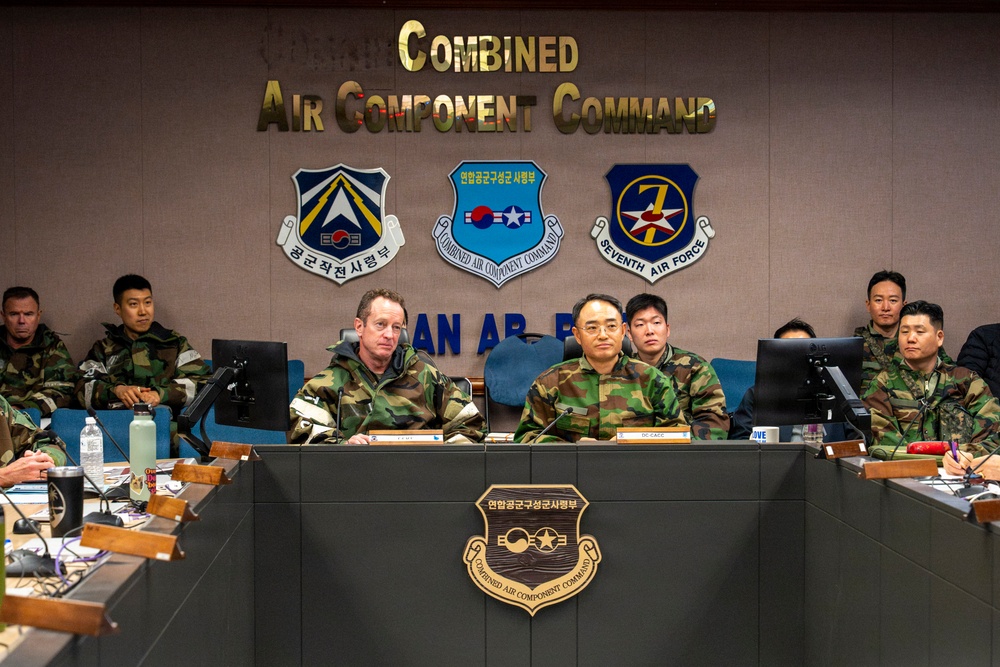
Photo By Senior Airman Brenden Beezley | U.S. Air Force Lt. Gen. David Iverson, center left, Seventh Air Force and Combined Air Component Command commander, and Republic of Korea air force Lt. Gen. Jun Sun Cha, center right, ROK Air Force Operations Command and CACC deputy commander, host a meeting during exercise Freedom Shield 26 at Osan Air Base, Republic of Korea, March 13, 2026. The CACC integrates U.S. and ROK airpower to plan, direct and execute combined air operations across the Korean Peninsula. (U.S. Air Force photo by Senior Airman Brenden Beezley) see less
| View Image Page
Distributed operations enable Seventh Air Force to sustain airpower during Freedom Shield 26
OSAN AIR BASE, Republic of Korea — During exercise Freedom Shield 26, the Seventh Air Force tested its ability to command and control airpower in the event its primary Air Operations Center is no longer available, forcing personnel and capabilities to operate from multiple dispersed locations.
Known as distributed operations, this approach allows the AOC to continue planning, directing and executing airpower across the theater even when personnel and systems are physically separated in contested environments.
“In this exercise, we are practicing what happens in a wartime scenario where the AOC is no longer usable and we still have to get the job done somewhere else,” said U.S. Air Force Capt. Kathleen Dickerson, Seventh Air Force A1 manpower, personnel and services deputy director. “This exercise gives us an opportunity to practice doing that in new ways.”
Previous exercises have focused on relocating operations to a designated alternate AOC. During FS26, planners expanded that approach by testing a distributed operations model that spread personnel and capabilities across several facilities, forcing teams to operate while separated from their normal workspaces and, in many cases, their existing support networks.
“In the past we’ve gone to an alternate AOC, and at this point we know how to do that,” Dickerson said. “This time we wanted to show we could set up somewhere else entirely and still operate.”
Executing this capability required significant communications planning to ensure teams operating in separate locations could still access mission systems and maintain connectivity required to coordinate air operations.
“When we started capturing requirements for the exercise, there was no time for additional procurement, so we had to work with what we already had on hand,” said Master Sgt. Luke Long, 607th Air Communications Squadron operations support division. “That meant using existing resources to enable the combined battle staff and Seventh Air Force to continue planning, executing and disseminating the air tasking orders from dispersed locations, relying solely on communications capabilities.”
The communications preparation also required coordination beyond U.S. systems alone, as teams worked through their Republic of Korea counterparts to identify requirements and ensure systems and capabilities were aligned across dispersed sites.
Supporting that combined environment required more than basic network access. Long explained that some locations needed both U.S. and ROK systems and additional communications support for combined workflows, while differences in how each side installs and manages systems added another layer of complexity.
“We had to account for both U.S. and ROK systems at some of these locations, which meant coordinating requirements and making sure everything was in place to support how both sides operate,” Long said. “Even simple things like printers or how systems are installed can be different, so we had to plan for that as we built out each site.”
In a distributed environment, that coordination becomes essential. Long said teams must rely entirely on communications systems to share information, synchronize actions and maintain alignment across multiple locations without the benefit of face-to-face interaction, making reliable connectivity critical to sustaining command and control.
By testing distributed operations during major combined exercises like Freedom Shield, the Seventh Air Force can identify limitations, refine procedures and strengthen its ability to command and control airpower in contested environments, reinforcing the combined defense posture on the Korean Peninsula.
“As long as we can still produce the products we need and get the information to the commander so he can make decisions, that will be a success,” said Dickerson. “If everyone walks away with at least one lesson learned that improves the process next time, then the exercise did its job.”