
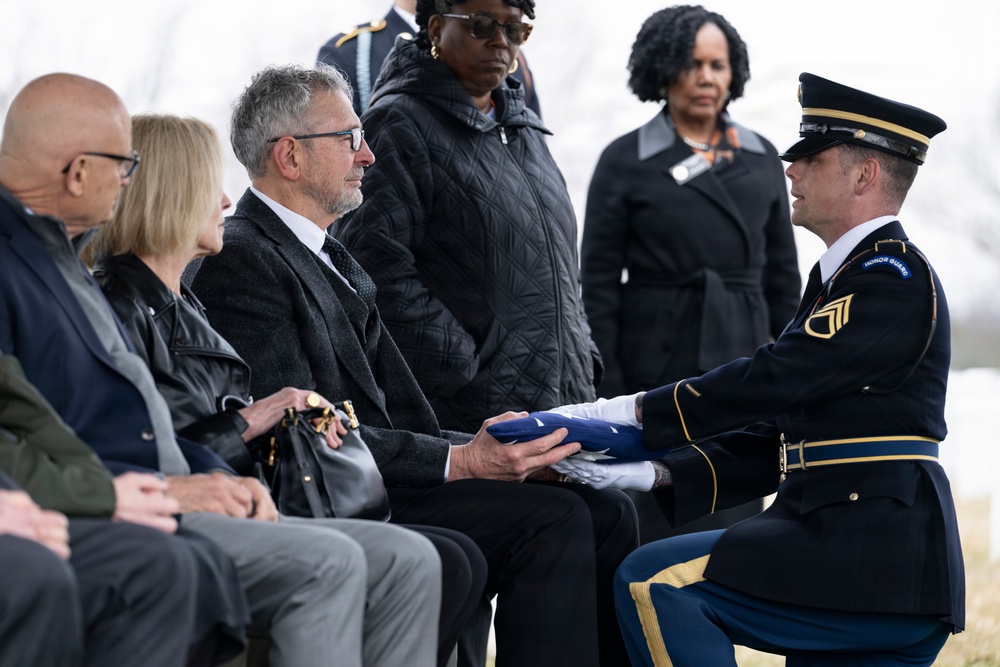
Photo By Elizabeth Fraser | John Pecorark is presented with the U.S. flag from the funeral service for his father,...... read more read more
 Subscribe
On a cold night in Anzio, Italy, in 1944, U.S. Army Cpl. Thaddeus Pecorak was too tired to dig a foxhole, so he crawled under an American tank and fell asleep. When he woke up the next morning, the tank’s belly was touching his nose. The tank had sunk in the mud overnight, forcing Pecorak to wiggle himself out from underneath. “If it was real super-wet ground I wouldn’t be sitting here today,” he recalledin a 2017 Veterans of Foreign Wars (VFW) interview about his experiences in World War II. “I doubt anybody would have heard me under that tank.”
Pecorak, who fought as an armored infantryman with the 1st Armored Division, died on March 15, 2024, at age 101. His children gathered at Arlington National Cemetery on March 6, 2026, to say goodbye to both him and their mother, Phyllis Ann Pecorak, who passed away in 2013. The two were inurned together.
Pecorak joined the 1st Armored during the last months of 1943, as the Allies fought to capture Rome. Italy, once part of the Axis Powers, had been knocked out of the war, but the Allies continued to fight north through the country to relieve German pressure on the Soviet Union (then a member of the Allies). When Pecorak reached his new squad near Mount Porchia, west of Rome, he was made a machine gunner and soon helped repel several enemy attacks. He recalled bullets ricocheting off rocks and wounding soldiers. “More men were wounded by rock chips than they were by bullets,” he told the VFW interviewer. “That was my baptism of fire.”
Allied commanders decided that, with the German army blocking the way south and east of Rome, they would launch an amphibious attack behind enemy lines at the port city of Anzio, southeast of Rome. The maneuver should have led to an easy capture of Rome, but the Germans counterattacked and surrounded the Anzio beachhead for almost five months.
The 1st Armored came ashore on Jan. 28, 1944, six days after the initial amphibious assault, and Pecorak spent his days fighting around Anzio’s perimeter. Because the area was so small, “the Germans couldn’t fire a round or drop a bomb and not hit something,” he recalled. He covered the infantry with his machine gun, blew up barbed wire fences and survived artillery barrages. He also lost friends to enemy fire and suffered his own injuries, particularly when a church roof collapsed on him while he was taking cover from German fire.
Once the Allies broke out of Anzio, Pecorak took part in the liberation of Rome on June 4, 1944. He finished the war as an artilleryman before returning home, where he used the GI Bill to attend the University of New Hampshire. There, he met and fell in love with Phyllis, a fellow student. They married and had three children: John, Thaddeus and Susan.
Yet the war stayed with Pecorak. For at least five years into their marriage, he noted in the VFW interview, Phyllis had to wake him up to stop his nightmares about combat.
As the Pecoraks grew into their later years, Phyllis was moved to an assisted living home, where he visited her daily. “He really, really tried to take care of her,” his son John said. After Phyllis passed away in 2013, Pecorak told his daughter Susan that he wanted to be buried at Arlington National Cemetery, considering it the most honorable place to rest. He also chose a joint urn made of New Hampshire granite to honor Phyllis’s home state.
At the funeral service in Section 70, U.S. Army Chaplain (Capt.) Raymond Akeriwe recited prayers and told Pecorak’s collected family that their father and grandfather had faithfully served his nation. When John accepted the flag that had been tightly folded over his parents’ urn, he felt an overwhelming feeling of honor and pride. “My dad was part of the greatest generation who defended our country and made it so that I can enjoy the freedoms that I've been able to enjoy,” he later said.
When the service ended, Pecorak’s grandson, Thaddeus Pecorak, carried his grandparents’ urn to the columbarium. A cemetery official placed the urn in the niche as family members hugged each other and cried. John later said he especially appreciated his father’s service after he learned the details of what his father had experienced. “My dad gave up an awful lot,” John concluded. “I think people who were never in the armed services have no idea how much is being done for them by those who serve.”
**Learn More:**Explore our Education Program materials on World War II, including lesson plans and readings that feature oral histories.
| Date Taken: | 03.17.2026 |
| Date Posted: | 03.17.2026 09:37 |
| Story ID: | 560706 |
| Location: | ARLINGTON, VIRGINIA, US |
| Web Views: | 141 |
| Downloads: | 0 |

This work, U.S. Army Soldier Fought to Liberate Rome During World War II, by Kevin Hymel, identified by DVIDS, must comply with the restrictions shown on https://www.dvidshub.net/about/copyright.


No keywords found.




