
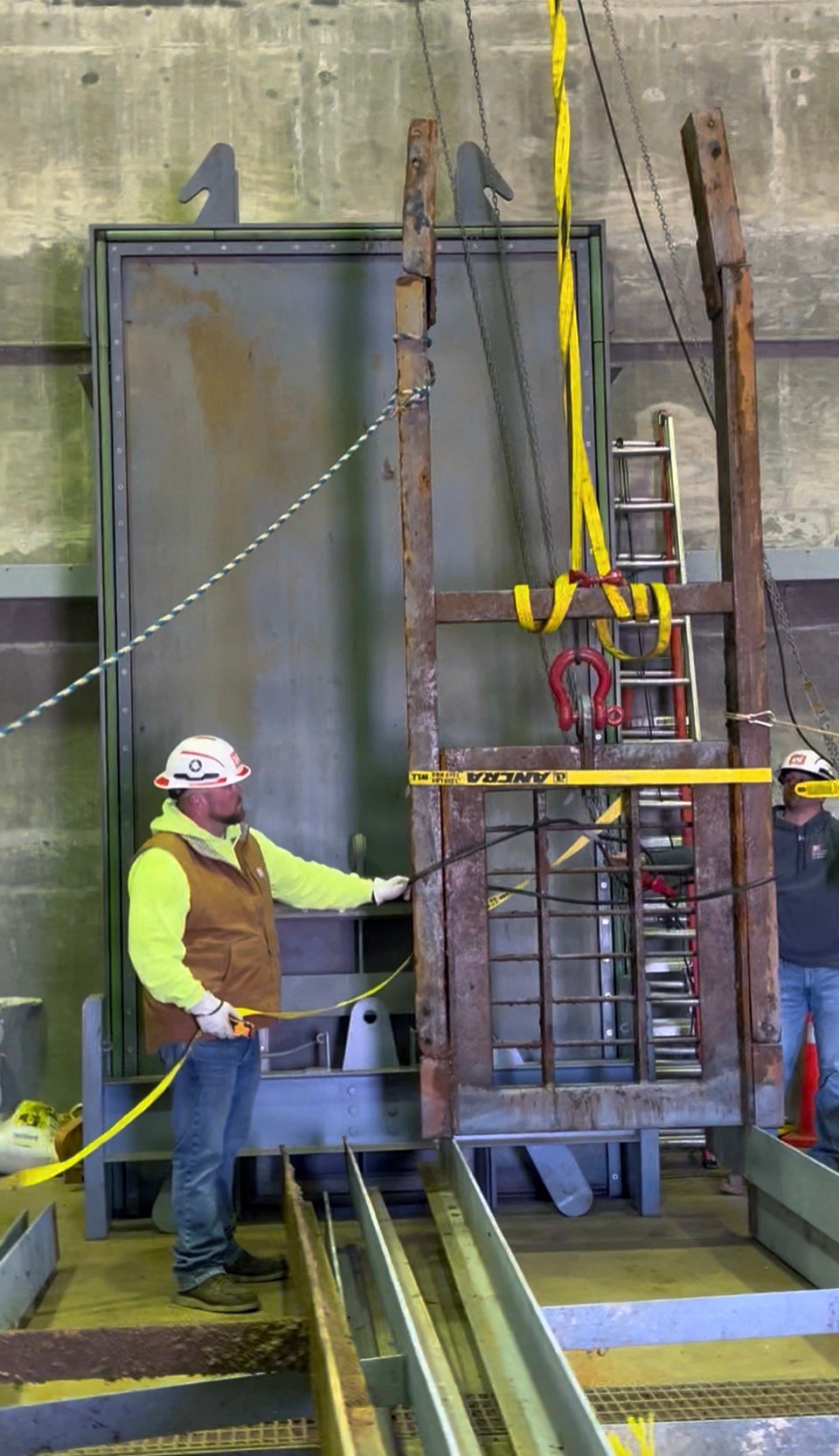
Photo By Stacey Reese | Kody Jenkins, civil engineering technician, U.S. Army Corps of Engineers, Tulsa...... read more read more
TULSA, Okla. —The U.S. Army Corps of Engineers, Tulsa District, and a team of divers removed a portion of a damaged trash rack during a specialized underwater operation at Arcadia Lake in Oklahoma March 6.
In preparation for an upcoming gate replacement, Tulsa District employees needed to remove trash racks from the structure. These metal barriers prevent debris from entering the structure’s system. Multiple trash racks protect the inlets and are staggered at different heights, allowing the system to continue functioning as lake levels rise and fall. The project marked the first time the trash racks have been physically removed from the structure, as they are normally inspected remotely during periodic inspections.
“During previous inspections, we identified corrosion that had weakened the bolts,” said Kody Jenkins, civil engineering technician, Tulsa District. “Over time, corrosion had thinned the bolts to the point they could no longer hold the trash rack together.”
Because of the complexity and risk associated with underwater operations, safety planning played a central role in the project.
“When a diver goes into the water, the entire team plays a role in their safety,” said Greg Snider, industrial hygienist, Tulsa District. “From reviewing the plan ahead of time to maintaining communication throughout the operation, every step is focused on protecting the diver and the crew supporting the work.”
Allen Hood, Northern area engineer, Tulsa District and dive safety inspector for this project, led a comprehensive safety briefing before the dive. The briefing covered the structure’s operation, the gates’ function, lockout/tagout procedures and how pressure equalization ensures diver safety.
The dive team reviewed the structure’s layout to understand the relationship between the gates and trash racks before the diver entered the water. Because the other trash racks had been successfully removed, they also had an opportunity to gain firsthand knowledge of the rack structure. Following the meeting, USACE personnel and the dive team verified the lockout/tagout protocols, a safety procedure using locks and warning tags to prevent equipment from being energized during maintenance, were in place to ensure the system was fully secured. According to Snider the team follows a simple principle when conducting underwater dive projects.
“We follow the plan the dive, dive the plan philosophy,” said Snider. “When conditions changed due to high winds, we had to shift the operation from a boat-based dive to diving from the bank. Any change to the dive plan requires formal approval to make sure every detail is reviewed, and the safety of the diver remains the top priority.”
Underwater visibility at the site was extremely limited, requiring the diver to rely on touch to locate and work with the equipment.
“When visibility is low, we rely on our hands to find what we are looking for,” said Jaime Velasquez, dive team member. “We wear protective gloves because there can be sharp edges or other hazards we can’t see when feeling along the structure and equipment.”
Once the diver located the equipment, he attached a wire rope to an eye on the rack, allowing Jenkins to lift it from the water using a crane. Coordination between USACE and the City of Edmond also ensured the dive could be completed efficiently.
“The dive was scheduled while the City of Edmond’s water treatment personnel were already performing maintenance,” said Ashley Ayers, assistant lake manager for Arcadia Lake. “By coordinating the work, we were able to complete the dive without creating a need for additional downtime for the facility.”
Arcadia Lake is a reservoir located in northeastern Oklahoma County, northeast of Oklahoma City and east of Edmond. Construction on the dam began Oct. 15, 1980, and the project became operational in November 1986. The conservation pool was filled on May 28, 1987.
The lake was constructed as a cooperative effort between the City of Edmond and the U.S. Army Corps of Engineers. Today, Arcadia Lake plays an important role in managing flooding in the Deep Fork River Basin, supplying water to the City of Edmond and providing recreational opportunities for surrounding communities.
| Date Taken: | 03.11.2026 |
| Date Posted: | 03.13.2026 16:21 |
| Story ID: | 560540 |
| Location: | OKLAHOMA, US |
| Web Views: | 220 |
| Downloads: | 0 |

This work, Divers help remove damaged trash rack at Arcadia Lake, by Stacey Reese, identified by DVIDS, must comply with the restrictions shown on https://www.dvidshub.net/about/copyright.


No keywords found.





