
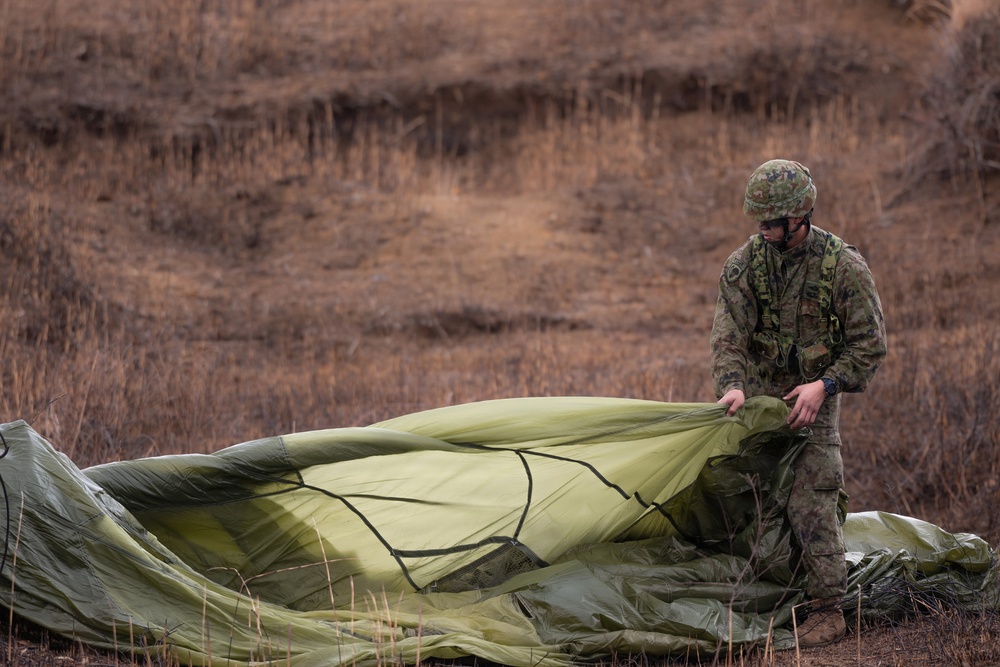
Photo By Airman 1st Class David S. Calcote | A Japan Ground Self-Defense Force paratrooper assigned to the 1st Airborne Brigade...... read more read more
 Subscribe
YOKOTA AIR BASE, Japan -- U.S. Air Force and U.S. Marine Corps C-130Js integrated with the Japan Ground Self-Defense Force 1st Airborne Brigade during Airborne 26 at JGSDF East Fuji Maneuver Area, Japan, March 2–4, 2026. Airborne 26 is the largest annual static-line personnel jump and airdrop exercise conducted between the USAF and the JGSDF. The training strengthens joint airborne operations capabilities and enhances coordination between U.S. aircrews and Japanese paratroopers.
During Airborne 26, five USAF C-130J Super Hercules aircraft from the 36th Airlift Squadron and one USMC KC-130J from Marine Aerial Refueler Transport Squadron 152 (VMGR-152) operated from Yokota Air Base to insert approximately 180 JGSDF 1st AbnB paratroopers and deliver approximately 70 container delivery system bundles during daytime and nighttime airdrop operations.
“This exercise highlights the level of coordination required between aircrews and paratroopers to safely execute large-scale airborne operations,” said U.S. Air Force Capt. Jason Katsar, 36th Airlift Squadron mission commander. “Training with our JGSDF partners helps refine our procedures and strengthens our ability to conduct joint airborne missions.”
Airborne 26 focused on improving interoperability and operational readiness through combined personnel insertion and cargo airdrop operations. The training required detailed coordination to ensure proper equipment preparation, safety inspections and drop procedures prior to flight.
The coordinated flight operations demonstrated the ability of U.S. and Japanese forces to plan, load and execute large-scale personnel drops, highlighting the close integration required between aircrews and ground personnel to safely deliver paratroopers and cargo during airborne operations.
“Working with our Japanese and U.S. Air Force partners is critical because security and stability in the region is a shared responsibility,” said U.S. Marine Corps Capt. Samantha Webb-Martin, VMGR-152 KC-130J pilot. “Training together strengthens our ability to operate as a combined team and ensures we are ready to respond quickly and effectively when a crisis arises.”
Additional participating units included the U.S. Army’s 358th Civil Affairs Brigade, which provided jumpmasters; the 353rd Special Operations Wing, supporting jumpmaster and drop zone control operations; and III Marine Expeditionary Force, which provided air mobility liaison officers.
“Participating in this exercise strengthened my confidence in the KC-130J’s ability to contribute to larger joint force operations on a moment’s notice,” said Webb-Martin.
| Date Taken: | 03.01.2026 |
| Date Posted: | 03.14.2026 04:30 |
| Story ID: | 560456 |
| Location: | JP |
| Web Views: | 160 |
| Downloads: | 0 |

This work, U.S., Japan strengthen joint airborne operations during Airborne 26, by A1C David S. Calcote, identified by DVIDS, must comply with the restrictions shown on https://www.dvidshub.net/about/copyright.


No keywords found.




