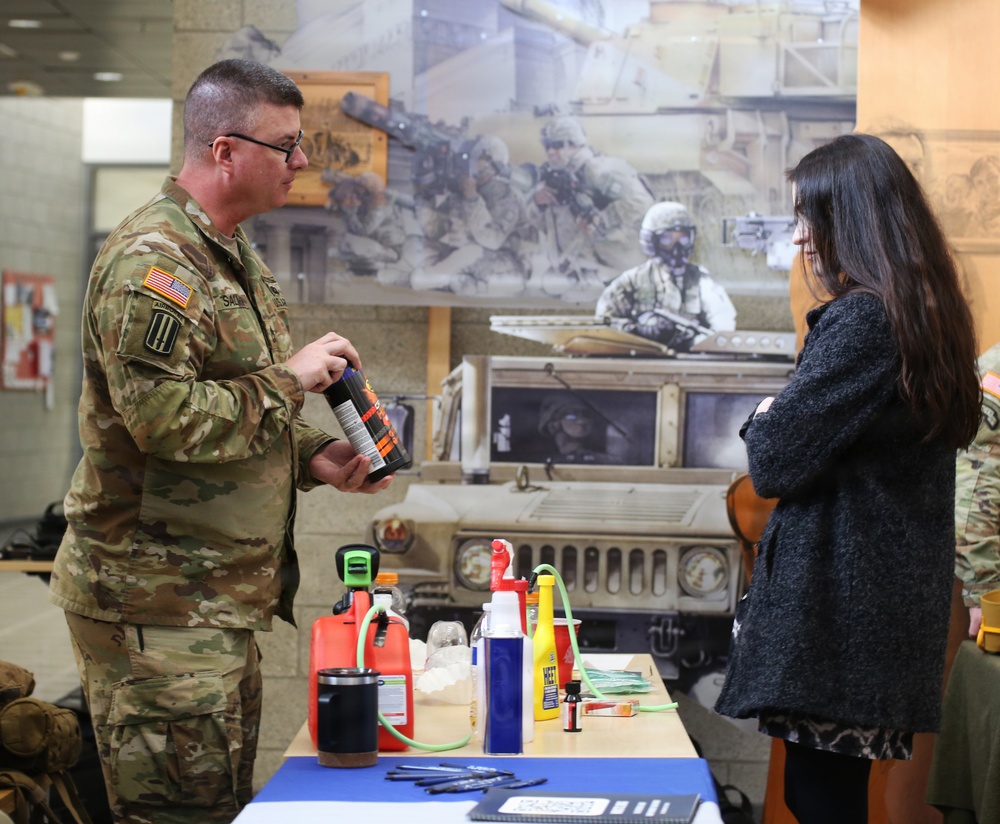
Photo By Joseph Siemandel | Sgt. 1st Class Scott Salmon, illicit substances instructor at the Western Regional Counterdrug Training Center talks with an attendee at the 2026 Tribal Police Leadership & Counterdrug Conference March 10, 2026, at the Thurston County Readiness Center, Tumwater, Wash. (U.S. National Guard photo by Joseph Siemandel) see less
| View Image Page
Washington National Guard Hosts Annual Tribal Police Leadership & Counterdrug Conference
With a focus on increasing public safety and reducing the availability of illegal drugs in Washington Tribes, the Washington National Guard’s Counterdrug Program held its annual Tribal Police Leadership & Counterdrug Conference March 10–11, 2026, at the Thurston County Readiness Center in Tumwater, Wash.
“This brings the tribal chiefs of police together with our counterdrug team to brief them on the resources we can bring to the fight on drug enforcement and strengthen connections with the Attorney General’s office and other partners,” said Chief Warrant Officer 4 Bill Elliott, tribal liaison with the Washington Military Department and organizer of the event. “What started as a one-time event has now become annual, with funding from the Tribal Opioid Task Force so it costs the Guard nothing to participate.”
Leaders from the Washington National Guard Counterdrug Program joined tribal, state, and federal law enforcement for two days of collaboration, information sharing, and professional development aimed at strengthening counterdrug efforts and public safety in tribal communities. The conference also addressed cross-jurisdictional coordination and explored training and policy initiatives impacting tribal law enforcement.
The opioid and illegal drug crisis continues to disproportionately affect Washington Tribes. While statewide overdose numbers began to decline slightly in early 2024, American Indian and Alaska Native (AI/AN) communities still face the highest rates of drug-induced fatalities in the state—158 per 100,000 residents, nearly four times higher than the state average.
“Most tribes have limited resources, so events like this are a godsend,” said Elliott. “They learn about available resources like aviation support for large areas such as Colville and Yakima, and training that can be delivered regionally despite limited budgets.”
Col. Craig Broyles, commander of the Washington National Guard Counterdrug Program, opened the conference highlighting the importance of partnerships.
“We are committed to supporting each other through this crisis, and we always have room to improve,” Broyles said. “Our goal is to provide the best support possible, especially as we combat the opioid and fentanyl crisis impacting families and communities across our state.”
Throughout the two days, guest speakers emphasized collaboration between tribal nations and federal, state, and local agencies. Subject matter experts provided updates on operational resources, including intelligence, analytical, and investigative support. Presentations also covered unmanned aerial systems for law enforcement, counter-UAS considerations, and regional intelligence resources through the Washington State Fusion Center and the FBI.
Washington State Attorney General Nick Brown encouraged tribal leaders to leverage his office’s resources.
“Events like these help strengthen ties and support safety in our tribal communities,” Brown said. “We want to be part of the solution, so please reach out to our office.”
Afternoon sessions explored prosecutorial and operational perspectives. U.S. Attorney’s Office representatives reviewed federal drug prosecution guidelines affecting tribal jurisdictions, while the Northwest High Intensity Drug Trafficking Area program shared current trafficking trends and prevention strategies. The Tulalip Tribal Police Department concluded the day with a case study on complex drug investigations.
Sgt. 1st Class Scott Salmon, illicit substances instructor at the Western Regional Counterdrug Training Center, highlighted the educational value of the event. “We teach law enforcement about safety and hazard mitigation around synthetic opioids and clandestine drug environments. Conferences like these help tribes with their counterdrug efforts and provide opportunities to generate leads and instructional outreach.”
On the second day, discussions broadened to public safety initiatives, legislative developments, and national programs supporting AMBER Alert in Indian Country. Bureau of Indian Affairs representatives highlighted cross-deputation authorities, funding, and programs for tribal policing, while experts addressed Missing and Murdered Indigenous Persons (MMIP) initiatives and cold case support.
Professional development opportunities were also highlighted, including Federal Law Enforcement Training Centers programs and key legislative frameworks like the Tribal Warrants Act, Tribal Law and Order Act, and the proposed Tribal Law Enforcement Parity Act.
Throughout the conference, leaders emphasized that effective counterdrug operations rely on sustained partnerships, shared intelligence, and access to modern training and resources. The event provided a forum for tribal law enforcement to exchange best practices, build professional networks, and develop collaborative solutions.
By the end of the two-day conference, participants had strengthened relationships across agencies and reaffirmed their commitment to protecting tribal communities and disrupting drug trafficking networks.
“We are here together, united in this fight, with the shared goal of supporting each other in tackling this crisis,” said Broyles. “I look forward to our continued work together.”

 Subscribe






