
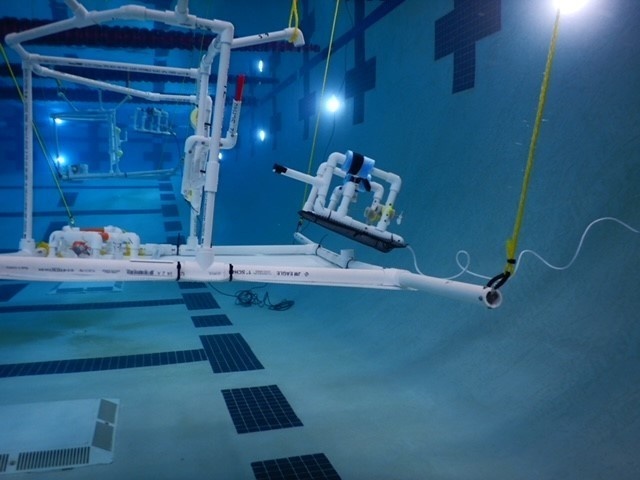
Photo By Stacia Courtney | An underwater look at unmanned robots created by local students. The teams competing...... read more read more
Every year, technology becomes increasingly complex, introducing an array of new capabilities that once were a mere pipe dream. Low-cost materials like Polyvinyl Chloride (PVC) pipe – among other things – are now part of science and engineering projects building the knowledge for today’s revolutionary ideas to be the technology of the future for U.S. Navy Sea Cadets sponsored by Strategic Systems Programs.
SeaPerch, an innovative underwater robotics program that guides students, teachers, and parents to build their own Remotely Operated Vehicle (ROV), serves as a key resource for teaching K-12 students basic engineering design principles. William “Ryan” Brown, a general engineer at one of SSP’s Program Management Offices, recently advocated to bring this hands-on activity to a group of Sea Cadets he mentors.
Sea Cadets are high school students – part of the United States Naval Sea Cadet Corps – who participate in maritime activities and exercises at Navy installations. According to the Sea Cadets webpage, these prospective Sailors learn the highest ideals of honor, respect, commitment, and service. Brown, whose son is a Sea Cadet, said exposing students to engineering design challenges like SeaPerch may ignite interest in potential science, technology, engineering, and mathematics (STEM) careers as an active duty servicemember or as a civilian.
“I like that this is a Navy-sponsored program,” Brown said. “The kids show up to drill wearing their Navy uniforms and do everything the way a Sailor would. By incorporating these STEM projects into their military experience, it gives them an inside look at what could be done in a STEM career field or, more specifically, an engineering career field. We hope, by doing these kinds of projects, that it gives these kids insight into what it takes to be an engineer and to see that this profession is available in the Navy as an active-duty member or in a civilian role.”
To kickstart the Sea Cadets’ SeaPerch project, Brown submitted a funding proposal through SSP’s STEM Outreach Office to acquire supplies in February 2025.
“We bought five SeaPerch ROV kits and three SeaPerch toolkits,” he said. “Then we bought some Drive Pack kits, which gives us more flexibility to modify the frames and other features on the ROV. When we meet, we put aside two hours of out of our ‘drill day’ to work on these kits. So far, the kids have been able to build their frames and are almost finished with their controller assembly. They are now starting to work on the propulsion system.”
Assembling a ROV isn’t so simple, so teaching the cadets how to build and operate their SeaPerch device with dexterity is another priority for the mentors.
“I think it’s been a great experience for the kids,” Brown said. “They’re soldering – which before we did this project, I never did any soldering. We have them using a bunch of different tools that they’ve never been exposed to and, so far, the feedback has been positive – their experience has been positive.”
While Brown serves as the lead in guiding the Sea Cadets through their assembly of SeaPerch, he is supported by adult volunteers from other private and public organizations, including local school teachers. Brown said he’s appreciated the community around building the ROVs and praised the various expertise the kids can rely on to problem-solve any technical or assembly issues they encounter.
As the Sea Cadets inch closer to completing their machine, their next major milestone will be to test it in the water.
“We’re hoping to test our devices in the summer,” Brown said. “There might be an opportunity to create a mini obstacle course and have the five teams – currently building their SeaPerch – compete against each other.”
In the Spring, Brown and his fellow volunteers will look for a test site. The aspiring Sailors will have the chance to not only drive their tethered ROV machines through an obstacle course, but will also have to think fast – and critically – to troubleshoot any mishaps on the day of the competition.
Unmanned vehicles and ROVs, in particular, are part of specialized technologies that have enabled the U.S. Navy to conduct mission-critical operations at sea while protecting the warfighter on the frontlines. As these technologies continue to intertwine with the defense sector, teaching the next generation of STEM professionals how to build, leverage, and advance these capabilities is imperative for maintaining a dominant maritime presence.
SSP is responsible for sustaining the strategic weapon system (SWS) on the Ohio-class ballistic missile submarines (SSBN) and supporting the integration of the D5LE weapon system on the new Columbia-class SSBNs. Looking to the future, SSP is actively modernizing the sea-based leg of the nuclear triad through the development of the D5LE2 SWS and pioneering regional strike capabilities of the future through development of the nuclear-armed sea launched cruise missile (SLCM-N) and the non-nuclear hypersonic conventional prompt strike system (CPS).
| Date Taken: | 03.10.2026 |
| Date Posted: | 03.10.2026 15:09 |
| Story ID: | 560226 |
| Location: | US |
| Web Views: | 129 |
| Downloads: | 0 |

This work, Strategic Systems Programs Leads U.S. Navy Sea Cadets in Underwater Robotics Program, by Edvin Hernandez, identified by DVIDS, must comply with the restrictions shown on https://www.dvidshub.net/about/copyright.


No keywords found.





