
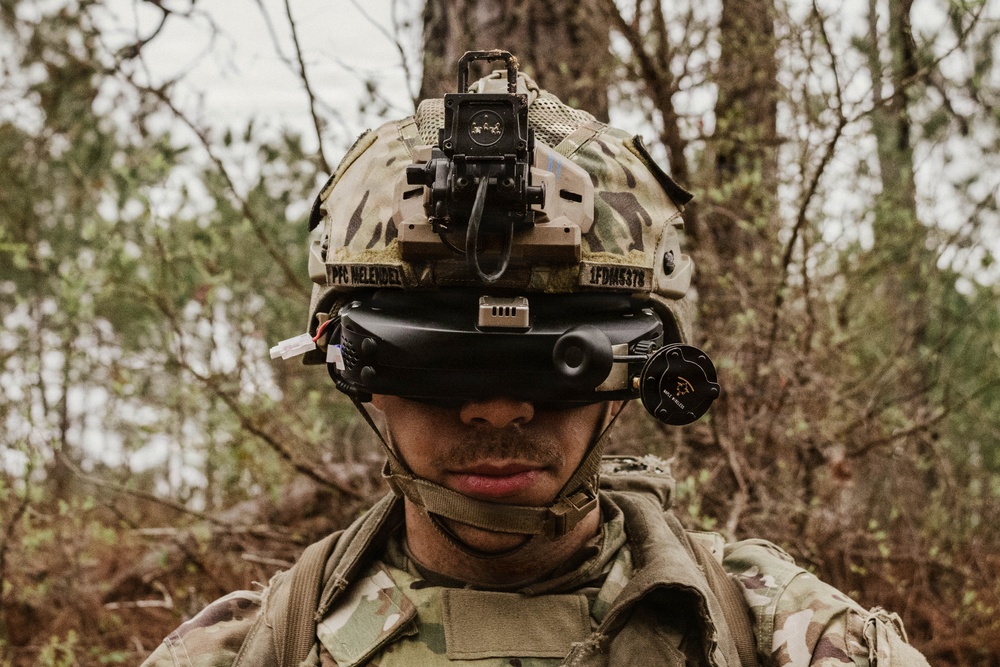
Photo By Sgt. Andrew Clark | Spc. Demetrius Melendez, a paratrooper assigned to 3rd Brigade Combat Team, 82nd...... read more read more
 Subscribe
FORT POLK, La. - The 3rd Brigade Combat Team, 82nd Airborne Division, began a training rotation at the Joint Readiness Training Center with an emphasis on the Army’s Transforming in Contact initiative at Fort Polk, Louisiana, on March 9, 2026. Since 2024, the Transforming in Contact initiative, or TiC, has been adapting the way Army organizations experiment, innovate, and train with new technologies and tactics necessary to succeed on the modern battlefield. The initiative focuses on making operational units the drivers of modernization in combat.
TiC integrates new technologies by placing emerging capabilities directly into the hands of operational units so they can test and refine their use in real-world training. These technologies range from the creation of new, complex tactical communications architecture, to infantry squad vehicles, advanced electronic warfare measures, and unmanned aerial systems (UAS) and counter-UAS capabilities.
One of the key technologies being used in 3BCT’s TiC integration are UAS produced in conjunction with the Army’s new SkyFoundry program. Led by Army Material Command, and alongside industry partners, the SkyFoundry program allows the service to rapidly develop, test, and produce small drones on a massive scale. Eventually, the intent is that every squad can be issued a UAS system.
“I think all unmanned systems have a place on the combat zone, not only to do reconnaissance, but to actually execute missions and execute strikes,” Staff Sgt. Oliver Cantu, an unmanned aircraft systems operator and instructor assigned to the 3rd Brigade Combat Team, 82nd Airborne Division, said. “I believe each squad, each scout platoon, they're all going to have small unmanned aerial systems to support their mission.”
The process of technological integration now begins with rapid field testing through deployment with units that are training in combat training centers. These units then evaluate and adjust usage in real-time. During the current JRTC rotation, 3BCT focused on implementing live-fire exercises with the Switchblade 600 loitering munition system and the Orqa first person view drone.
“Soldiers are always adapting and they're always trying to challenge themselves to make the new best thing for counter-reconnaissance and for reconnaissance,” Spc. Landon Stone, an infantryman assigned to the 3rd Brigade Combat Team, 82nd Airborne Division, said. “It’s helping increase our lethality. We're able to save many lives and save Soldiers from having to take out targets themselves and put themselves in harm's way when we can do it from behind our lines and do it more efficiently.”
TiC reaffirms the Army’s commitment to rapid technological adaptation and continuous transformation based on data emerging from contemporary conflicts around the globe. By introducing new technologies to units conducting field training, both the systems and the units receive vital hands-on data on how the technology and the Soldiers operating those systems will perform in real-world scenarios. This feedback and information can then be scaled out to other units across the force.
The 82nd Airborne Division, known as an immediate response force, can be expected to deploy and fight anywhere in the world within an 18-hour window. Training and integrating with emerging technologies is a vital component to the 82nd Airborne Division maintaining its lethal fighting edge.
| Date Taken: | 03.09.2026 |
| Date Posted: | 03.09.2026 15:28 |
| Story ID: | 559890 |
| Location: | FORT JOHNSON, LOUISIANA, US |
| Web Views: | 1,021 |
| Downloads: | 0 |

This work, JRTC 26-05 Tranformation in Contact, by SGT Andrew Clark, identified by DVIDS, must comply with the restrictions shown on https://www.dvidshub.net/about/copyright.


No keywords found.




