
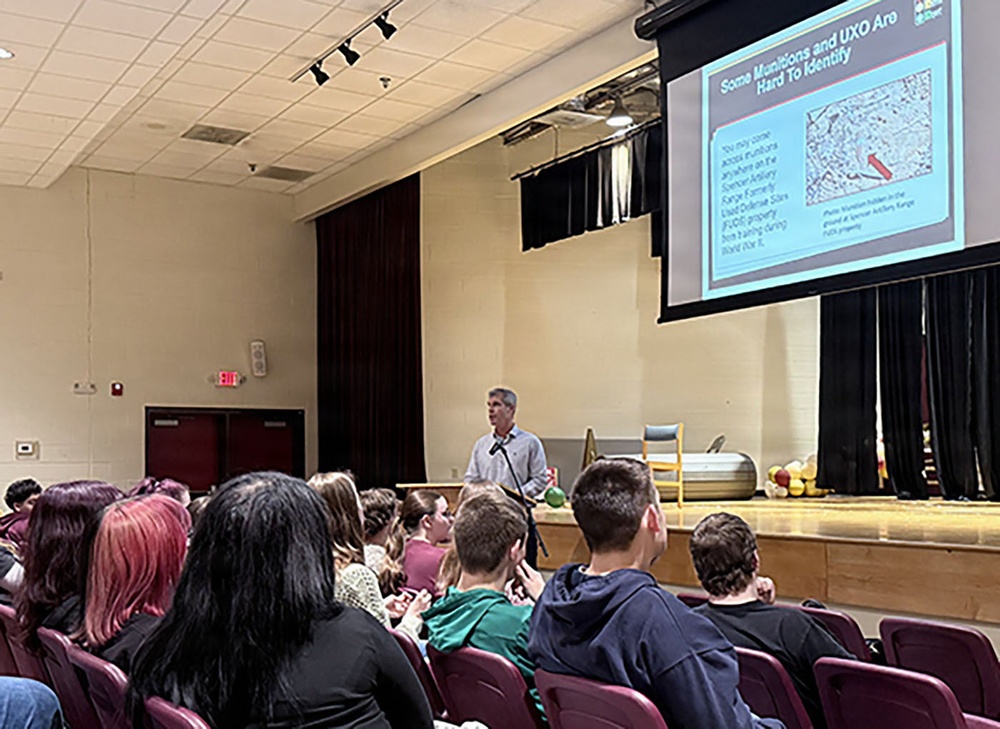
Photo By Cheri Dragos-Pritchard | Ray Livermore, U.S. Army Corps of Engineers, Wilmington District environmental...... read more read more
Students living by Formerly Used Defense Site area learn the 3Rs
By* Cheri Dragos-Pritchard, Corporate Communications Savannah District, U.S. Army Corps of Engineers*
The U.S. Army Corps of Engineers, Savannah District, manages the Formerly Used Defense Sites (FUDS) Program across seven states, and part of that mission is to educate the communities by FUDS properties about what to do if they come across unexploded ordnances.
Recently, Ray Livermore, an environmental engineer from the Wilmington District, who provides technical support for the Savannah District FUDS Program, taught the 3Rs of Explosives Safety to approximately 350 Van Buren County middle and high school students who live near the Spencer Artillery Range FUDS property in Spencer, Tennessee.
The 3Rs training teaches people what steps they need to take to remain safe when they come across an unexploded ordnance. If something that looks like a munition is encountered, Recognize that it may be a munition and could be dangerous; Retreat by not touching, moving, or disturbing it and carefully leaving the area while noting the location; and Report it to local law enforcement by calling 911.
“This training is an important part of the FUDS Program,” Livermore explained. “Although the land where the Spencer Artillery Range was located is very rural, and any munitions left behind are 80 plus years old, there could still be unexploded ordnances out there, and those could pose a serious risk if handled.”
The Spencer Artillery Range FUDS property encompasses 30,618 acres in three different counties close to McMinnville and Spencer, Tennessee. The property served as the main artillery range for Camp Forrest from 1941 until 1944. Troop training included the use of anti-aircraft guns, mortars, anti-tank rockets, target rockets and various sizes of artillery rounds.
“Staying safe is far more important than taking home a souvenir,” Livermore explained during his presentation. “The incidents I’ve talked to you about today are proof. Please don’t disturb anything that could possibly be an unexploded munition of any type.”
Approximately 25 years ago, while on the FUDS property, a logging crew found an eight-inch explosive projectile and not too long after that a boy found a 37mm projectile and took it to his home. The projectile exploded two years later and severely injured the boy. Currently, all land within the Spencer Artillery Range FUDS property is privately owned, except for the Trail of Tears National Historic Trail and public rights of way.
“As the Coordinated School Health Director for Van Buren County, I felt this would be a valuable learning opportunity for our middle and high school students because many of them spend time outdoors coon hunting, deer hunting, turkey hunting, riding four-wheelers, and hiking,” said Kelly Lewis. “Teaching them the 3Rs of Explosives Safety -- Recognize, Retreat, and Report, would give them practical knowledge on how to respond safely if they ever encounter something dangerous while in the woods or exploring outdoor areas.”
The determination process
The Corps of Engineers conducted a Remedial Investigation (RI) to find what munitions and explosives of concern (MEC) as well as munitions constituents were left at the Spencer Artillery Range FUDS property, where they're located and how risky they are to people.
Munitions constituents are chemical substances left behind by unexploded ordnances, military munitions, or residues from training, including explosives, propellants, and degradation products.
The investigative actions included the use of geophysical equipment on paths called transects and grids (square or rectangular areas of various sizes) to map metallic objects in the ground. The RI report was finalized and the results concluded that MEC items are potentially present and pose an explosive hazard to people and the environment, but there were no unacceptable risks identified or associated with munitions constituents.
After the RI, a proposed plan that identified a preferred remedial alternative for the seven projects within the Spencer Artillery Range FUDS property was made available to the public for comments. After considering public comments, remedial actions were selected for each project. For Project 01, it is educational awareness and the installation of warning signs. For Projects 03 through 08, the selected remedial actions involve geophysical investigations, MEC removal and educational awareness.
| Date Taken: | 03.06.2026 |
| Date Posted: | 03.06.2026 15:02 |
| Story ID: | 559568 |
| Location: | SPENCER, TENNESSEE, US |
| Web Views: | 76 |
| Downloads: | 1 |

This work, Students living by Formerly Used Defense Site area learn the 3Rs, by Cheri Dragos-Pritchard, identified by DVIDS, must comply with the restrictions shown on https://www.dvidshub.net/about/copyright.

No keywords found.





