
Courtesy Photo | R2 Performance Centers provide customized performance and resilience training and...... read more read more
 Subscribe
FORT BRAGG, N.C. — Warfighting demands more than physical strength. It requires teams who can communicate under pressure, leaders who can build trust across ranks and Soldiers who can perform when conditions are far from perfect.
The Ready and Resilient Program helps meet that need.
For nearly two decades, the R2 Program has supported Soldiers and Families with performance psychology, resilience training and team development designed to strengthen readiness across the installation. Yet many Service Members are still not aware this program is available.
“A lot of people thought we went away years ago,” John Gagan, Western Hemisphere Command Ready and Resilient Area of Responsibility Manager, said. “But in fact, the program has been going steady for almost 18 years.”
Gagan stated that the misconception grew after changes to mandatory training requirements led some to assume R2 had been eliminated. The program remains active and is “probably more relevant now than ever.”
While R2 often works alongside other readiness-focused organizations and units on post, the program fills a unique niche by offering services not limited to only Service Members.
“We can work with family members,” Gagan said. “We can also work with Department of the Army civilians.”
That availability and reach is critical on an installation where mission readiness is tied to the well-being and stability of the entire community, not just those in uniform.
R2 also supports units through team building and training sessions that aim to reduce friction in formations and improve how teams function across various leadership levels. The goal is to give these units an opportunity to practice and develop their skills together so they can be a more advantageous and well-rounded team.
“A culture of trust is a big topic that a lot of units are working on,” Gagan said, noting that breakdowns in communication are one of the most common reasons units seek support.
Gagan added that formations often request support to strengthen collaboration across ranks, particularly between officers and enlisted Soldiers.
The program’s goal isn’t to respond only when a Soldier is already struggling. Instead, it focuses on building skills before pressure hits, accenting the idea of preparedness.
“We’re not here only to respond in a crisis,” Brandon Eisenhart, Fort Bragg R2PC Performance Expert, said. “If someone is having a physically, mentally or emotionally dense day, we can help them develop skills to overcome challenges and to perform in any situation.”
Eisenhart compared the concept to physical training.
“You train your body consistently to stay ready. Mental performance is no different,” he said.
R2’s training teaches Soldiers how to regulate emotions, manage stress, sharpen focus and sustain performance in any environment. Those skills translate directly into better outcomes during high-tempo cycles like demanding training events and operational deployments.
The program also helps units build versatile teams by putting Soldiers in situations where they can practice skills that strengthen unit cohesion and lead to mission success.
“Team building is a way to give them an opportunity to practice and develop their skills so they can become a more fruitful group,” Eisenhart said. “There are ways in which people need to interact with one another to go from being just a group of people to making an actual team.”
He highlighted skills such as trust, accountability and alignment, ensuring everyone is moving toward the same objective together rather than competing priorities.
The program is designed to strengthen combat efficacy, enabling Soldiers to execute thoroughly, remain composed and operate as a cohesive team.
Eisenhart recalled a moment that helped him frame the program’s purpose while speaking to Soldiers.
He said that elite performers often distinguish themselves not by doing different tasks, but by bringing a different mental approach to the same tasks: staying focused, composed and adaptable when conditions change.
“The secrets of being an effective Soldier are not really secrets,” Eisenhart said. “But how you get to that top level is maintaining composure and working well as a team.”
R2 is also connected to prevention-focused efforts across the installation and works with partners such as behavioral health and other support programs through Womack Army Medical Center, helping ensure Soldiers are directed to the right resource(s) based on need.
Gagan described a “targeted care initiative” in which Soldiers who seek behavioral health support and are assessed as not needing a clinical provider, such as a psychiatrist or psychologist, may be connected to skill-building resources like R2 to help look at their battles through a different lens.
“When we ask a crowd, ‘How many of y’all train every day to build your body?’ everybody raises their hand,” Gagan said. “Then we ask, ‘How many of you train your mind the same way?’”
R2 services are available by phone or walk-in, and the team works to meet Soldiers and Families where they are. “Come see us,” Gagan said. “We’ll take you to the next level.”
The R2 office is located at 1 All American Way, Gavin Hall C7417, Fort Bragg, NC 28310. The R2 office number is (910) 908-4460.
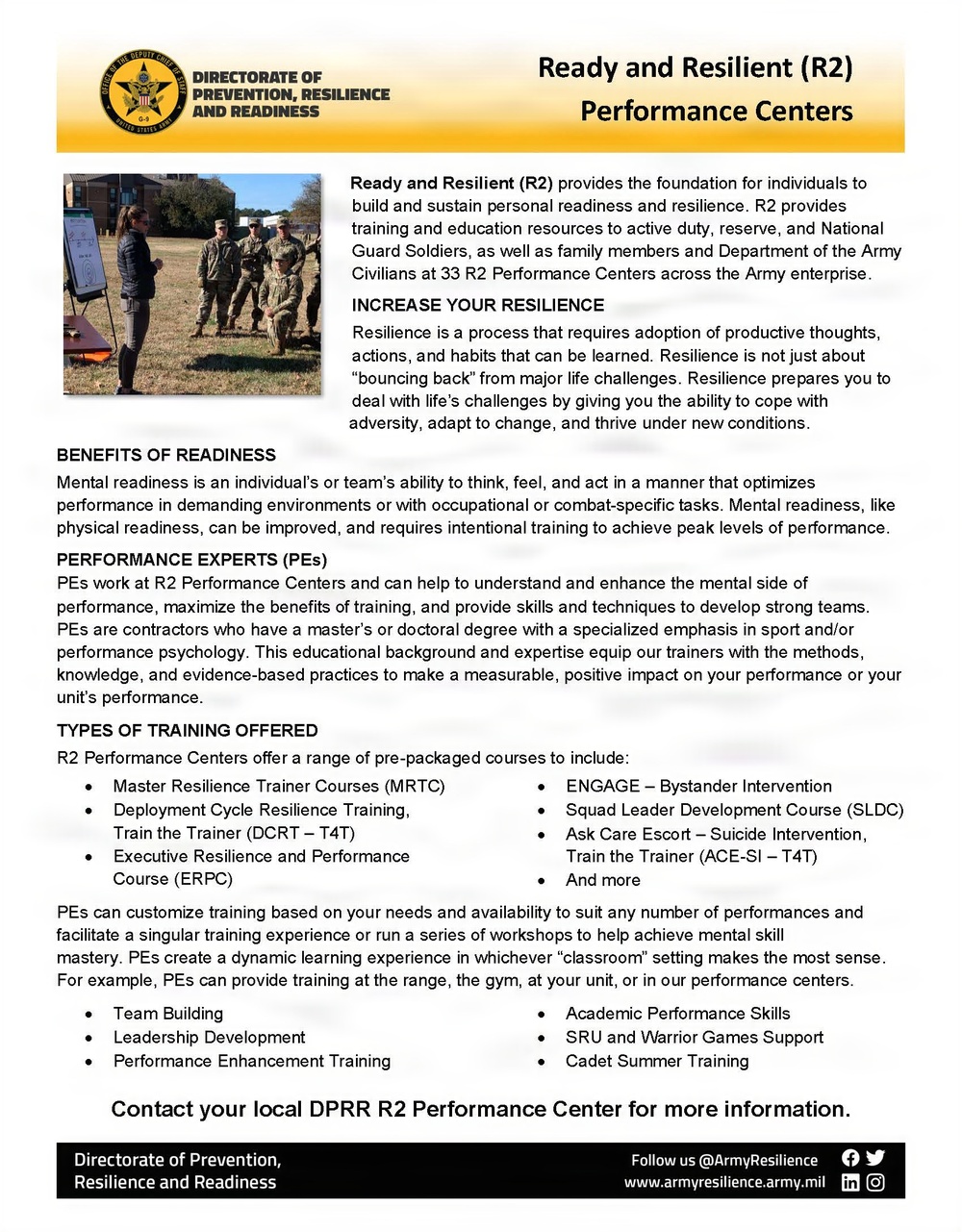
R2 Performance Centers provide customized performance and resilience training and education to Soldiers that will help them sustain personal readiness, enhance resilience, improve human performance and build unit cohesion. Training is available at centers Army-wide for active-duty military, reservists, guard members, Family members and DA Civilians.
| Date Taken: | 03.04.2026 |
| Date Posted: | 03.04.2026 13:10 |
| Story ID: | 559364 |
| Location: | FORT BRAGG, NORTH CAROLINA, US |
| Web Views: | 88 |
| Downloads: | 0 |

This work, R2 Program Builds Mental Readiness to Strengthen Warfighting at Fort Bragg, by Lauren Reho, identified by DVIDS, must comply with the restrictions shown on https://www.dvidshub.net/about/copyright.


No keywords found.




