
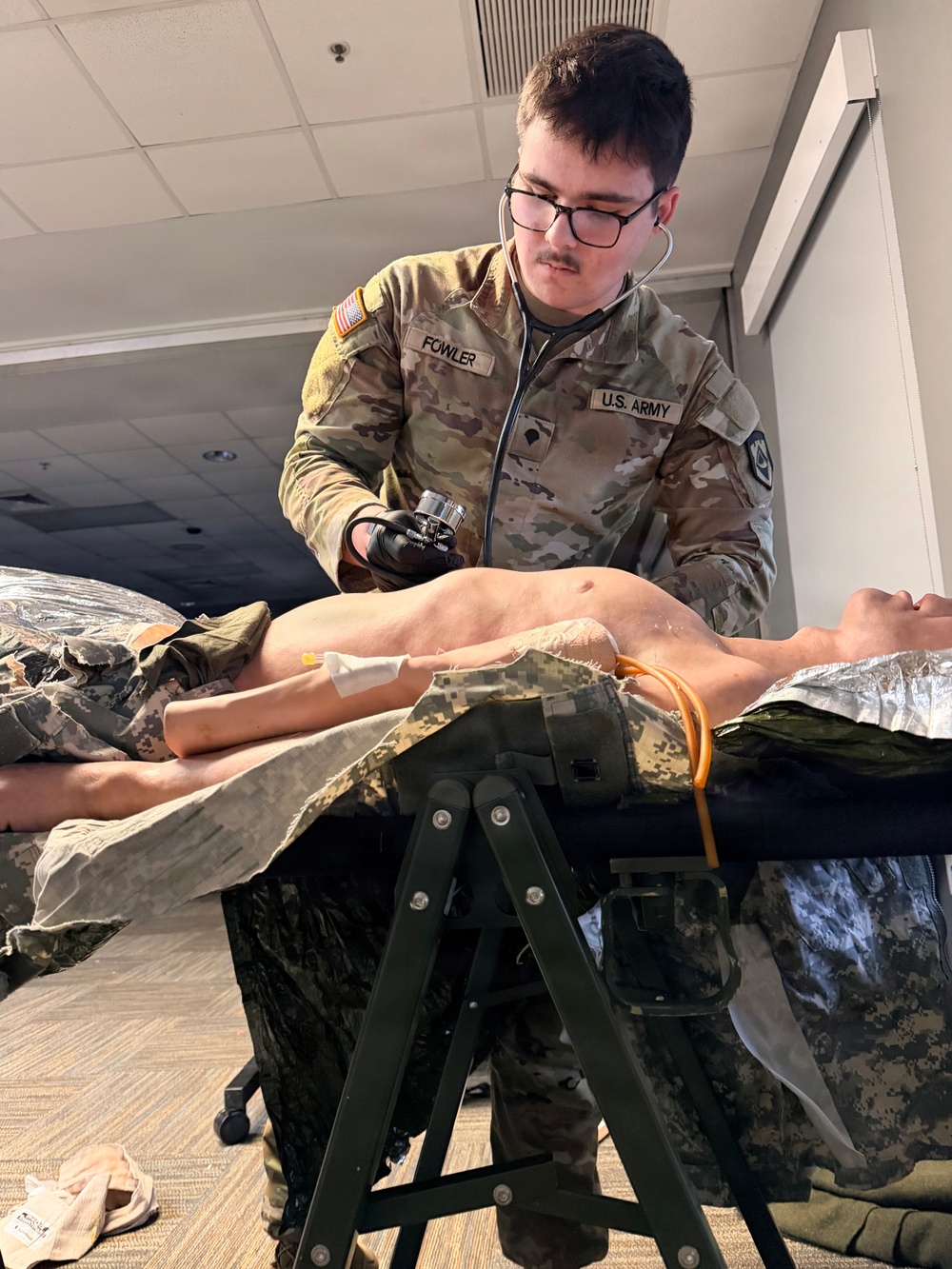
Photo By Erica Bodker | West Virginia Army National Guard medics sharpened their lifesaving skills during a...... read more read more
CHARLESTON, W.Va. –West Virginia Army National Guard medics sharpened their lifesaving skills during a 12-day combat medic recertification course at Camp Dawson in Kingwood, West Virginia, on Jan. 19-30, 2026, culminating in a large-scale field exercise simulating the realities of battlefield medicine.
A total of 51 combat medics (MOS 68W) from units across West Virginia attended the training, which provides 72 continuing education credits, Basic Life Support recertification, and required skills validation necessary to maintain their military occupational specialty and National Registry of Emergency Medical Technicians (NREMT)certification.
During the first portion of the course, medics refreshed core lifesaving skills and progressed into more advanced medical care techniques. Teams trained on patient assessment, trauma management, and evacuation procedures until they demonstrated proficiency in their required skill sets.
Breakout sessions throughout the course allowed medics to work in smaller groups, providing hands-on practice and time for individual instruction. The format created an environment where Soldiers could ask questions, repeat skills, and learn from the experience of fellow medics and instructors.
“The 68W recertification course was run smoothly by leadership, with each instructor being more than proficient in the skills required for their respective instruction block,” said Sgt. Savannah Cohenour, assigned to the WVARNG Medical Detachment. “The course allowed for a vast background of medics to come together and learn from one another. Every medic should revisit the basics to reinforce good habits and foundational knowledge. Overall, the course met expectations for recertification and exceeded standards in fostering a comfortable, open learning environment.”
The final day of the course culminated in a large-scale field exercise designed to simulate the realities of battlefield medicine. Approximately 40 medics participated in the Culminating Exercise on Jan. 29 beginning at 1 p.m. and continuing into the evening.
During the CulEx, Soldiers rotated through realistic clinical scenarios and TC 8-800 trauma lanes that required scene size up, casualty triage, and patient assessments using the MARCH algorithm. The MARCH model prioritizes treatment of Massive hemorrhage, Airway, Respirations, Circulation and C-Spine injuries, and Hypothermia prevention.
The scenario emphasized rapid assessment, treatment, and casualty movement while introducing prolonged field care situations lasting several hours. As conditions evolved, medics were required to adapt treatment plans and manage compounding medical needs while awaiting evacuation.
Training also included evacuation procedures and aerial loading and unloading of patients, reinforcing coordination between ground medical teams and aviation assets to move casualties quickly to higher levels of care.
Medics were also able to use telehealth capabilities during the exercise, allowing them to consult with WVARNG medical providers when needed.
“I attended my first 68W recertification cycle this last January and it allowed me to expand my understanding of necessary skills, tactical considerations, and knowledge needed to become an effective combat medic for the WVARNG,” said Spc. Rebecca Lemaster of the 1-150th Cavalry Regiment. “Topics such as MARCH-PAWS, prolonged field care, and field sanitation helped me understand not just what to do, but why we do it. The training expanded my knowledge beyond my initial training and made me more confident in my ability to treat casualties both short term and long term.”
The course also included instruction in specialized medical topics that medics may encounter in the field, including public health considerations and childbirth simulations using training mannequins.
“I feel the 68W course is a well-rounded and needed course for our 68W Soldiers,” said Sgt. Luke LaFollette of 2nd Battalion, 19th Special Forces Group (A). “Over the past few years it has grown and adapted to the needs of current operational environments. The value of this training keeps our state medics competent in their skills.”
This year’s training also incorporated artificial intelligence tools to help build realistic trauma patient scenarios and provide improved trending data during the CulEx. The addition of AI enhanced the realism of prolonged casualty care situations and simulated the types of complex cases medics may encounter while caring for patients for extended periods. The CulEx is a collaborative effort across multiple West Virginia National Guard units, bringing together experience and knowledge to provide the best possible training environment for medics across the state.
Training events like the 68W recertification course ensure WVARNG medics remain highly trained and ready to provide lifesaving care wherever they are called to serve.
| Date Taken: | 03.04.2026 |
| Date Posted: | 03.04.2026 14:04 |
| Story ID: | 559347 |
| Location: | CHARLESTON, WEST VIRGINIA, US |
| Web Views: | 76 |
| Downloads: | 0 |

This work, W.Va. Army National Guard Medics Complete Intensive Recertification, by Erica Bodker, identified by DVIDS, must comply with the restrictions shown on https://www.dvidshub.net/about/copyright.


No keywords found.





