
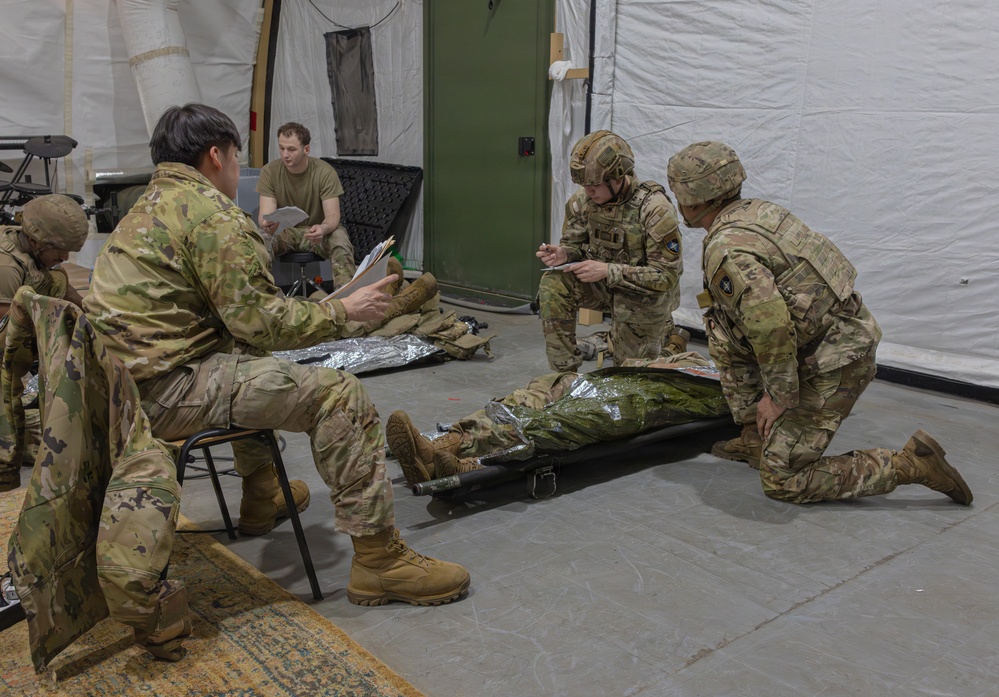
Photo By Spc. Andre Gremillion Jr | U.S. Army Soldiers assigned to 3rd Battalion, 8th Cavalry Regiment, conduct a medical...... read more read more
 Subscribe
3rd Battalion, 8th Cavalry Regiment certifies on a Combat Lifesaver Course
__BEMOWO PISKIE TRAINING AREA, Poland __— U.S. Soldiers assigned to 3rd Battalion, 8th Cavalry Regiment, receive their certifications on medical techniques alongside NATO partners during a Combat Lifesaver Course at Bemowo Piskie Training Area, Poland, Feb. 20, 2026. The course trained Soldiers in the stabilization and transportation of casualties from a combat zone.
The Combat Lifesaver Course is a 5-day, 40-hour, combat trauma care program designed to reduce casualties through training Soldiers to help themselves and each other with the three major contributing factors to fatalities in combat; control bleeding, maintain airways, and stabilize casualties until evacuation is possible.
“This class is important because, as much as the medics want to be everywhere, all the time, it's just not possible,” said Spc. James Reed, one of the medics assigned to teach the course.
Soldiers practiced treatment in various scenarios to properly care for casualties during combat: care under fire, tactical field care, and tactical evacuation care. During the week-long course, Soldiers learned how to correctly identify and prioritize wounds on a casualty's body, how to quickly and safely transport that casualty to a secure area using both improvised carries and a standard litter, and transmit a nine-line medical evacuation request, a standardized report used to communicate a casualty’s condition and required support.
Care under fire emphasized the casualty's ability to return fire and to stop any massive bleeding while under threat, while tactical field care allows for more thorough treatment once conditions are secure. Tactical evacuation care focuses on monitoring and preparing casualties for transport.
Training alongside British and Romanian allies allowed the forces to learn together standardized lifesaving procedures and improved their communication methods. The ultimate outcome of combined training is the shared understanding between the forces that they can each fight together and, when needed, provide lifesaving medical support during combined operations.
The Combat Lifesaver Course strengthened unit readiness by training non-medical Soldiers in critical lifesaving techniques and preparing them to respond to injuries in austere and contested environments. Soldiers applied battlefield medical principles, enabling them to provide immediate care at the point of injury while maintaining operational effectiveness alongside NATO allies.
-30-
| Date Taken: | 02.19.2026 |
| Date Posted: | 03.06.2026 08:00 |
| Story ID: | 559268 |
| Location: | PL |
| Web Views: | 22 |
| Downloads: | 0 |

This work, 3rd Battalion, 8th Cavalry Regiment certifies on a Combat Lifesaver Course, by SPC Andre Gremillion Jr, identified by DVIDS, must comply with the restrictions shown on https://www.dvidshub.net/about/copyright.

No keywords found.




