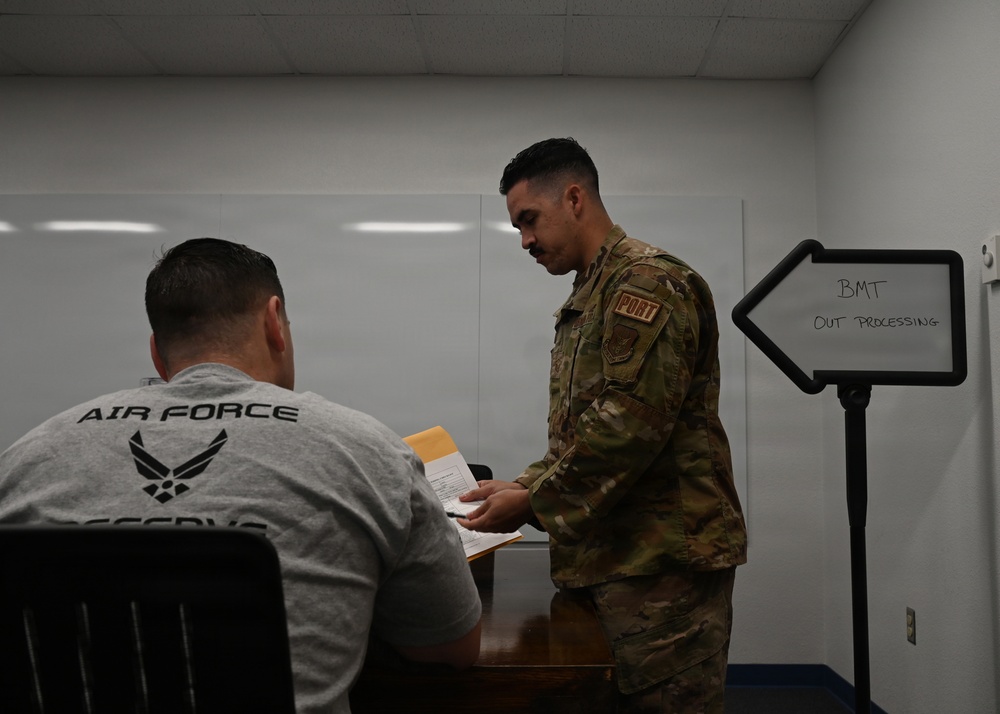
Photo By Jessica Kendziorek | Master Sgt. Taylor Landry, 403rd Wing Development & Training Flight coordinator, explains the Basic Military Training outprocessing paperwork to an Airman. The D&TF assists Air Force Reserve members who have enlisted but have not departed for Basic Military Training. (U.S. Air Force photo by Jessica L. Kendziorek) see less
| View Image Page
KEESLER AIR FORCE BASE, MISSISSIPPI, UNITED STATES
Development and Training Flight: Building the foundation for future Citizen Airmen
For many new recruits, the transition from civilian life to military service can be both exciting and overwhelming.
The Development and Training Flight serves as a bridge to assist with the transition between enlistment and Basic Military Training, preparing future Citizen Airmen for the physical, mental and professional demands of Air Force service.
“The D&TF is designed for Air Force Reserve members who have enlisted but have not yet departed for BMT,” said Master Sgt. Taylor Landry, 403rd D&TF coordinator. “Our new trainees attend regular Unit Training Assemblies, where they begin learning the fundamentals of military life while building the discipline and confidence needed to succeed, instead of waiting months with minimal guidance.”
The primary purpose of the Development and Training Flight is readiness. The program ensures that recruits arrive at BMT physically prepared, knowledgeable about Air Force standards, and familiar with military customs and expectations. By introducing structure early, the D&TF reduces attrition rates, increases training success and helps new members integrate more smoothly into the force.
“The Development and Training Flight is where our future Airmen start learning what it truly means to serve,” said Landry. “We focus on building discipline, accountability and confidence so they arrive at Basic Military Training ready to succeed, not just survive.”
D&TF instructors are typically experienced noncommissioned officers, who mentor trainees and model the standards expected of Airmen. They emphasize core values, accountability, teamwork and attention to detail, laying the groundwork for a professional military mindset.
Landry said that during these monthly training weekends, trainees participate in a variety of activities designed to mirror aspects of BMT while remaining appropriate for their pre-BMT status. Some of these activities include physical fitness training to meet Air Force standards, drill and ceremony instruction, customs and courtesies education, uniform wear and appearance guidance and rank structure, chain of command familiarization, and team-building exercises.
“Our goal is to remove as many unknowns as possible before they step off the bus at BMT,” Landry said. “If they already understand drill, standards and how to function as part of a team, they can focus on performing at their best.”
In addition to structured training, D&TF members often receive administrative support to ensure all required documentation, medical clearances and security requirements are completed before shipping to BMT.
Physical conditioning is a major focus. Trainees work on running endurance, strength, and overall fitness so they can meet or exceed minimum standards upon arrival at training. This preparation not only improves performance but also reduces the risk of injury.
Equally important is mental preparation. Instructors help trainees understand the pace, expectations and stressors of BMT, providing practical advice on time management, resilience and adapting to a highly structured environment.
“D&TF builds the foundation for a successful career,” said Chief Master Sgt. Tige Platt, 403rd Wing command chief. “These men and women arrive at training already understanding standards, teamwork and what it means to be part of something bigger than themselves.”
By the time trainees leave for BMT, many already understand how to march, follow commands, maintain standards and work as part of a team, skills that can significantly ease the transition.
The program also fosters camaraderie among recruits who will often ship to training around the same time. These relationships can provide valuable support during the early stages of a military career.
“We’re not just preparing individuals—we’re building future members of the 403rd Wing team,” Platt said. “Investing in them early strengthens the entire force.”
While many Airmen first encounter the D&TF as new recruits awaiting BMT, the program also relies on experienced Reserve members to serve as instructors and leaders. Noncommissioned officers selected for these roles bring operational experience, professionalism and a commitment to developing the next generation of Airmen.
Platt said that Airmen interested in becoming D&TF cadre typically coordinate through their unit leadership or chain of command. Positions may be filled through internal selection, special duty assignments or volunteer opportunities, depending on wing requirements. Candidates are expected to demonstrate exemplary military bearing, strong communication skills and the ability to train and motivate others.
“D&TF leaders set the tone for everything these recruits will experience moving forward,” Platt said. “Selecting the right people for these roles ensures our newest members receive the guidance and mentorship they deserve.”
Serving as a D&TF leader requires strong leadership skills, physical readiness and a passion for mentorship. Leaders are responsible for planning and executing training, enforcing standards, guiding trainees through challenges and ensuring each member is fully prepared for BMT.
“Leading D&TF is one of the most rewarding jobs in the Reserve,” Landry said. “You get to shape future Airmen at the very start of their careers and watch them grow in confidence, discipline and pride.”

 Subscribe






