
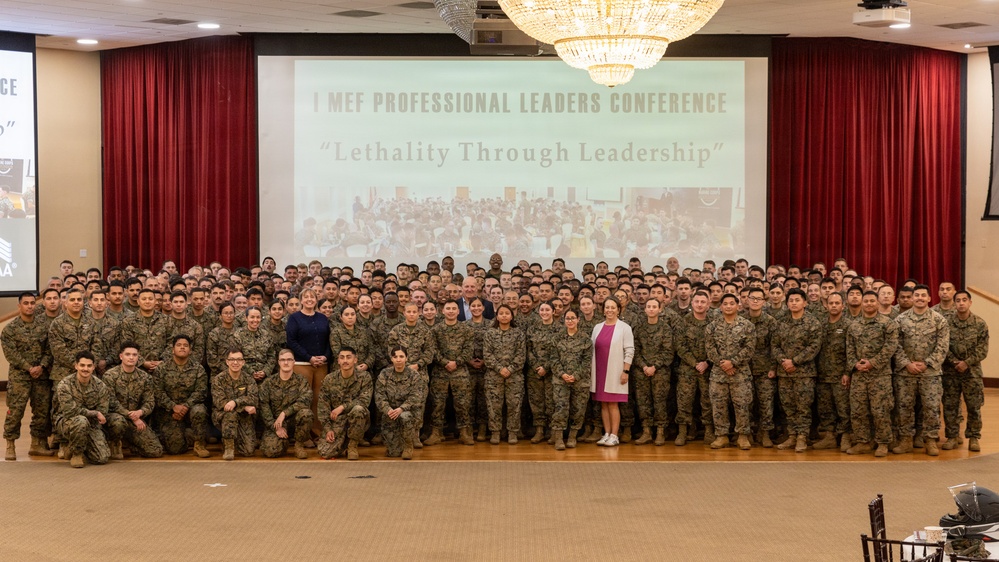
Photo By Cpl. Joshua Bustamante | U.S. Marines with I Marine Expeditionary Force and Marine Corps Association employees...... read more read more
 Subscribe
MARINE CORPS BASE CAMP PENDLETON, Calif. — Company grade officers and non-commissioned officers from I Marine Expeditionary Force gathered Feb. 11-12, 2026, for the Lethality Through Leadership Seminar, a two-day event designed to strengthen small-unit leadership, reinforce discipline and accountability and translate combat and leadership experience into unit-level action.
“Discipline is not rigid adherence to order alone; it is the bedrock of trust that allows freedom of action,” said U.S. Marine Corps Sgt. Maj. Rodney E. Nevinger, command senior enlisted leader of I Marine Expeditionary Force. “It is the ingrained habits of excellence that endure under the most trying conditions.”
The seminar was built around senior leader reflections, question-and-answer periods and small-group discussion intended to convert lessons learned into practical application.
Throughout the seminar, speakers repeatedly linked readiness to fundamentals: disciplined daily habits, engaged leadership and clear standards enforced at the small-unit level. Leaders emphasized that discipline is not separate from warfighting; it is the foundation that allows teams to operate with speed, initiative and confidence when conditions change and decisions must be made at the lowest level.
In a reflection focused on combat leadership at the platoon level, U.S. Marine Corps Sgt. Maj. Idris Turay, senior enlisted leader of Marine Aircraft Group 39, 3rd Marine Aircraft Wing, underscored the continuity between preparation in garrison and performance in crisis. “Preparation for combat starts back here,” Turay told attendees. “You never know when you are going to go forward.”
Retired Chief Warrant Officer 4 Anthony L. Viggiani, a Marine gunner and Navy Cross recipient, reinforced that the decisive point in combat is often the quality of leadership closest to the action, stating, “We have to focus on the small-unit leaders. That’s where it happens.”
Later, Col. David J. Hart, assistant division commander, 1st Marine Division, framed trust as a daily, earned relationship leaders cannot outsource and cannot evade. “Trust and confidence is a two-way street,” Hart said. “You can hide from your seniors. Sometimes you can hide from peers. You can’t hide from your subordinates. Your subordinate Marines and Sailors see you for who you really are.”
Day 2 continued with reflections that emphasized leadership under pressure, risk-informed training and the role of repetition in creating consistent performance. Brig. Gen. Michael R. Nakonieczny, deputy commanding general of I Marine Expeditionary Force, told the audience that training standards are practical safeguards that become decisive when conditions deteriorate. “Practice like you’re fighting,” Nakonieczny said. “In crisis, professionals fall back on their training; amateurs rise to the occasion. This might be the last time you do something in practice before it’s the first time you do it in war.”
A surprise virtual appearance by Sgt. Maj. Carlos A. Ruiz, 20th sergeant major of the Marine Corps, reinforced the seminar’s theme. He argued that culture and discipline come from people, not policies. Using daily colors as an example, he explained that while the order is simple, the standard is upheld by the individuals involved. “It’s the hands of the Marine raising the colors—not the policy or the order—it is the young Marine with their hands on that rope, with a corporal ensuring that is performed properly and a lieutenant supervising and making sure it happens on time. That’s how we work.”
U.S. Marine Corps Sgt. Maj. Michael Escobar, command senior enlisted leader of 1st Marine Regiment, 1st Marine Division, emphasized that engaged leaders who care for their people and the mission build belief and pride within their unit. “When you take care of your people and your operations, that takes care of everything else,” Escobar said. “They start believing in what they do. When they put this frog on, they don’t want to take it off.”
During closing remarks, Lt. Gen. Christian F. Wortman, commanding general of I Marine Expeditionary Force, emphasized that readiness is sustained through consistent standards and a shared culture, not isolated excellence. “When you look at the best teams over extended periods, most often it was not about the best player in the team,” Wortman said. “Most often it was not about the captain of the team. It was about the culture of excellence.”
Nevinger closed by returning to the premise of the seminar: disciplined leaders, armed with commander’s intent, are expected to make decisions, take calculated risks and act with speed at the point of friction. “Micromanagement is the antithesis of maneuver warfare,” Nevinger said. “We will not win by directing every action from higher headquarters. We will win because our small-unit leaders—armed with commander’s intent—are empowered to make decisions, take calculated risks, and act faster than the adversary.”
I Marine Expeditionary Force provides combatant commanders with a globally responsive, expeditionary and fully scalable Marine Air-Ground Task Force capable of generating, deploying and employing ready forces and formations for crisis response, forward presence, major combat operations and campaigns.
| Date Taken: | 02.19.2026 |
| Date Posted: | 02.27.2026 19:23 |
| Story ID: | 559154 |
| Location: | MARINE CORPS BASE CAMP PENDLETON, CALIFORNIA, US |
| Web Views: | 831 |
| Downloads: | 0 |

This work, Forging lethality through leadership: I MEF hones mid-level leaders at two-day seminar, by 1LT Logan Tompkins, identified by DVIDS, must comply with the restrictions shown on https://www.dvidshub.net/about/copyright.


No keywords found.




