
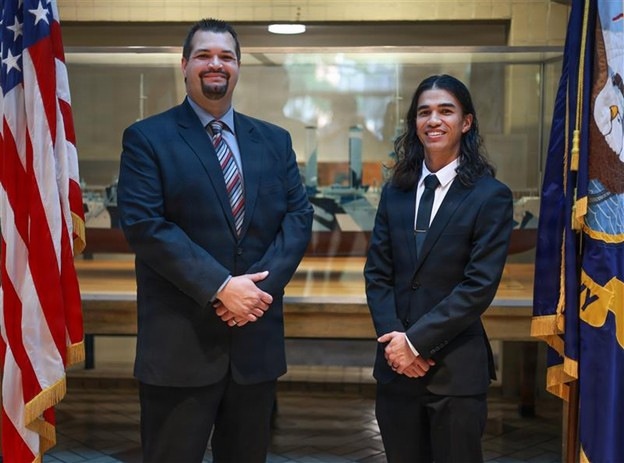
Photo By Jay Butterbaugh | Naval Surface Warfare Center, Philadelphia Division (NSWCPD) Electrical Engineer...... read more read more
 Subscribe
The U.S. Navy has long faced a major challenge when it comes to fixing complex problems aboard its ships. In the past, engineers and experts often had to travel across the world to reach vessels in need of repair. These missions could take weeks, involve costly flights, and were often slowed by limited and incomplete information, delaying critical repairs and investigations. But today, a new data toolset developed by two software engineers at the Naval Surface Warfare Center, Philadelphia Division (NSWCPD) is transforming how the Navy supports its fleet.
NSWCPD Machinery Control System Team Software and Cybersecurity Technical Lead Nicholas Stepenosky said the goal was straightforward: “to make data retrieval simple and fast, so remote teams can get the information they need within hours, not days.” His colleague NSWCPD Machinery Control System Team Senior Software Developer Brian Rivera-Lau added, “These tools let support teams see exactly what happened on the ship at the time of an incident, almost as if they were there, but without having to be physically present.”
The toolset directly interfaces with the DDG 51 Arleigh Burke-class Machinery Control System, which supports the ship’s critical functions, including propulsion, electrical power, and damage control. Since the 1990s, these destroyers have been a backbone of the Navy’s surface fleet. However, until now, the ship’s data logs and alarms could only be accessed physically onboard a ship, using multiple complex consoles. When a problem arose, specialists needed to be shipboard and manually sift through hours of technical logs to piece together what happened.
Stepenosky and Rivera-Lau have changed the status quo with their new Data Extraction Tool. It allows a trusted operator onboard a ship, such as a Sailor or a waterfront representative, to select up to 48 hours of vital control system data and send it safely to remote engineers for analysis. The process is automated, removing the need to decode any confusing file names or navigate through complex systems, dramatically cutting investigation time.
But the real magic lies in the Data Playback Tool. Instead of static records, this tool creates a dynamic replay of events, much like a DVR. Engineers thousands of miles away can watch a precise replay of the ship’s console screens as events unfolded. They can pause, rewind, or fast-forward through the timeline, closely examining alarms and operator actions.
“This gives support teams a clear picture of the events leading up to a problem, helping them find out what went wrong faster and with more detail,” Rivera-Lau explained.
Before this toolset, investigations such as the one following the 2017 collision of USS John S. McCain (DDG 56) with a commercial tanker required several experts traveling to the ship and days of analysis. Now, with trusted local agents collecting and forwarding data, teams can reduce costs and downtime by up to 85 percent, a process that once took a week might now take a single day.
“We’re trusting in the integrity of ship system data and giving support teams better tools to access and analyze it,” Stepenosky said.
The toolset also opens new doors for training. Real events can be replayed for crews, helping Sailors learn from actual incidents without the risks or expenses of live drills. The video player-style controls are easy for Sailors and engineers to use without requiring specialized knowledge.
The Navy’s push for digital solutions doesn’t stop there. New remote maintenance technologies, such as the Augmented Reality Maintenance System (ARMS), are being installed fleet-wide, allowing Sailors wearing AR headsets to connect in real time with shore-based experts. These systems let them share their exact viewpoint while experts guide repairs remotely, sparing the need for costly travel. This new method powers self-sufficiency and keeps ships mission-ready.
“This team took on a real fleet problem. After a machinery casualty, our shore-based engineers often had to work with incomplete, hard-to-reach information, which slowed everything down and kept ships from getting back on mission,” NSWCPD Acting Department Head for Cybersecurity, Hull, Mechanical, and Electrical Control Systems & Networks, Jeffrey Merlino said.
“With the DDG 51 MCS Data Extraction Tool, they can now replay exactly what the operators saw before, during, and after an event and identify the root cause much faster. That capability has already proven itself on some very complex issues, underscoring this team’s commitment to giving the warfighter better tools and a more effective Navy,” Merlino added.
Stepenosky and Rivera-Lau presented their toolset at the American Society of Naval Engineers Fleet Maintenance and Modernization Symposium in September 2025. This technology is already deployed in the Philadelphia Division and aboard multiple DDGs, with plans to expand its use across the Navy. The goal is clear: faster, clearer, and more affordable support that strengthens the entire fleet.
NSWCPD employs approximately 2,700 civilian engineers, scientists, technicians, and support personnel. The NSWCPD team conducts research and development, test and evaluation, acquisition support, and in-service and logistics engineering for non-nuclear machinery, ship machinery systems, and related equipment and materials for Navy surface ships and submarines. NSWCPD is also the lead organization responsible for providing cybersecurity for all ship systems.
| Date Taken: | 02.27.2026 |
| Date Posted: | 02.27.2026 10:43 |
| Story ID: | 559080 |
| Location: | PHILADELPHIA, PENNSYLVANIA, US |
| Web Views: | 613 |
| Downloads: | 0 |

This work, NSWCPD Engineers Create Remote Data Toolset to Revolutionize Fleet Support, by Steven Infanti, identified by DVIDS, must comply with the restrictions shown on https://www.dvidshub.net/about/copyright.

No keywords found.




