
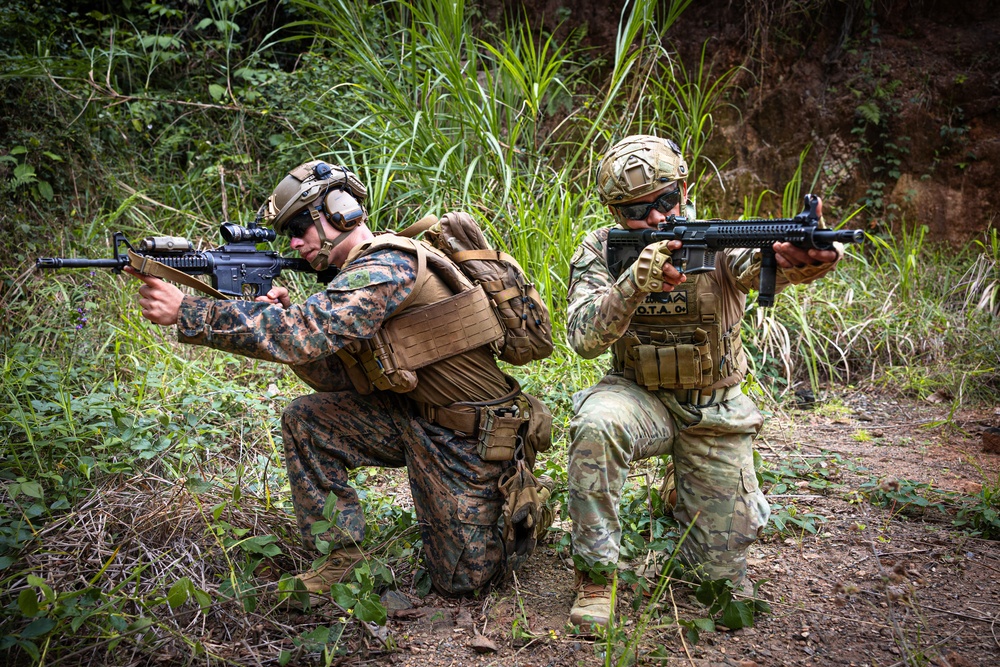
Photo By Sgt. Antonino Mazzamuto | U.S. Marine Corps Lance Cpl. Peter D. Deluke, left, a combat engineer with 2nd Combat...... read more read more
 Subscribe
PANAMA CITY, Panama – “For me, it always comes back to discipline and mastering the fundamentals because if we are not consistent in the basics, nothing else we do will hold up under pressure,” said U.S. Marine Corps 1st Sgt. Lonnie D. Stowers, the senior enlisted leader of Charlie Company, 2nd Combat Engineer Battalion, 2nd Marine Division.
U.S. Marines with 2nd CEB conducted bilateral training alongside Panamanian security institutions during Panamanian Partnership 26-3A from Jan. 10-Feb. 26, 2026. The purpose of the partnership and training was to reinforce readiness and interoperability through combined training in dense jungle terrain and austere range environments.
The 45-day training iteration featured four different courses hosted by 2nd CEB alongside the Joint Security Cooperation Group-Panama: a Provisional Infantry course, a Basic Engineer’s course, a Radio Operators course, and a Jungle Operations Training course. Throughout the instruction periods, U.S. Marines, U.S. Army Soldiers and Panamanian partners executed small-unit training designed to improve coordination, communication, and shared execution in a combined training environment.
“Panamanian Partnership is a bilateral training event designed to strengthen combat readiness while building professional trust with our Panamanian partners,” said Stowers. “At its core, it’s about Marines sharpening their skills and improving how we operate together as a combined force.”
According to Stowers, operating away from home station plays a critical role in reinforcing readiness across the 2nd Marine Division.
“For 2nd Marine Division, readiness means being able to deploy, adapt, and execute anywhere we’re sent,” said Stowers. “This partnership reinforces that by placing Marines in unfamiliar terrain, operating through friction, and maintaining standards away from home station.”
At the squad and platoon level, Marines executed live-fire fire team attack ranges and maneuver iterations alongside Panamanian forces, placing an emphasis on small-unit leadership and disciplined execution.
U.S. Marine Corps 1st Lt. Paul Brown, the executive officer of Charlie Company, 2nd CEB, and the Marine Detachment officer in charge of Panamanian Partnership 26-3A, said the training reinforced foundational Marine Corps leadership principles under challenging conditions.
“I think it makes me value how much emphasis we put on the small-unit leader and the Marine Corps’ emphasis on decentralized command,” said Brown.
For combat engineers, the training focused on applying core engineer tasks while operating alongside partner forces. U.S. Marine Corps Cpl. Thomas J. Timberlake Jr., a squad leader with 2nd CEB, said the event allowed Marines to instruct and execute across a range of engineering and tactical skill sets.
“In general, we’ve been hitting basic engineering, basic demolitions, advanced demolitions and expedient demolitions,” said Timberlake. “We also have a lot of route clearance down here to assess what to do in the event that we come across different types of explosives and mines, as well as practicing urban demolitions.”
Timberlake noted that training alongside Panamanian forces highlighted similarities in tactics while requiring adaptation in instruction and communication.
“When we actually got to the tactics portion of things, such as clearing rooms and open-field tactics, that’s when we really started to see that their methods are very similar to what we do,” said Timberlake.
From the partner-nation perspective, Teniente Jezith Ramos, a foreign liaison officer for the Servicio Nacional Aeronaval de Panamá, said the joint training supports a shared understanding between the two nations’ forces.
“Training alongside U.S. Marines helps unify how we plan and conduct operations, both in rural and urban environments, which facilitates joint operations between our forces,” said Ramos.
As training progressed in dense terrain, Marines adjusted how they maneuvered and communicated under limited visibility, reinforcing adaptability and discipline.
“You don’t build interoperability during a crisis, you build it through repetition, shared hardship and trust,” said Stowers. “And trust starts with professionalism.”
Panamanian Partnership 26-3A concluded with U.S. Marines and Panamanian security institutions completing combined training iterations designed to strengthen readiness and the ability to operate together.
“My biggest takeaway is that readiness and relationships go hand in hand,” said Stowers. “Tactical excellence builds credibility, and credibility builds trust.”
| Date Taken: | 02.23.2026 |
| Date Posted: | 03.02.2026 13:29 |
| Story ID: | 559079 |
| Location: | PANAMA CITY, PA |
| Web Views: | 127 |
| Downloads: | 0 |

This work, Exercise Panamanian Partnership 26: U.S. Marine Corps Engineers Build Readiness Side by Side with Panamanian Forces, by Sgt Antonino Mazzamuto, identified by DVIDS, must comply with the restrictions shown on https://www.dvidshub.net/about/copyright.


No keywords found.




