
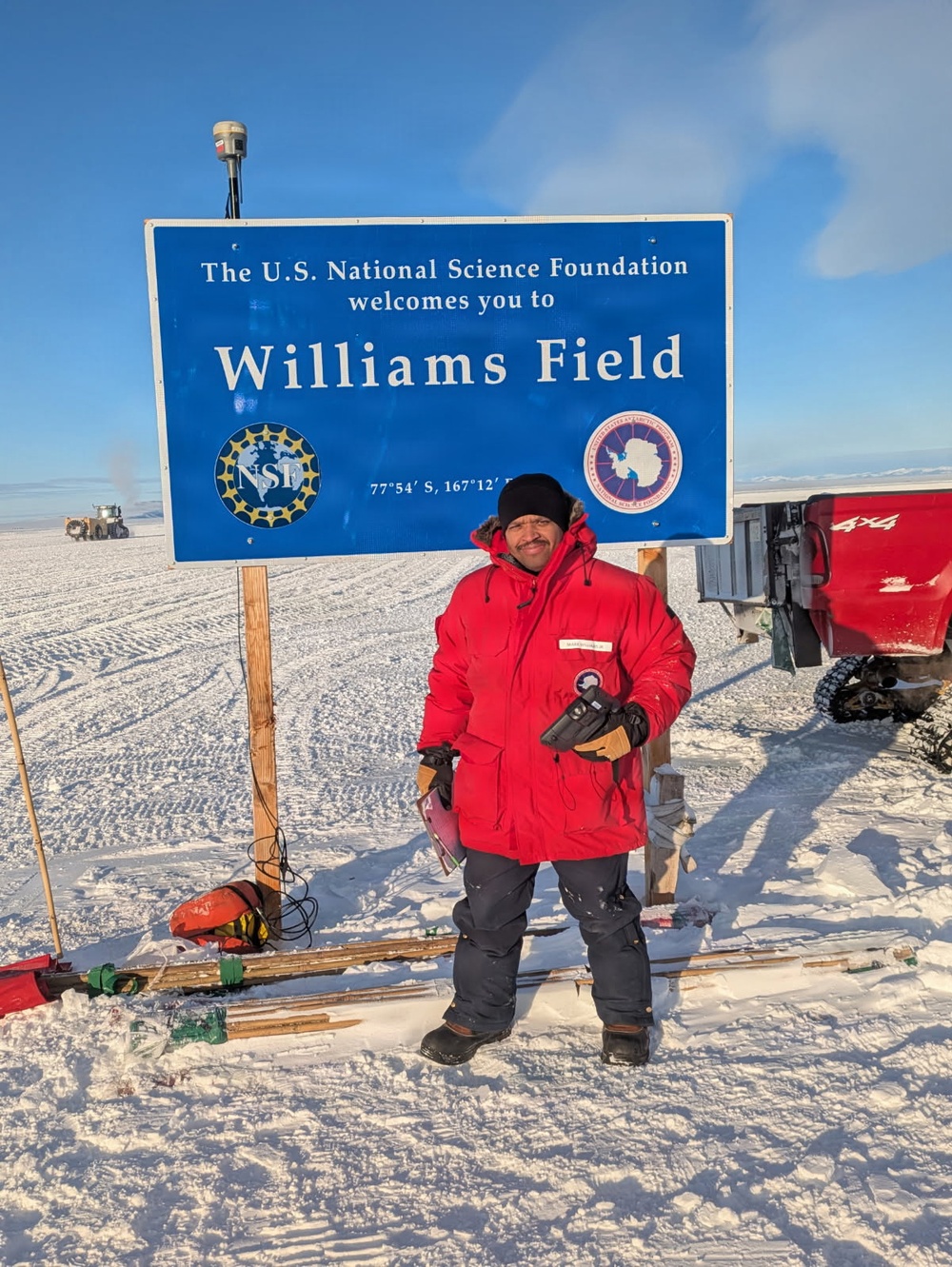
Photo By National Geospatial-Intelligence Agency | U.S. Army Master Sgt. Mark Williams, NGA geodetic surveyor, poses for a photo at...... read more read more
The wind howled across Antarctica's Ross Ice Shelf at 40 knots, driving snow horizontally and dropping visibility to near zero. Huddled inside a makeshift shelter, two National Geospatial-Intelligence Agency surveyors watched their equipment struggle against the cold as the temperature outside dropped to 30 degrees below zero.
The mission: precision surveying at the bottom of the world, where Jay Drake and U.S. Army Master Sgt. Mark Williams, NGA geodetic surveyors, were mapping the ice runways that keep America's Antarctic research program alive.
The National Science Foundation had relied on commercial contractors for years to survey Antarctica's airfields, but the results weren't meeting operational requirements. When aircraft depend on runways carved from compacted snow on floating ice shelves, "close enough" doesn’t cut it.
To close this operational gap, NSF turned to NGA’s precision surveying capabilities.
“If you think about the surveys you see being done on the side of the road, which are land surveys — geodetic surveying isn’t far off in concept,” said Williams. “The big difference is the variety of ways we collect and analyze survey data, and the amount of detail and precision we can provide. It’s a big leap in how far after the decimal point we can go in providing data to meet our customer requirements*.”*
The survey data is used by NGA’s Aeronautical Navigation office to design and produce instrument approach procedures — essential capabilities when Antarctic weather conditions reduce visibility to near zero and force pilots to rely entirely on instruments for safe landings.
Safety of navigation is a key component of NGA’s mission, and the agency is responsible for the production and maintenance of data on thousands of airfields worldwide.
The two Antarctic airfields surveyed — Williams Field and Phoenix Airfield — handle thousands of passengers and millions of pounds of cargo annually, supporting the flow of researchers and supplies to the continent's largest research hub, McMurdo Station.
Both facilities face annual reconstruction challenges. Buildings, fuel lines and support equipment must be removed each winter, and the airfields themselves can shift hundreds of feet due to ice movement, rendering previous survey data obsolete.
The 2025 mission began in New Zealand for equipment preparation and cold weather training, followed by transit to Antarctica for the surveys themselves. However, Antarctica’s remote and harsh conditions make planning strict mission timelines difficult, especially when the runways are still being set up for the season.
“The logistics of getting to and from Antarctica are not an exact science,” said Drake. “Weather and mechanical issues always play a role in arrival and departure timelines.”
“This year our arrival on station was delayed,” Drake continued. “Once on station, we had to work some long hours to get the survey back on the project schedule. Long days in the field and nights processing data allowed us to get back on the project timeline.”
Daily operations and long hours on the ice often meant working from vehicles to shelter from the harsh Antarctic conditions. In addition to survival, the prolonged exposure to extreme cold created immediate challenges for equipment.
These issues required some quick field innovation, as any delays in completing the surveys would, in turn, delay necessary support and equipment from arriving at the research stations to begin the season. The mission could not afford weeks waiting on new gear to be flown in.
“The airfield surveys we did in Antarctica are the same that we provide to other airfields, but with a few location-specific challenges and adaptations,” said Williams. “The biggest difference was the extreme cold weather conditions. The cold always had a negative effect on our GPS equipment — specifically the battery life. We quickly realized that if we did not insulate our batteries they would die within minutes. So we adapted to conditions by using existing insulated prism bags and pelican cases to allow us to work a standard day in the field.”
The survey mission fell under Operation Deep Freeze, the military's support mission for civilian Antarctic research.
Their work supports over 100 aircraft missions each season, including flights by the New York Air National Guard's LC-130s equipped with skis for ice landings and heavy C-17 cargo aircraft from Joint Base Lewis-McChord — all dependent on the precise runway surveys NGA provides.
These flights provide personnel and equipment that are responsible for cutting-edge science that is reshaping understanding of climate, space and life itself. Antarctic researchers discovered microbial ecosystems beneath 2,600 feet of ice that may mirror life on other planets. The IceCube Neutrino Observatory at the South Pole has detected high-energy particles that originated outside our solar system. Ice cores extracted from the continent contain atmospheric records spanning millennia, providing crucial data for climate research.
"This mission is one where multiple agencies work in conjunction for the completion of the mission," said Drake. "We worked with the National Science Foundation, the Naval Information Warfare Center and the Federal Aviation Administration to name a few. The sense of mission is held by all when working in remote conditions like Antarctica."
The partnership will continue next year, when another team will deploy to map the ice runways that serve as America's gateway to the Antarctic — with NGA’s precision geospatial intelligence enabling scientific discoveries that help us better understand our planet and our place in the universe.
| Date Taken: | 02.26.2026 |
| Date Posted: | 02.26.2026 10:12 |
| Story ID: | 558949 |
| Location: | US |
| Web Views: | 145 |
| Downloads: | 0 |

This work, NGA surveys Antarctica's airfields, ensures successful open to research season, by National Geospatial-Intelligence Agency, identified by DVIDS, must comply with the restrictions shown on https://www.dvidshub.net/about/copyright.


No keywords found.





