
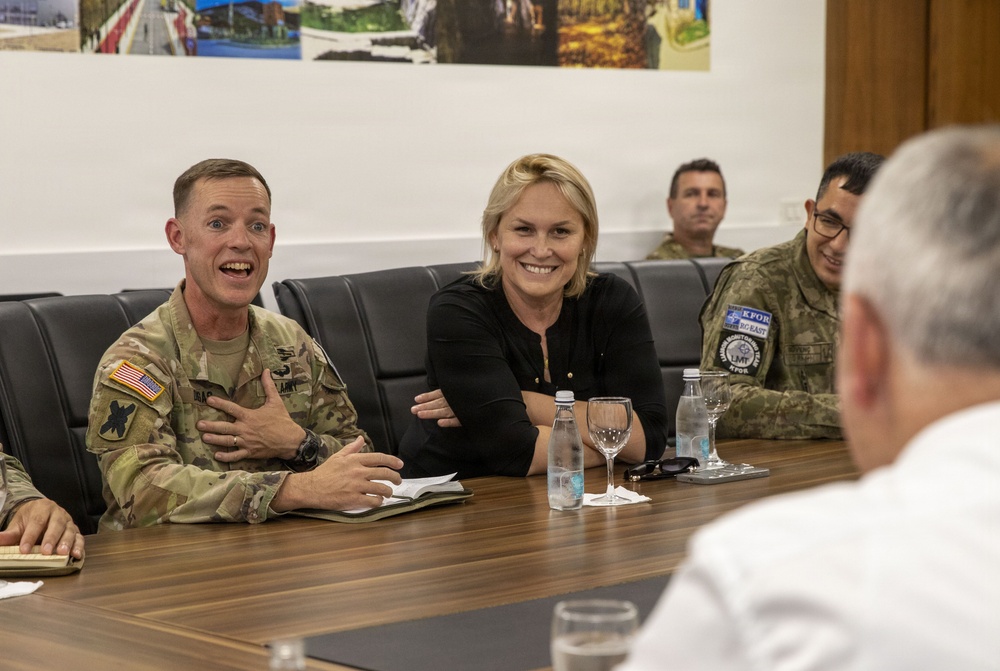
Photo By Staff Sgt. Alyssa Lisenbe | Kosovo Forces (KFOR) Regional Command-East Chief of Staff Lt. Col. Kevin Duga and...... read more read more
CAMP BONDSTEEL, Kosovo – Since the beginning of Kosovo Forces (KFOR) on June 12, 1999, generations of soldiers have rotated in and out to support the mission. One element, however, that has remained constant from the very beginning are the interpreters, also known as Category II Linguistics.
From the mission’s earliest days to the present, the interpreters have served as the vital link that enables Kosovo Force to provide a safe and secure environment and freedom of movement for all people in Kosovo.
The two main languages in Kosovo are Serbian and Albanian. Therefore, interpreters need to know both languages and cultures thoroughly to be cognizant of both sides.
Working behind the scenes, KFOR interpreters have been essential to every successful meeting between KFOR and Kosovo’s local leaders. KFOR calls these meetings Key Leader Engagements or KLEs.
Among these highly skilled interpreters are Jeton “Toni” Imeri and Lumnije Robelli, both of whom were witnesses to the Kosovo war. While Robelli has been an interpreter for the U.S. Army since 2020, Toni has been an interpreter since the beginning of KFOR.
For both interpreters, they complete annual training to keep their skills sharpened. Their work extends beyond language support to directly contribute to KFOR’s mission.
Robelli, a Category II interpreter supporting KFOR Regional Command-East (RC-E), brings more than 20 years of professional interpreting experience. Her cultural awareness, tone and context are just as important as linguistic accuracy.
“Accurate interpretation ensures messages are conveyed faithfully, without confusion or loss of meaning,” Robelli said. “Clear communication allows both sides to fully understand intentions and concerns, which is essential during sensitive discussions.”
Since joining the U.S. Army as an interpreter in 2020, she has supported a wide range of units and progressed to become the sole interpreter for the Command Group of RC-E.
Robelli highlighted the establishment of family rooms across Kosovo as one of the most rewarding efforts of KFOR 35.
“Supporting KFOR’s mission is both an honor and a responsibility,” Imeri said. “Knowing that my work helps strengthen cooperation and supports peacekeeping efforts is a source of great pride.”
Similarly, Toni serves as a professional interpreter across engagements with municipal authorities, security institutions, religious leaders, community representatives, and international partners. His role focuses on facilitating effective dialogue by preserving meaning and intent during discussions that often involve complex security and political topics.
“Even small misunderstandings can affect trust or operational outcomes,” Imeri explained. “Precision and clarity are critical in these engagements.”
High-level discussions frequently involve sensitive subjects and rapid exchanges, requiring interpreters to remain composed and adaptable.
“Maintaining accuracy under pressure while ensuring neutrality is one of the biggest challenges,” Robelli said. “Preparation and focus make all the difference.”
From reviewing terminology and objectives beforehand to maintaining neutrality and discretion during meetings, interpreters operate under constant pressure to deliver accurate, culturally appropriate communication in fast-paced environments.
Imeri noted that effective interpretation allows leaders to focus on substance rather than language barriers, resulting in more productive discussions and stronger partnerships.
“Interpreters are not just language facilitators; we are enablers of cooperation, trust, and mission success,” Imeri said. “In a multinational environment like KFOR, effective interpretation is essential for achieving shared objectives and long-term stability.”
As KFOR moves forward, interpreters will continue to be a vital link between dialogue and understanding, helping transform communication into a lasting partnership.
| Date Taken: | 02.18.2026 |
| Date Posted: | 02.20.2026 05:22 |
| Story ID: | 558358 |
| Location: | CAMP BONDSTEEL, ZZ |
| Web Views: | 71 |
| Downloads: | 0 |

This work, Voices That Build Trust: KFOR Interpreters Strengthen Dialogue and Stability in Kosovo, by SGT Laura Bradley, identified by DVIDS, must comply with the restrictions shown on https://www.dvidshub.net/about/copyright.

No keywords found.





