
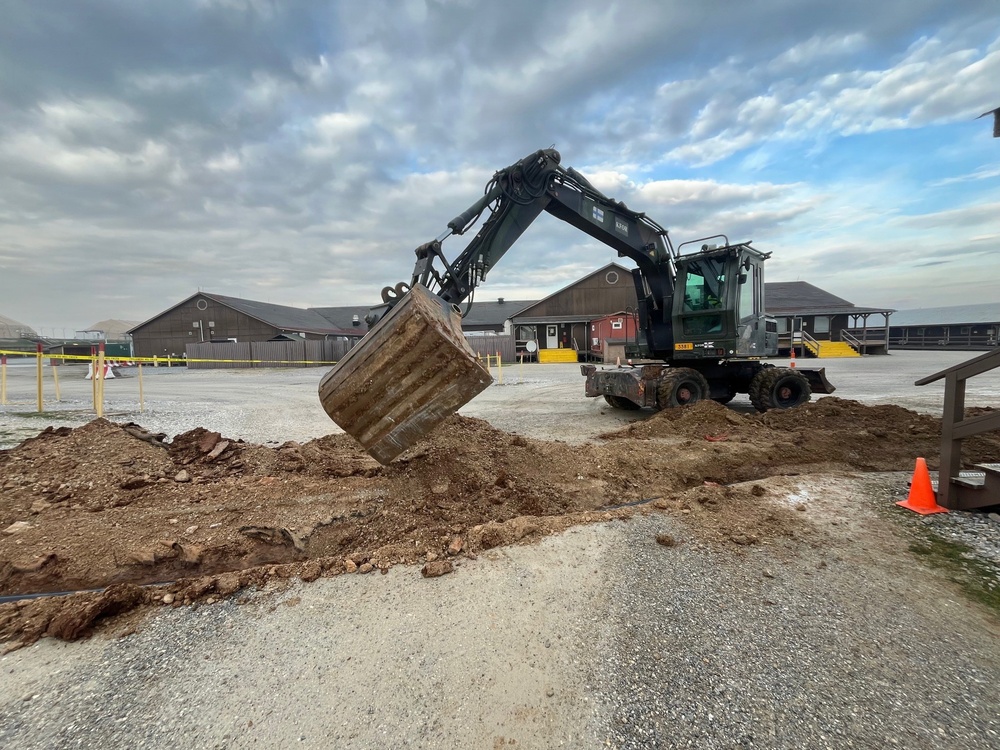
Photo By Staff Sgt. Alyssa Lisenbe | Kosovo Forces Regional Command-East Engineers work on a dig project on Camp Bondsteel,...... read more read more
CAMP BONDSTEEL, Kosovo - Engineering within Kosovo Forces Regional Command-East (KFOR RC-E) is not only about clearing obstacles; it is about laying the groundwork for a safe and secure future.
KFOR RC-E is a NATO-led peacekeeping mission focused on maintaining freedom of movement and a safe, secure environment for all people in Kosovo. Engineers from Finland, Germany and the United States routinely support this mission by clearing roadways and obstacles to ensure safe passage throughout the region.
However, most recently, they can now be found improving local infrastructure through community-focused projects, such as building playgrounds for orphanages and conducting debris removal to create safer spaces for building activities like soccer fields.
“My favorite project is the SOS Children's Village in Pristina,” said OR-7 Christoph S. “The children's joy shows us immediately how important this support is. It is very satisfying for all of us to be able to help exactly where help is actually needed.”
While KFOR engineers provide the labor, tools and heavy equipment required to complete these projects, funding and materials are largely dependent on local municipalities. Even tasks as simple as debris removal can be challenging when disposal costs are involved.
“We aim to influence municipality leaders to improve infrastructure,” said 1st Lt. Jacob Riederer, 256th Infantry Brigade Combat Team engineer and Force Protection Chief. “We try to establish those relationships and do the best with what we are given.”
These projects also allow multinational engineering teams to share different approaches to problem-solving, overcoming barriers both literally and culturally.
“Each country has its own way of engineering,” said Riederer. “Everyone does things differently. Jobs get done, but usually not in the way you expected. It adds layers of fun and mystery.”
Each nation brings unique capabilities to the mission. Finnish engineers typically employ heavier equipment such as excavators and dump trucks, while German engineers, as part of an airborne division, rely on lighter, air-transportable equipment like sling loaders.
“These different experiences and thought processes we can take back home with us,” said Riederer. “The first project we finished was the orphanage project. Whenever someone asks my wife what I do overseas, she tells them I build facilities for the Army.”
In addition to community construction projects, engineers maintain capabilities that support long-term stability across the region.
During possible periods of heightened tension, they are prepared to assist with crowd and riot control operations by providing armored personnel carriers for the safe movement of personnel and loaders to clear obstacles and restore freedom of movement.
“Working with the Finnish and American engineers is very straightforward and pleasant,” said OR-7 Christoph S. “Working together is rewarding, and the atmosphere is collegial and friendly, but always professional. Regardless of nationality, we are all pursuing the same mission.”
Whether improving infrastructure for local communities or enabling security operations, KFOR engineers are clearing obstacles today to build the foundation for a safe and secure future.
| Date Taken: | 02.19.2026 |
| Date Posted: | 02.20.2026 05:22 |
| Story ID: | 558357 |
| Location: | CAMP BONDSTEEL, ZZ |
| Web Views: | 51 |
| Downloads: | 0 |

This work, KFOR Engineers Lay the Groundwork for a Safer Future in Kosovo, by SSG Alyssa Lisenbe, identified by DVIDS, must comply with the restrictions shown on https://www.dvidshub.net/about/copyright.

No keywords found.





