
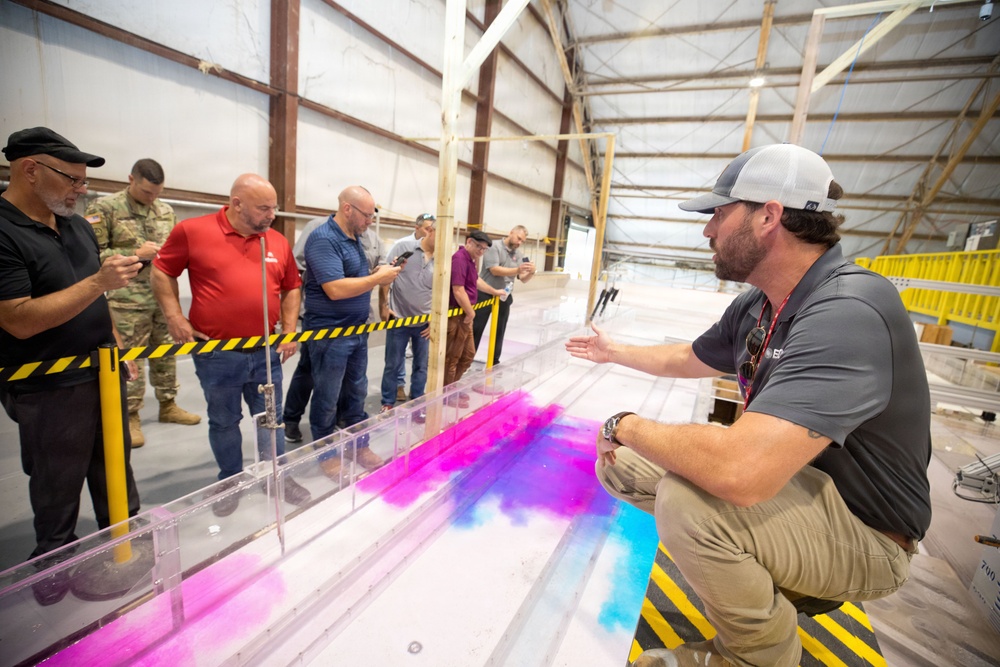
Photo By Jared Eastman | Researchers at the U.S. Army Engineer Research and Development Center use colored dye...... read more read more
 Subscribe
VICKSBURG, Miss. – As navigation improvements continue along the upper Ohio River, a team of researchers at the U.S. Army Engineer Research and Development Center (ERDC) are developing physical models to test new designs of the lock systems to ensure they function as intended.
Emsworth, Dashields and Montgomery locks have the oldest and smallest lock chambers in the entire Ohio River Navigation System and have been around since the 1920s and 1930s. In 2016, Congress authorized the Upper Ohio Navigation Project, allowing for improvements to be made to the structures.
Researchers at ERDC’s Coastal and Hydraulics Laboratory (CHL) partnered with the U.S. Army Corps of Engineers Pittsburgh District on the Montgomery lock system in 2020, and now that construction is underway on that facility, the team has turned their attention to Emsworth.
“This effort has been ongoing since 2023, so a little over two years now,” said Gary Bell, a research hydraulics engineer at ERDC-CHL. “The physical model provides all the details and information on the filling and emptying system itself. We need the physical model to tell us how efficient the lock is filling and emptying.”
The team built both a 1:25 scale model of the lock system and a 1:100 scale navigation approach model. The filling and emptying model will evaluate the hydraulic processes of the new lock design and help determine if any design modifications are needed while the navigation model ensures vessels can move through the lock safely and efficiently.
“It's very challenging,” said Bell. “The level of precision required on all these models is very high. We must make sure that everything is calibrated correctly. That everything's running like it should — actuators are running at the speed they need to, pressure cells are calibrated, load cells are calibrated — because all this data is collected and used for performance evaluations of the lock.”
With so many moving parts and pieces, that type of accuracy can only be achieved through collaboration and teamwork.
“For the navigation model, we have towboat pilots from the district that actually help us evaluate the model,” said Ryan Hoben, a research hydraulic engineer with ERDC-CHL. “We started with the existing conditions to make sure that everything in the model matches what the pilots are currently experiencing in the field. We run the model boats for them to make sure everything we're seeing in the model is what they’re seeing.”
Along with the Pittsburg District, ERDC’s Fabrication Shops have also been heavily involved in the process.
“Without the Fabrication Shops, we would not be able to build these models,” said Bell. “There’s a lot of back and forth that goes into making sure everything is built correctly. They allow us to be flexible enough so that if any needs or changes arise from the sponsor, we're able to deploy that quickly.”
The team began by using real-world data along with numerical modeling provided by the district to ensure the accuracy of the model.
“We had some data sets that we were able to compare to the physical model — making sure that everything was performing like it should — that was step one,” said Bell. “The next steps are to perform test after test after test on this system and hit it from all sides. We'll do hundreds of filling and emptying test on the chamber to evaluate it. That's the main thing we're looking at — just how well the chamber fills and empties — we want to get a good idea of how it's performing.”
The experimental results will be used to help inform the design modification decisions of the new system. Then, once a new design has been chosen, the proposed lock will be constructed, installed and tested again for hydraulic performance. Those tests will ultimately help develop a safe and efficient design for the proposed new lock.
“The physical modeling efforts for the Emsworth Lock New River Chamber have helped shape the design requirements and project features necessary for efficient and safe navigation on the upper Ohio River,” said Cory Morgan, technical lead for the Upper Ohio Navigation Project. “CHL used their modeling efforts and expertise to help the Pittsburgh District balance navigation safety and lifecycle costs through risk-informed decision-making. They also collaborated closely with design engineers, operations personnel and navigation-industry stakeholders, instilling confidence that the design will perform as intended and meet commercial navigation users’ needs.”
“It’s been great working with the Pittsburgh District and the Inland Navigation Design Center on this project,” said Bell. “We're not just out here coming up with the best hydraulic solution, but also things that will help the navigation industry as a whole.”
| Date Taken: | 02.17.2026 |
| Date Posted: | 02.25.2026 09:59 |
| Story ID: | 558225 |
| Location: | VICKSBURG, MISSISSIPPI, US |
| Web Views: | 45 |
| Downloads: | 0 |

This work, Testing continues on lock improvements along upper Ohio River, by Carol Coleman, identified by DVIDS, must comply with the restrictions shown on https://www.dvidshub.net/about/copyright.


No keywords found.




