
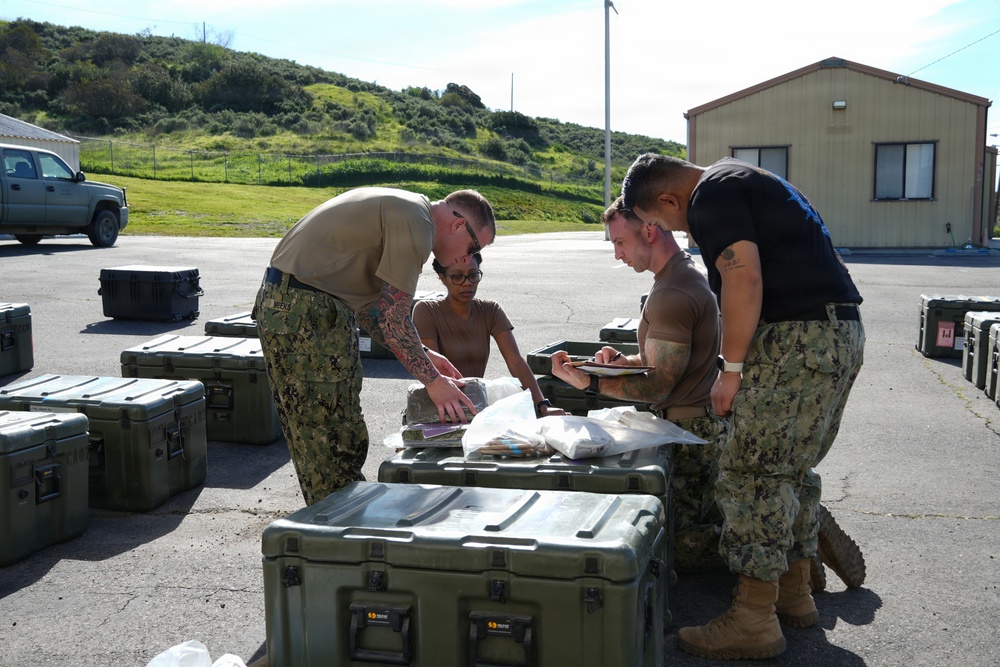
Photo By Petty Officer 2nd Class Moira Esquivel | Cmdr. Ranata Simmons(back left),, a certified registered nurse anesthetist Lt. Ryan...... read more read more
CAMP PENDLETON, Calif. — An Expeditionary Resuscitative Surgical System (ERSS) course held Jan. 19-30, 2026 where Sailors trained at the Naval Expeditionary Medicine Warfighter Development Center (NEMWDC), showcased how Expeditionary Medicine demands not only clinical expertise, but also the ability to deliver lifesaving care while managing limited resources.
Designed to prepare medical teams for operations in austere environments, the ERSS course places students in realistic scenarios where supply constraints, delayed resupply, and high patient volume force them to adapt and make critical decisions with what is available on hand. In these environments, every member of the team shares responsibility for conserving resources and prioritizing care. Hospital Corpsman 2nd Class Tatrelia Kunda, a surgical technician with ERSS 21, Navy Reserve, said the training changed her perspective. “The ERSS course really changed the way I think about patient care in an austere environment,” Kunda said. “It taught me that medicine doesn’t stop when resources are limited, it just requires smarter planning, prioritization, and teamwork.”
Throughout the course, students were required to track equipment usage, conserve consumables, and communicate constantly about available supplies while supporting simulated surgical and resuscitative operations.
“Every piece of equipment and every consumable item has operational value,” Kunda said. “I learned how to track usage, anticipate needs, and make sure critical supplies were available for the patients who needed them most. That experience reinforced how logistics directly impacts patient outcomes, especially when resupply is delayed or uncertain.” In addition to clinical skills, the training emphasized adaptability and coordination across the entire medical team.
“Instead of relying on ideal conditions, we trained to work with what we had, conserving materials, preventing waste, and communicating constantly with the entire team about what was available,” Kunda said. That awareness allows providers to adjust treatment plans appropriately without compromising care.”
By integrating resource management into every phase of care, ERSS teams are prepared to operate effectively in expeditionary environments where supply lines may be limited or disrupted.
“Effective patient care in an austere environment is a balance between clinical knowledge and resource management,” Kunda said. “By understanding supply flow, prioritization, and contingency planning, I’m better prepared to support mission readiness and ensure patients still receive safe, effective care even in resource-constrained settings.”
NEMWDC, located at Camp Pendleton, serves as Navy Medicine’s center of excellence for Expeditionary Medicine training. The command develops, delivers, and sustains advanced, scenario-based training to ensure medical personnel are ready to support combat operations across the globe. NEMWDC’s programs strengthen warfighter readiness and prepare Sailors to provide critical care anytime, anywhere.
| Date Taken: | 02.13.2026 |
| Date Posted: | 02.13.2026 14:14 |
| Story ID: | 558127 |
| Location: | CAMP PENDLETON, CALIFORNIA, US |
| Web Views: | 116 |
| Downloads: | 0 |

This work, ERSS training emphasizes supply management in austere environments for Expeditionary Medicine, by PO2 Moira Esquivel, identified by DVIDS, must comply with the restrictions shown on https://www.dvidshub.net/about/copyright.


No keywords found.





