
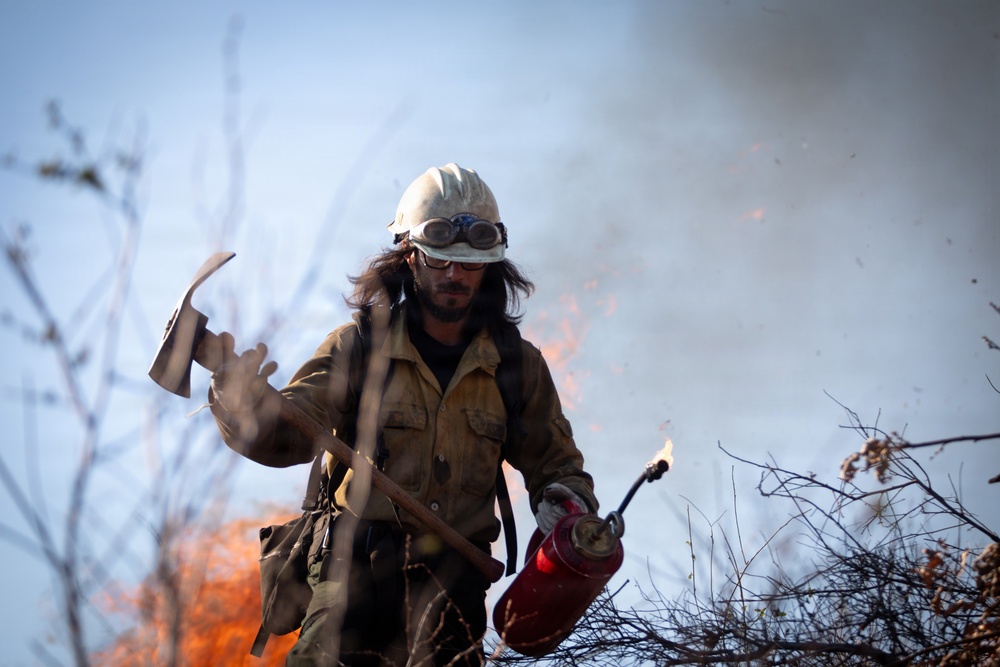
Photo By Andrew Avitt | A firefighter with Firestorm Wildland Fire Suppression Inc., assisting the Plumas...... read more read more
 Subscribe
In the mountains above Paradise, Calif., blackened trees still stand — a natural testament to the 2018 Camp Fire, which destroyed 90% of the town of Paradise, along with most of Concow, Magalia and Butte Creek Canyon, killed 85 people, and grew to more than 150,000 acres in a rare November wildfire that at the time was the most destructive in California state history.
Since then, communities continue to rebuild and land managers continue their work to restore the surrounding wildlands and prepare for future wildfire.
Over the past seven years, the restoration and fuels reduction work that needs to be done has required many hands from federal, state and local agencies, as well as local contractors. In December, that cooperation was on full display when officials used prescribed burns along Rim Road above Concow.
Wildland firefighters with the Plumas National Forest, forestry professionals with Firestorm Wildland Fire Suppression Inc., Butte County Resource Conservation District, and tribal monitors with the Konkow Valley Band of Maidu gathered to share their expertise.
Before the Camp Fire, the landscape around Concow looked much different. There were thick forests of mixed conifer, including Douglas fir and ponderosa pine, as well as deciduous trees like black oak. During the fire, much of the area burned at a high severity, killing trees and altering the landscape.
“A lot of work has happened between then and now,” said James Lico, district fire management officer in Plumas National Forest on the Feather River Ranger District. He oversees the fire and the fuels program there.
“Right after the fire, contractors came in to salvage damaged trees, take out hazard trees, and clear roadways,” Lico said. “After that, this area has been basically treated by hand — with hand tools, saws and chainsaws — to make piles.”
Those piles are then burned as part of an important step in the multi-stage restoration project, clearing woody material off the landscape that could serve as fuel for the next fire.
This treated area along the Rim Road may also help firefighters in the event of a future fire, allowing them to safely set up in that area, or even make it easier for firefighters to stop a wildfire’s advance.
“Ridges and roads are some of the best places to engage fire,” said Lico. “Having these strategic fuels breaks will enable us to keep fire smaller, engage fires better, and then also the severity of the fire in these areas will be minimized.”
Fuels treatments like this prescribed burn on the Plumas National Forest have been occurring across California since Oct. 1, as conditions were appropriate, cooler and wetter. Since then, as of Dec. 15, over 14,000 acres have been treated across the region, and over 270,000 acres have been treated across the country.
As the towns affected by the Camp Fire began the years-long task of rebuilding, so did nature. The telling signs of natural regeneration helped planners decide which direction to guide restoration efforts.
“We know historically, based on archeological records, oak trees once dominated this landscape,” said Julia Sidman, forestry program manager for the Butte County Resource Conservation District. “So, the idea behind this project that we worked on with the Plumas National Forest is to clear the brush, burn it, and then create this landscape where oaks are dominant once again.”
Resource conservation districts like Sidman’s exist throughout California and routinely work with the Forest Service to manage the land with a focus on https://carcd.org/page/forestry-and-fire-resilience.
“When we work with the Forest Service, we have an agreement with them. So, we're able to pretty much plan, execute, and everything in between. For this specific project in Concow, we've assisted with cutting the brush, piling it, and now burning it.”
Combined pile burning and prescribed burning prepares the ground by ensuring the new trees have plenty of space, access to sunshine that oaks love, water, and increased nutrients returned to the soil through prescribed burning to help them grow fast and strong. Prescribed burning will continue to be used over the years to help manage brush and conifers to help keep the forest fire resilient and healthy.
For Sidman, cutting back the brush doesn’t just help fire resilience, it also supports future reforestation efforts. On the hillside, there’s a lot of deer brush and invasive blackberry bushes, both competing with new trees for limited resources such as water.
“It will be important for us to get the brush taken care of before we come back in and do a heavy replanting,” said Sidman.
“Because if we do replant in a landscape that hasn't been properly prepped, brush is going to come back, and it's going to compete with the new trees. But if you can have a landscape where brush is managed and under control — often by using prescribed fire — then you can come in and plant and have a higher likelihood of success.”
| Date Taken: | 02.11.2026 |
| Date Posted: | 02.12.2026 21:46 |
| Story ID: | 558098 |
| Location: | CONCOW, CALIFORNIA, US |
| Web Views: | 87 |
| Downloads: | 0 |

This work, Post-wildfire restoration in the 2018 Camp Fire area on the Plumas National Forest, by Andrew Avitt, identified by DVIDS, must comply with the restrictions shown on https://www.dvidshub.net/about/copyright.


No keywords found.




