
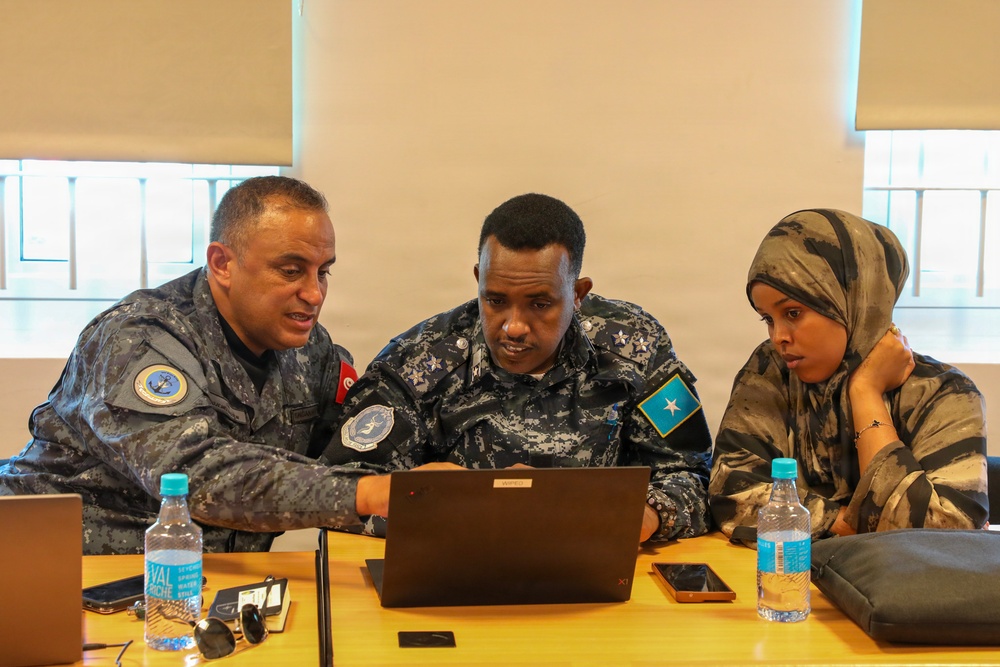
Photo By Petty Officer 1st Class Stephanie Butler | Partner nations work together using a sea vision tool called SMARTMast, during Cutlass...... read more read more
 Subscribe
Cutlass Express 2026 (CE26) arrives at a decisive moment for maritime security in the Western Indian Ocean, where drug trafficking, human smuggling, and illegal, unreported and unregulated (IUU) fishing continue to threaten coastal economies and regional stability. More than half of African regional economic activity relies on safe and lawful use of the maritime environment.
Illicit maritime activity thrives in vast, lightly monitored waters, placing significant pressure on African nations charged with protecting their maritime domains. CE26 focuses on strengthening maritime governance, enhancing maritime domain awareness, and improving coordinated regional responses—core elements needed to counter these persistent threats.
“Exercises like Cutlass Express are no longer just about interoperability; they are about how fast we introduce and integrate cutting‑edge technology to address real‑world threats,” said U.S. Air Force Lt. Col. Jared Bindl, Chief of Science, Technology, and Innovation at U.S. Africa Command.
STRENGTHENING MARITIME GOVERNANCE TO COUNTER TRAFFICKING AND IUU FISHING
Nations participating in CE26 train together to sharpen their ability to disrupt maritime trafficking networks and illegal fishing operations, both of which directly undermine regional prosperity. CE26 focuses on improving maritime domain awareness, building tactical interdiction skills, and enhancing information‑sharing in the Maritime Operations Centers (MOCs). These capabilities are foundational to deterring illicit actors who rely on unmonitored waters to move narcotics, smuggle people, or exploit fisheries.
Protecting Africa’s maritime environment is a shared strategic priority for U.S. Africa Command and its African partners. By strengthening maritime institutions and improving coordination at sea, African partner nations are better able to safeguard coastal resources and reinforce rule‑of‑law across the region.
INNOVATION AT SEA: EXPANDING PARTNERS’ ABILITY TO DETECT AND DISRUPT ILLICIT ACTIVITY
A central theme of CE26 is the adoption of practical, adaptable technologies that enhance awareness in large or remote maritime regions. SmartMast, SeaVision, and Lightfish are examples of systems that give operators a clearer picture of their waters by detecting vessel movement, highlighting night‑time anomalies and feeding real‑time information into regional command‑and‑control centers. These tools enable small patrol craft to detect and report potential illicit maritime activity, including signs of illegal fishing or trafficking, and rapidly pass that information to national and regional maritime operations centers that coordinate responses
By expanding maritime awareness and improving how information moves between ships and operations centers, U.S. Africa Command and its African partners are strengthening their ability to protect coastal waters, counter illicit activity, and respond more effectively to emerging maritime threats.
BUILDING AN INTEGRATED REGIONAL RESPONSE AGAINST ILLICIT MARITIME NETWORKS
CE26 includes advanced visit, board, search and seizure (VBSS) drills, command‑post exercises and information‑sharing scenarios that replicate real‑world interdiction operations. These events challenge partner nations to coordinate investigations, track suspicious vessels and execute controlled boardings—skills essential for counter‑narcotics and counter‑IUU fishing missions across the Western Indian Ocean.
The exercise also reinforces the importance of synchronized, multinational action. U.S. Africa Command highlights that maritime cooperation enables partners to protect territorial waters, respond to crises, and counter illegal activity that transcends national boundaries. Improving interoperability across navies and coast guards strengthens deterrence and supports regional governance efforts.
CE26 demonstrates what is possible when innovation and partnership converge. Emerging technologies, from SmartMast to unmanned vessels like Lightfish, are helping partner nations build the situational awareness needed to identify traffickers, disrupt illicit networks and prevent illegal fishing across vast maritime zones. These advances directly support the long‑term stability and economic resilience of East African coastal nations.
As Lt. Col. Bindl noted, deploying new sensor technologies across the exercise “is fundamentally enhancing our collective ability to secure the seas and counter illicit maritime activities.” The result is a stronger, more integrated maritime security environment—one where partner nations have the tools, training and shared operational picture needed to defend their waters and protect the region’s future.
| Date Taken: | 02.10.2026 |
| Date Posted: | 02.11.2026 08:35 |
| Story ID: | 557903 |
| Location: | PORT LOUIS, MU |
| Web Views: | 163 |
| Downloads: | 0 |

This work, Cutlass Express 2026: Innovation to Drive the Fight Against Trafficking And Illegal Fishing, by LTJG Allen BOYD II, identified by DVIDS, must comply with the restrictions shown on https://www.dvidshub.net/about/copyright.


No keywords found.




