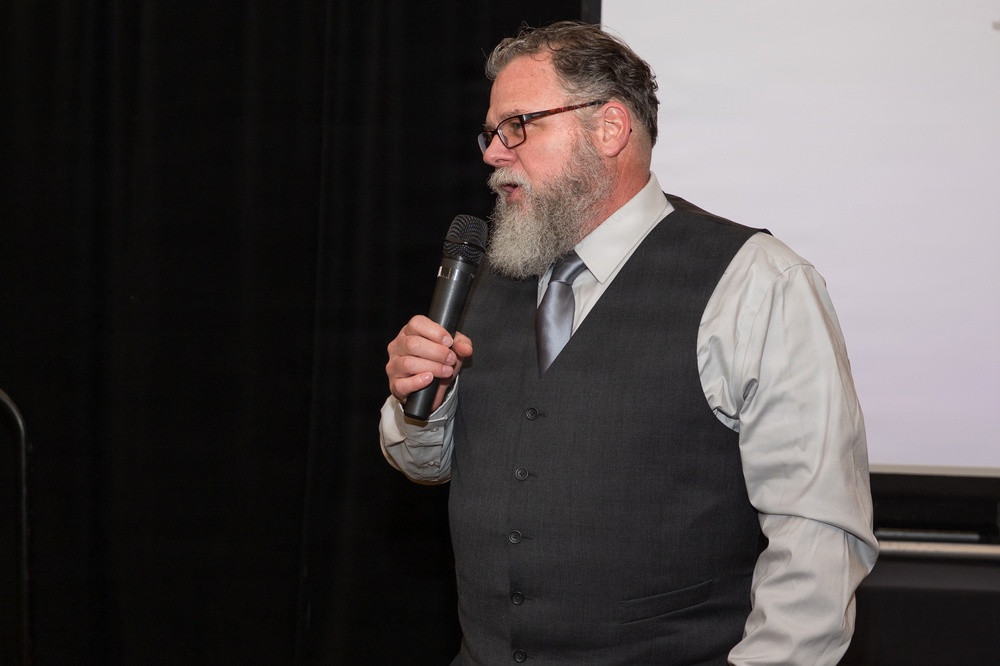
Dr. Cory Koger, senior chemist and water quality program manager for the U.S. Army Corps of Engineers Sacramento District, received the Environmental Professional of the Year award Feb. 6 during the district's annual awards ceremony.
The national-level USACE award recognizes Koger's work on the Palisades and Eaton Wildfires recovery mission, but the recognition speaks to a 24-year career built on leadership in environmental cleanup, habitat restoration and emergency response.
"I didn't even know I had been nominated," Koger said. "It was a great surprise."
Koger has spent his entire career with the district in the Environmental Engineering Branch's Environmental Chemistry Section, progressing from toxicologist to his current role. The award caps a career built on solving complex environmental challenges while advancing USACE’s engineering and construction missions. Trained in aquatic toxicology, Koger has worked on some of the organization's most technically demanding projects, from sites contaminated with chemical and biological warfare agents to the delicate recovery work following the 2023 Maui Wildfire and last year's devastating Los Angeles wildfire.
His approach reflects how the Sacramento District integrates environmental stewardship into every aspect of its work.
"You could look at it as an issue or a problem for projects but, in reality, it can be an opportunity as well to do things in the correct and right way," Koger said.
His work often requires answering questions that sound straightforward but require sophisticated scientific analysis. How much lead in soil is natural, and how much came from decades of firing weapons? When can dredged harbor sediment be reused for beneficial purposes like habitat restoration?
At former small arms ranges, for example, Koger's team must distinguish between metals that occur naturally in California's geology and contamination from military activities.
"Understanding what the geology is, what would be a normal concentration, applying and understanding background concentrations is critical in a lot of these cleanup sites," he said.
Early in his career, Koger worked on the massive environmental cleanup at Dugway Proving Ground in Utah, a site contaminated with chemical and biological warfare agents. The technically difficult project involved a large number of contaminated sites that required timely decisions while ensuring worker and public safety.
"It taught me a lot about what the organization can do and how we can do it," he said.
Emergency response has become an increasingly important part of his work in recent years. When wildfires devastate communities, Koger deploys to assess and manage the toxic ash and debris left behind, work that draws directly on his chemistry background.
The Maui deployment was particularly meaningful, he said, requiring sensitivity to both environmental and cultural concerns as USACE helped the community recover from one of the deadliest wildfires in American history. Lahaina, the former royal capital of Hawaii, contains sacred archaeological sites that required 100% assessments on every property before environmental cleanup could proceed.
The first contract USACE awarded was not for debris removal but to hire cultural liaisons, archaeologists and cultural observers from the community to oversee the work.
"We knew this was not going to be a normal job or normal work site," Koger said. "We had a significant loss of life, and that changed the nature of how we approached this. And beyond that was the cultural significance of Lahaina itself."
Competing priorities required difficult tradeoffs. While emergency response typically demands speed, cultural preservation required the opposite approach.
"In some cases, slow and steady might not be the preferable way to go, but it's the only way to go to be able to actually get this done," Koger said.
Those emergency deployments have reinforced lessons he applies to his regular work at the Sacramento District, where he also serves as the dredging lead. Building strong relationships with stakeholders and bringing everyone together early in the planning process helps projects succeed.
"Coordination with all stakeholders, whether it's the community, regulatory agencies or even our own customers, it's knowing how to form relationships, who we need to get in the room to make decisions to move forward," he said.
He advocates for involving environmental staff at the beginning of projects rather than waiting for issues to arise.
"Early coordination with environmental professionals is critical for a lot of the core mission functions," Koger said.
Koger is particularly enthusiastic about the Delta Islands and Levees program, which proposes reusing dredged material for habitat restoration in the Sacramento-San Joaquin Delta.
"We're taking something that would be costly to dispose of or place somewhere else and using it in a very beneficial way," he said.
Koger credited his former supervisor John Esparza, who retired last year, and his current supervisor Jennifer Neuhard for supporting his professional growth and enabling his emergency response deployments.
The Environmental Professional of the Year recognition reflects not only Koger's individual achievements but also the Sacramento District's broader commitment to environmental stewardship, he said.
"We have a very large environmental workforce within Sacramento District," Koger said. "I think we're known throughout USACE as a resource, not just for our district or our division, but USACE-wide."
| Date Taken: |
02.10.2026 |
| Date Posted: |
02.10.2026 14:16 |
| Story ID: |
557854 |
| Location: |
SACRAMENTO, CALIFORNIA, US |
| Web Views: |
93 |
| Downloads: |
0 |
PUBLIC DOMAIN

This work, Sacramento District Chemist Wins National Environmental Professional of the Year Award, by Grant Okubo, identified by DVIDS, must comply with the restrictions shown on https://www.dvidshub.net/about/copyright.