
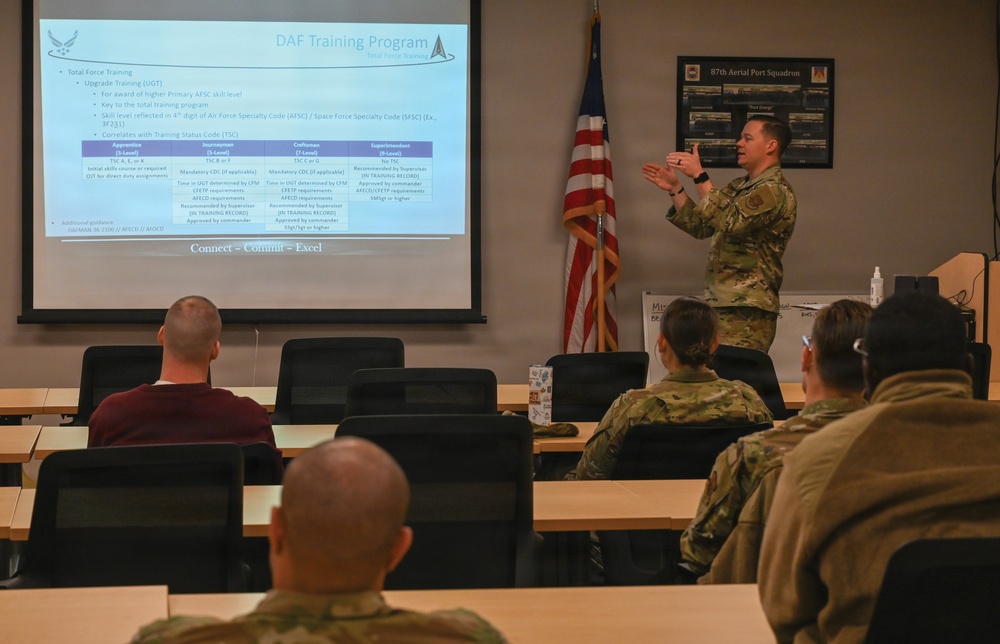
Photo By Tech. Sgt. Johnathan Quiñones | U.S. Air Force Master Sgt. Brandon J. Davis, back, 445th Mission Support Group...... read more read more
A highly capable and lethal total force is critical to meeting the demands of modern global operations. The Air Force Reserve leverages a vigorous education and training framework to ensure its Citizen Airmen are not only qualified, but combat-ready and mission-proficient when the call to duty comes. At the heart of this system is the pivotal role of unit and group training managers, who ensure every Airman is equipped with the necessary skills and certifications to support national defense priorities.
“On a macro level, Air Force Reservists essentially have two jobs – that’s to train and deploy,” said Master Sgt. Brandon J. Davis, 445th Mission Support Group training manager. “You can’t deploy if all your readiness requirements aren’t completed, and being fully trained/qualified is a part of the readiness requirements.”
The process is a continuous cycle of learning, beginning with the foundational Department of the Air Force Training Course, or DAFTC, known to many as "train the trainer."
“The effectiveness and long-term impact of the DAFTC can be measured several ways but the most important is by the Wings Fully Qualified Rate,” Davis said. “This is the percentage of enlisted members who are fully qualified to perform their job at their current rank and skill level. The Air Force Reserve Command’s standard for FQ rate is 75%, and the 445th Airlift Wing is exceeding that standard with an 81% FQ rate as of the start of FY26.”
The Air Force Reserve provides 20% of the Air Force’s total capabilities with a fraction of the budget, a feat only possible through robust and detailed training. Programs like DAFTC and ongoing upgrade training are critical to building strategic depth – the ability to provide a ready, credible force for commanders whenever and wherever needed.
The DAFTC is a crucial first step for many non-commissioned officers and senior NCOs who will eventually oversee the development of their peers and subordinates.
“The DAFTC prepares supervisors to train the next generation of Airmen and Guardians,” said Master Sgt. Renée Parcell, 445th Force Support Squadron Education and Training office training technician. “Training is essential to meet mission requirements, and that training relies on the trainers to synchronize tasks and information with individualized learning styles. This is what we teach in the DAFTC. It is about developing the self, developing others, developing ideas, and thus, developing the organization. If the mission is essential, then training is essential. After all, drill weekend is called a Unit Training Assembly,”.
Training foundations are a vital area within the DAFTC curriculum. It encompasses the initial evaluation of trainee qualifications, a critical aspect of any effective training program. Supervisors and trainers must carefully review these foundational principles and requirements with all new trainees.
“This is often an overlooked and undervalued requirement, in the training process, but it shouldn’t be,” Davis said. “Accomplishing and documenting the initial evaluation of trainee qualifications can help ensure that someone does or doesn’t know how to safely operate a piece of equipment or tool that may be specific or unique to your region or duty station. Time is vital in the training process, and becoming fully qualified has major implications in things like promotions, special duties and professional development opportunities.”
The skills gained in the DAFTC directly translate into tangible readiness through the upgrade training process. Upgrade training is the mandatory path for Airmen to achieve higher skill levels (3-, 5-, 7-, or 9-level) within their Air Force Specialty Code, or AFSC, requiring specific courses, task qualifications and hands-on performance.
Qualifying supervisors to effectively sign off on these tasks in the Career Field Education and Training Plan, or CFETP, streamlines the process and ensures that the training is meaningful and meets operational standards.
“The last thing I would want to do is train another member without having the requirements ultimately forcing the member to re-accomplish said training,” said Staff Sgt. Leandra McQueen-Ford, 87th Aerial Port Squadron special handling representative and DAFTC attendee.
When asked what advice he would lend newly appointed supervisors and trainers, Davis said, “First, is to know that trainers and supervisors are the lynchpin of the DAF training program. Without them, training cannot be accomplished, and if training isn’t accomplished, the mission cannot be executed. Second, is to ask questions. If you don’t know a process or where to start in relation to training ask your Unit Training Manager, it’s their job to assist you and help you navigate and complete the training process for your trainees. Lastly, to be flexible and to be patient. Keeping these two qualities will go a long way in aiding you in becoming a proficient and effective supervisor and trainer.”
| Date Taken: | 02.07.2026 |
| Date Posted: | 02.07.2026 10:11 |
| Story ID: | 557675 |
| Location: | WRIGHT-PATTERSON AIR FORCE BASE, OHIO, US |
| Web Views: | 81 |
| Downloads: | 0 |

This work, 445th MSG training manager teaches training processes to new supervisors, trainers, by TSgt Johnathan Quiñones, identified by DVIDS, must comply with the restrictions shown on https://www.dvidshub.net/about/copyright.

No keywords found.





