
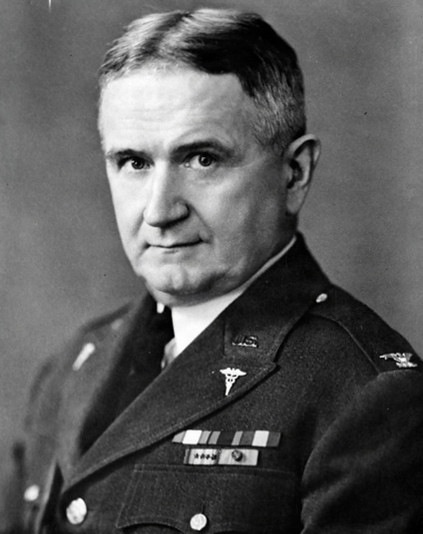
Courtesy Photo | In his decades of military service, Col. William Lordan Keller pioneered modern...... read more read more
Col. William Lordan Keller spent more than five decades in the U.S. Army, innovating in the operating room and putting patients first — earning the moniker the “Grand Old Man of Army Medicine.”
In the early 1900s, he began his military service as a contract surgeon in the Philippines. After earning his commission, he took on major cases at Manila’s First Reserve Hospital, drawing praise for results “that could not be excelled, saving many lives that would otherwise be lost,” a remark recorded by his commanding officer, Maj. John Banister, in his biography.
By the end of World War I, he had become a respected surgeon and teacher. In France, he managed a U.S. Army hospital and trained American medical officers. According to his biography, that assignment “laid the foundation for the outstanding surgical work accomplished in our own front-line hospitals.” Keller’s training of clinicians, standardized techniques, and promoted infection-control practices, which increased the Army’s capacity to treat battle wounds and return troops to their units, keeping them mission-ready.
While military hospitals today carry on Keller’s training techniques and surgical innovations — his namesake endures at the award-winning Keller Army Community Hospital at the United States Military Academy West Point, New York, where Keller served as a surgeon.
Setting a surgical innovation standard
While serving in Manila, Keller performed countless surgeries to get warfighters back on their feet — literally, devising an operation for bunions. His surgical technique for the common foot injury resulted with minimum postoperative pain.
When the United States declared war against Germany in 1917, Keller was enroute to a French military hospital at Ris-Orangis, where he served as chief medical officer and operated a large surgical clinic. He transformed the hospital into a critical teaching center for American medical officers. During the war, he emerged as an authority on fracture care and cocreated the Keller-Blake splint for femur fractures, a device that remains in use today.
After the Armistice, Keller led surgical services at Walter Reed General Hospital, Washington, D.C., serving as the hospital’s commanding officer from 1918 to 1935. In this role, he continued his surgical excellence when he introduced an “up-roofing” operation for emphysema, then a frequently fatal complication of influenza and pneumonia; a procedure that brought him international fame.
Keller also refined an operative method to cut recurrence of direct inguinal hernias, a change that reduced multiple surgeries and sped up recovery time. Each advance strengthened the military’s readiness by returning patients to full duty with fewer complications.
His commitment to patients led him to repeatedly decline high-visibility promotions that would have taken him out of the operating room, “but would only accept them on occasion to better aid the sick and wounded,” his official biography states.
In 1931, when President Herbert Hoover sought to appoint him Surgeon General of the U.S. Army, Keller declined — a decision consistent throughout his career turning down prestigious military appointments so he could continue treating the sick and wounded.
When Keller retired in 1935, President Franklin D. Roosevelt, with congressional authority, appointed him the first-ever U.S. Army lifetime consultant in surgery at Walter Reed. The honor recognized his “mature professional judgement,” according to his biography, and ensured his expertise would remain available to military medicine.
Along with the hospital that bears his namesake, he was further memorialized in 1953 by the establishment of a “living memorial,” his biography states, in the form of William L. Keller Memorial Lecture series presented in March each year.
Keller died at Walter Reed on July 10, 1959.
Hospital honors tradition of innovative care
Keller Army Community Hospital, built in 1977, treats and ensures future U.S. Army officers are mission ready. In 2025, the hospital received the Leapfrog Group’s “Top General Hospital Award”, honoring civilian and military hospitals across the country that demonstrate the highest performance in quality care and patient safety. This accomplishment recognized ethical billing, informed patient-consent procedures, low-infection rates, prevention of medication errors, and surgical safety.
The hospital’s mission today centers on force health protection and a ready, responsive medical force for the West Point community, a fitting tribute to a surgeon who linked clinical excellence with military readiness. Keller continues to strengthen the chain for the future of military medicine by being a host to the Defense Health Agency’s Graduate Medical Education Program, the premier platform for producing Medical Corps officers.
| Date Taken: | 02.06.2026 |
| Date Posted: | 02.06.2026 15:18 |
| Story ID: | 557640 |
| Location: | US |
| Web Views: | 97 |
| Downloads: | 0 |

This work, ‘Grand old man of Army medicine’ Col. William Keller’s namesake endures through high-quality care, by Robert Hammer, identified by DVIDS, must comply with the restrictions shown on https://www.dvidshub.net/about/copyright.

No keywords found.





