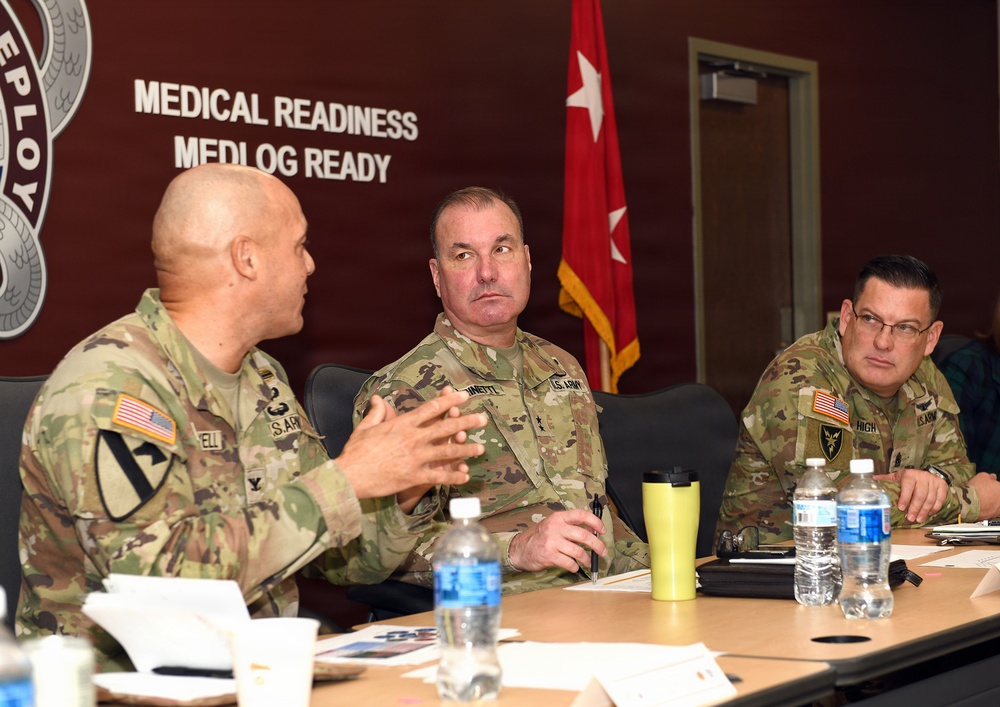
FORT DETRICK, Md. – Leadership through change was a key theme during Army Medical Logistics Command’s operational update to senior leaders at the U.S. Army Communications-Electronics Command on Jan. 29.
AMLC Commander Col. Deon Maxwell and Command Sgt. Major Gabriel Wright hosted Maj. Gen. James D. Turinetti IV, commanding general of CECOM, and Command Sgt. Major Jay High at Fort Detrick, where the teams discussed AMLC’s workforce optimization efforts and key transformation initiatives, including Medical Logistics in Campaigning, or MiC, and Medical Maintenance Optimization, or MMO.
“Leaders lead through change and I appreciate everybody’s attitude as we work through this,” Turinetti said. “As you look where we’re going … if you approach it from the mindset of doing what’s best for the Army, you’re in the right place.
“The Army is changing and we have to support that effort.”
AMLC, a major subordinate command to CECOM, serves as the Army’s Class VIII medical materiel command, delivering integrated medical logistics that enables Army and Joint Force readiness from the strategic support area to the tactical edge.
Undergoing its most significant transformation in decades, the Army is modernizing and preparing for future large-scale combat operations, or LSCO, a shift that involves a comprehensive overhaul of the force to be more agile and lethal.
This transformation includes the MiC initiative, which aims to integrate medical logistics into the larger Army sustainment enterprise, capable of supporting the force at the speed of war in a multi-domain operational environment.
Through its initial “waves,” or phases, MiC has successfully integrated medical materiel into the Army’s system of record, Global Combat Support System-Army, and launched a new Forward Repair Activity-Medical, or FRA-M, program at strategic locations to provide medical maintenance support to units at their home stations, improving overall medical readiness and reducing costs.
Future waves will see additional FRA-M sites come online, continue streamlining unit-level medical materiel ordering processes, incorporate supply chain improvements that anticipate needs and mitigate risks in real time.
“Our success is all about the people we have in this organization,” Maxwell said. “The drivers of the MEDLOG in Campaigning effort truly are subject-matter experts in the field, tuned into the challenges we face as an enterprise and working to affect positive change in support of the warfighter.”
The MMO initiative aims to optimize AMLC’s global medical maintenance footprint. Currently, this operation includes regional medical maintenance divisions stateside, a growing number of FRA-M sites, medical materiel centers in Germany and Korea, and specialized teams supporting Army Prepositioned Stocks, or APS, sites worldwide.
Under this new concept, AMLC’s Medical Maintenance Management Directorate, or M3D, will coordinate all maintenance capabilities across the enterprise, ensuring that support, such as that provided by expert “fly-away teams,” can be sent wherever it is needed most to meet readiness objectives.
“Our priority is realigning and optimizing our medical maintenance workforce and our capabilities throughout the AMLC enterprise,” M3D Director Jorge Magana said.
Putting these strategic plans into action requires dedicated leaders, and Turinetti and High also took the opportunity to recognize several individuals for their outstanding performance in support of the mission in recent months.
CECOM command coins were presented to three AMLC Soldiers, including Lt. Col. Raquel Giunta, Master Sgt. Kary LeBlanc and Staff Sgt. Tereso Hernandez.
Giunta received her coin in recognition of her role as acting chief of staff at the U.S. Army Medical Materiel Agency, where she also serves as the command’s pharmacy consultant and director of its Distribution Operations Center.
Giunta led a comprehensive overhaul of USAMMA's controlled medications accountability and compliance program, as well as developed and implemented robust new reporting mechanisms, produced a high-impact instructional training video, and provided direct, hands-on oversight to the management of all controlled items.
Leblanc, who was unable to attend the event, was honored for his role as AMLC’s operations noncommissioned officer in charge, synchronizing staff across three subordinate commands and 900 personnel in 20 locations while driving major elements of the AMLC transformation.
Hernandez was recognized for his service as detachment sergeant and acting APS-5 medical forward site manager in Kuwait. During a critical 30-day rotation, Hernandez volunteered to assume operational control of the U.S. Central Command APS-5 medical mission, seamlessly integrating into a complex joint and combined sustainment enterprise. He expertly managed more than $50 million in Class VIII medical materiel with zero losses.
| Date Taken: |
02.04.2026 |
| Date Posted: |
02.04.2026 09:52 |
| Story ID: |
557415 |
| Location: |
FORT DETRICK, MARYLAND, US |
| Web Views: |
326 |
| Downloads: |
0 |
PUBLIC DOMAIN

This work, Army leaders discuss MEDLOG transformation, by C.J. Lovelace, identified by DVIDS, must comply with the restrictions shown on https://www.dvidshub.net/about/copyright.