
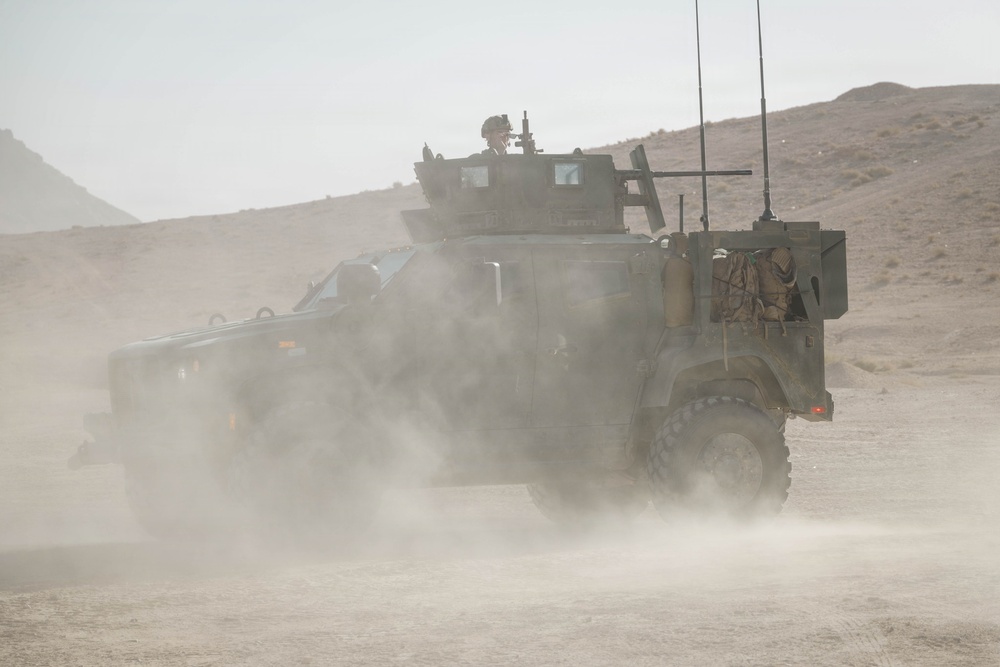
Photo By Eric Kowal | A U.S. Marines with 2d Battalion, 2d Marine Regiment, 2d Marine Division, drive a...... read more read more
PICATINNY ARSENAL, N.J. - The Reducible Height Gunner Protection Kit (RHGPK), developed at Picatinny Arsenal, has, in the past five years, turned from a blueprint to a highly successful patented vehicle turret system.
Developed in 2020, the RHGPK has evolved into the new standard for gunner protection kits across the U.S. Marine Corps, according to senior systems engineer Thomas Kiel, with more than 3,000 in operation. The turret can be compressed down to about eight inches, allowing for easier transport between Landing Platform Dock 17 and Landing Helicopter Dock 1-class ships, which are designed to embark, transport, and land Marines, their equipment, and supplies.
The RHGPK is a manned, rotating, integrated armor and ballistic glass turret that mounts to a bearing ring on the roofs of tactical wheeled vehicles. Such systems provide protection for exposed gunners, and work with the full range of common armaments.
The RHGPK’s collapsible design allows for vehicles such as the Joint Light Tactical Vehicle (JLTV), Heavy Guns Carrier (HGC), Medium Tactical Vehicle Replacement (MTVR), and Logistic Vehicle System Replacement (LVSR) to fit into shipboard spaces previously inaccessible, freeing room for aircraft and supplies. The turret also boasts improved ballistic and fragmentation protection and less expensive components.
The U.S. Army Combat Capabilities Development Command (DEVCOM) Armaments Center at Picatinny Arsenal submitted a design patent request for the RHGPK in 2021, and on Tuesday, Jan. 6, received word that the patent had been approved. The patent, entitled “Armored Turret Enclosure with Asymmetric Folding Panels,” should be issued in the coming weeks.
Kiel compared the turret to an “armored Transformer,” noting how it would allow Marines to mount a weapon upon it faster, ensuring they need not worry about preparing a turret while getting ready to make landfall. Testing at Marine Corps Base Quantico in Prince George’s County, Va. proved highly successful. Alongside the 3,300 units currently in use are 300 more in active production and another 3,000 being sought through a contract and market survey.
In Spring 2024, the RHGPK was selected by the Office of the Under Secretary of War for Research and Engineering (OUSW(R&E)) for funding under a pilot program to “Accelerate the Procurement and Fielding of Innovative Technologies,” receiving about $19 million for more production assets. According to Kiel, the RHGPK is thus seen as a “crucial capability” for warfighters, and as such should be pursued further.
The turret was selected for APFIT funding again in 2025, this time to evaluate possible adoption by the U.S. Army. According to Kiel, the Army does not have any sort of requirement for a reducible turret, and instead, current plans are to harvest the legacy Objective Gunner Protection Kit (OGPK) off of Humvees for use on modern JLTVs. As such, he said, there is an opportunity to rework the RHGPK into a modified version for Army use.
This modified turret, dubbed RHGPK-A, would lack the collapsible design mechanisms, but would still be lighter, less expensive, less complex, and more protective than the OGPK. The RHGPK design is government-owned to ensure fast upgrades and competitive sourcing.
The OGPK has been fielded on more than 50,000 military vehicles since its introduction in 2006.
According to Kiel, RHGPK turrets for U.S. Army platform evaluation will be delivered in early 2026, after which the Army will test the RHGPK out. It is possible, he said, that the Army will be satisfied with the existing collapsible design, but the RHGPK-A will remain a possibility if not.
Despite this, Kiel said he and his team will not dwell on this result and will instead look forward to their next project.
“We’re always looking at our next challenge, our next opportunity, and we are focused on that. Our top priority is making sure the Warfighter has the best equipment possible in the shortest time,” he said.
| Date Taken: | 01.29.2026 |
| Date Posted: | 01.29.2026 11:40 |
| Story ID: | 557029 |
| Location: | PICATINNY ARSENAL, NEW JERSEY, US |
| Web Views: | 154 |
| Downloads: | 0 |

This work, Picatinny-made Reducible Height Gunner Protection Kit thriving with Marine Corps, must comply with the restrictions shown on https://www.dvidshub.net/about/copyright.

No keywords found.





