
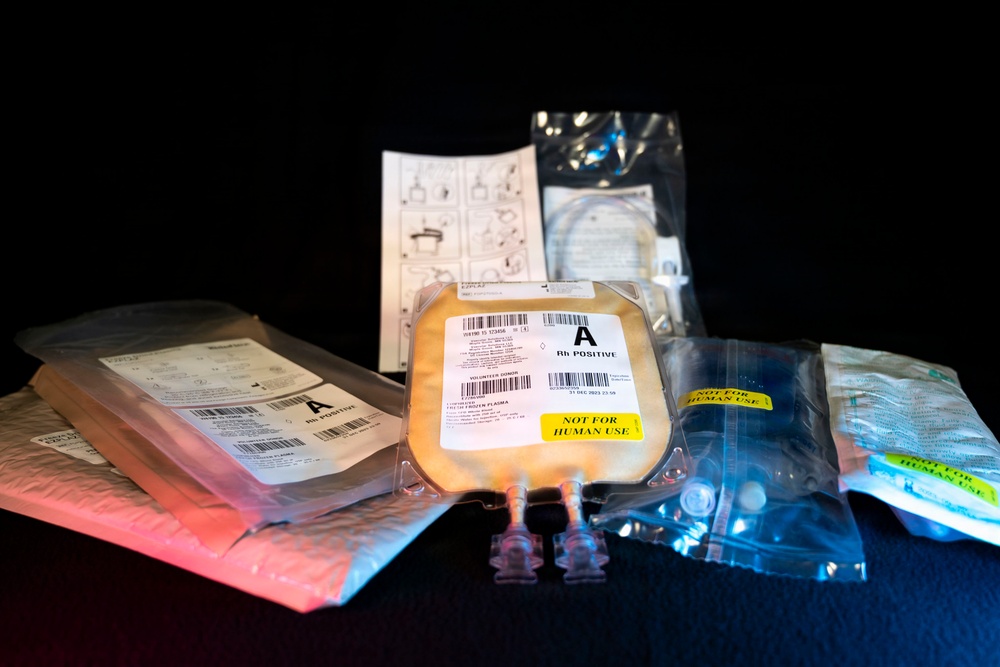
Photo By Cameron Parks | A prototype Freeze-Dried Plasma transfusion kit sits on display, Fort Detrick, Md.,...... read more read more
The battlefield of tomorrow demands medical innovations today, and within the Defense Health Agency, the Warfighter Protection and Acute Care project management office is at the forefront of this critical mission. Part of the Operational Medical Systems Program Management Office, WPAC is laser-focused on delivering medical solutions that empower warfighters to operate with confidence, even in the most austere and high-risk environments.
A significant thrust of WPAC’s efforts centers on delivering blood products to fill existing capability gaps for frontline providers across the Department of War. Recognizing that early transfusions of blood and blood components dramatically improve survival rates, WPAC is championing the development of easily deployable and shelf-stable blood treatments.
Freeze-Dried Plasma is a prime example. Plasma, blood’s liquid component, carries proteins that aid in blood clotting. It is vital to controlling and treating both external and internal blood loss caused by combat trauma. While lifesaving treatments for use at the front lines have increased survival rates exponentially since WWII, uncontrolled blood loss is the greatest determining factor when time and distance impede evacuation to higher levels of care.
FDP is a shelf-stable plasma designed for use in far-forward environments, potentially saving lives during future conflicts by enabling quicker access to this vital resource while simultaneously easing the logistical burden of transporting traditional blood products.
While FDP was initially developed as a U.S. Army program, the WPAC team has broadened the scope of its work to support the Joint Force. Following the realignment of OPMED under the Defense Health Agency in 2024, WPAC has been collaborating with stakeholders across the DoW to better meet the needs of each military branch and Combatant Command. Blood products remain at the top of the list of urgently needed solutions as warfighters continue to prepare for conflicts across the world, according to Lindsey Garver, Ph.D., WPAC’s deputy project manager.
“This process involved several big strategic meetings with key stakeholders to plan a concept of operations and determine quantities to meet the current and future needs of the service branches, Special Forces, and Combatant Commands,” said Garver.
In 2024, WPAC’s commercial partner, Octapharma USA, received U.S. Food and Drug Administration Emergency Use Authorization for its octaplasLG powder for use when no other blood replacement therapy is available during military operations. In addition to developing this interim solution, Garver noted, the WPAC team provided direct support to its military stakeholders over the past year to refine processes and strengthen lines of communication.
“To my knowledge, [FDP] is the first OPMED program requiring this level of coordination across so many organizations,” Garver said. “The validation of FDP as a solution to meet the needs of the Joint Force while partnering closely with end-user commands is really a testament to the importance of WPAC and OPMED as a force-enabler for frontline warfighters.”
FDP is a cost-effective, efficient, expeditionary solution to mitigate the challenges of time and distance found in places like the Indo-Pacific and Arctic regions of the globe, according to Andy Atkinson, the FDP product manager with WPAC.
“Blood products are a critical and urgent need across the [Department of War] and the service branches, and FDP is a game-changer to fill capability gaps at the front line,” said Atkinson. “Our focus has always been to enhance warfighter readiness and to provide a solution for military medical providers that works across the spectrum of conflict.
“FDP, because it is so user-friendly, portable, cost-effective, and shelf stable, is form-fitted for use by both conventional and special forces literally anywhere in the world,” he added. “[Blood products like FDP] are both urgently needed and in line with what our Joint Force partners need to save lives during future conflicts.”
About the Operational Medical Systems Program Management Office
The OPMED PMO, part of the Defense Health Agency, is the Department of War’s leading force in medical development and acquisition, focused on enhancing Warfighter lethality and readiness. OPMED’s project management teams develop and deliver next-generation, world-class medical capabilities that empower combatant commanders in Large-Scale Combat Operations, particularly within austere environments. For more information, visit https://dha.mil/opmed.
| Date Taken: | 01.26.2026 |
| Date Posted: | 01.27.2026 13:16 |
| Story ID: | 556775 |
| Location: | FORT DETRICK, MARYLAND, US |
| Web Views: | 389 |
| Downloads: | 0 |

This work, Freeze-Dried Plasma meets needs of Joint Force, Combatant Commands for future conflicts, by T. T. Parish, identified by DVIDS, must comply with the restrictions shown on https://www.dvidshub.net/about/copyright.


No keywords found.





