
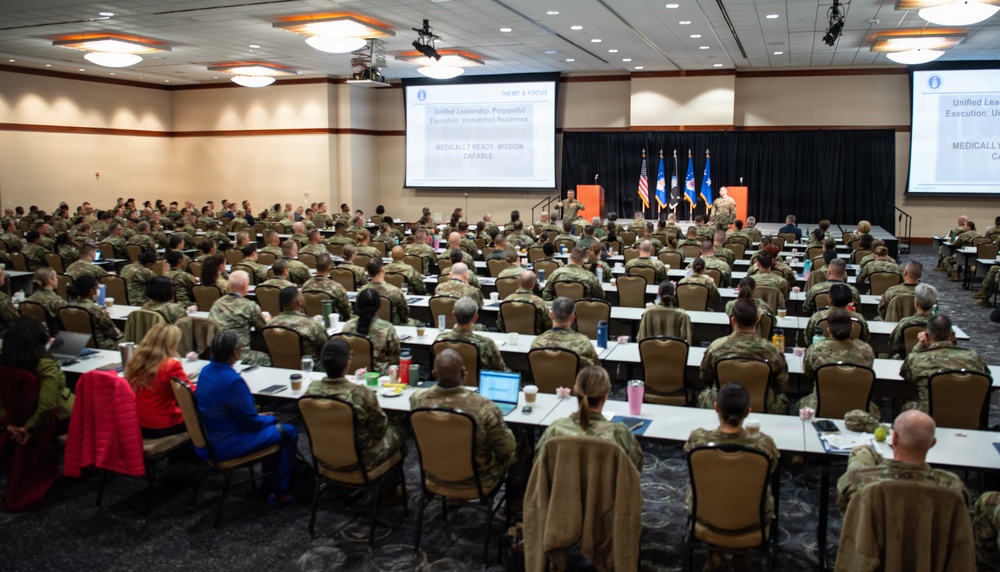
Photo By Megan Hearst | Lt. Gen. John DeGoes, Surgeon General and Commander, Air Force Medical Command,...... read more read more
Senior medical leaders convened for the Air Force Medical Service’s 2025 Senior Leadership Workshop, Jan. 12 to 15, 2026, to align the enterprise around unified leadership, purposeful execution, and unmatched readiness.
Hosted by Lt. Gen. John DeGoes, U.S. Air Force and Space Force Surgeon General, and Chief Master Sgt. James Woods, Chief, Medical Enlisted Force and Enlisted Corps, the workshop united AFMS senior leaders on a shared vision of a more integrated and operationally focused medical force.
DeGoes described the medical forces as the maintainers of the human weapon system.
“You contribute to having Airmen and Guardians optimized and sustained for peak performance,” he said.
“AFMS readiness is not just about medical excellence,” Col. Melissa J. Runge, U.S. Space Force Medical Operations Directorate deputy director, said. “It is about guaranteeing the health and well-being of the Airmen and Guardians who secure the nation, making readiness a non-negotiable prerequisite for national defense.”
Day 1 - Mission alignment & force design
To drive home mission readiness relevancy, day 1 included recognition of Staff Sgt. Michael Mendenhall, a pharmacy technician assigned 21st Medical Group, Peterson Space Base Delta 1. DeGoes and Woods celebrated Mendenhall as the 2025 Airman of the Battlefield for his providing aid to a wounded individual trapped in an overturned vehicle.
Seminar topics included capturing operational demand through improved data-driven analysis and AI supported technology, force development, global partnerships and initiatives that enhance medical capabilities, and Air Force Medical Command updates.
Tech. Sgt. Donald Belec, Non-Commissioned Officer in Charge of Force Readiness Reporting, and Maj. Alexander Moore, Chief Operational Readiness Support for AFMEDCOM, offered an overview of the Force Element Tracking, a platform designed to enable consistent, reliable analysis across organizational levels. They said, through employing AI, FET will shift the focus from data collection and reporting to predictive analysis and solution delivery.
Maj. Gen. Robert Blake, Mobilization Assistant to the Air Force Chief of Staff, gave insight on how medical forces support the operational mission in One Force Design.
He also addressed the pacing threat within the Pacific theater and shared the vision of Air Force Chief of Staff Gen. Kenneth Wilsbach, “to expect more rapid improvement and rapid direction” in the approach to strategic deterrence within the contested environment.
Day 2 - Future force of the AFMS
Shifting from mission alignment to execution, medical leaders examined AFMS efforts to innovate, modernize data and integrate medical expertise into operations to meet future demands.
Runge challenged leaders to embrace innovation and operational involvement as leadership responsibilities.
“The Air Force and the Space Force are relying on us to be strategic, to be innovative and to advise our comrades … in optimizing the warfighter,” she said. “Leadership isn’t confined to a job description. It’s about seeking risk clearly, acting decisively and improving systems so people can survive and succeed. This is what the future force demands.”
As leaders shared insights on data modernization, artificial intelligence enablement and the modernization of integrated operational support, the emphasis on communication during these developments became a central theme.
Day 3 - Strategic Alignment & Execution
Leaders shared the importance of executing readiness at scale, examining AFMEDCOM and medical readiness command efforts to align strategy, authorities and resources.
“My commander’s intent is to lead AFMEDCOM as one unit built on the foundation of generating medically optimized warfighters while presenting operationally relevant medical capability,” DeGoes said.
Brig. Gen. Eveline Yao, special assistant to the AFMEDCOM commander, led a candid discussion on enterprise friction points, highlighting how legacy processes, overlapping responsibilities and organizational change challenge execution. During the discussion, leaders emphasized meeting these challenges directly to improve clarity and trust across the enterprise.
Senior leaders emphasized the need to ensure alignment between strategy, policy, resourcing and mission execution, and the importance of integrating medical capabilities into the larger design of the force, especially as medical units transfer to AFMEDCOM through the inter-command transfer process.
“Air Force medical capability is a critical component of DAF missions. We must be integrated in Air and Space Force force design, mission areas, capability development, and force employment from start to finish,” said Brig. Gen. Jason Lennen, Director of Policy and Resources at the Office of the Surgeon General, Headquarters U.S. Air Force, noting that integration into the force design is an enabling function.
“Our effectiveness should be measured … by Airmen and Guardians medically ready to do their jobs, and by ready medics beside them to make sure they get home.”
AFMEDCOM recently concluded its first inter-command transfer, realigning medical Airmen from the Air Force District of Washington’s Joint Base Andrews, Maryland, under MRC-Bravo.
Col. Stacy Friesen, Andrews Medical Group commander and MTF director, shared her perspective of the transfer. She described adaptability as a critical leadership trait, noting that transparent communication and flexibility enabled the installation to maintain readiness while adjusting to new command relationships.
“That partnership does not change the day you become part of AFMEDCOM,” Friesen said, explaining that MDGs are mission partners. “Continue to invest in those relationships. We are just as present today as we were the day before.”
Day 4 - Medical Readiness Command standup and unity of command
The workshop’s final day included the formal standup ceremony for Medical Readiness Commands Alpha and Bravo, a landmark event in the AFMS’s ongoing transformation.
“This is a historic moment,” DeGoes said during the ceremony. “It’s not just symbolic, it’s operationally consequential.”
DeGoes explained that the MRCs enable the Air Force to articulate, advocate and integrate operational medical requirements within the joint health care enterprise in partnership with the Defense Health Agency.
Maj. Gen. Jeannine M. Ryder, MRC - Bravo Commander and Defense Health Network-Continental Director, reinforced the impact leaders have across the force.
“Ready medics, ready forces and safe, reliable care are the pillars of your responsibility,” she said. “AFMEDCOM’s success is dependent on you leading though challenges, making tough decisions and holding the line of accountability. Now let’s get to work because our Air and Space Force and nation are depending on us.”
| Date Taken: | 01.26.2026 |
| Date Posted: | 01.26.2026 14:23 |
| Story ID: | 556742 |
| Location: | FALLS CHURCH, VIRGINIA, US |
| Web Views: | 90 |
| Downloads: | 0 |

This work, AFMS Senior Leadership Workshop aligns purposeful execution with unmatched readiness, by Maristela Romero, identified by DVIDS, must comply with the restrictions shown on https://www.dvidshub.net/about/copyright.


No keywords found.





